
By CHERYL ERIKSEN
Reprinted with the permission of the author.
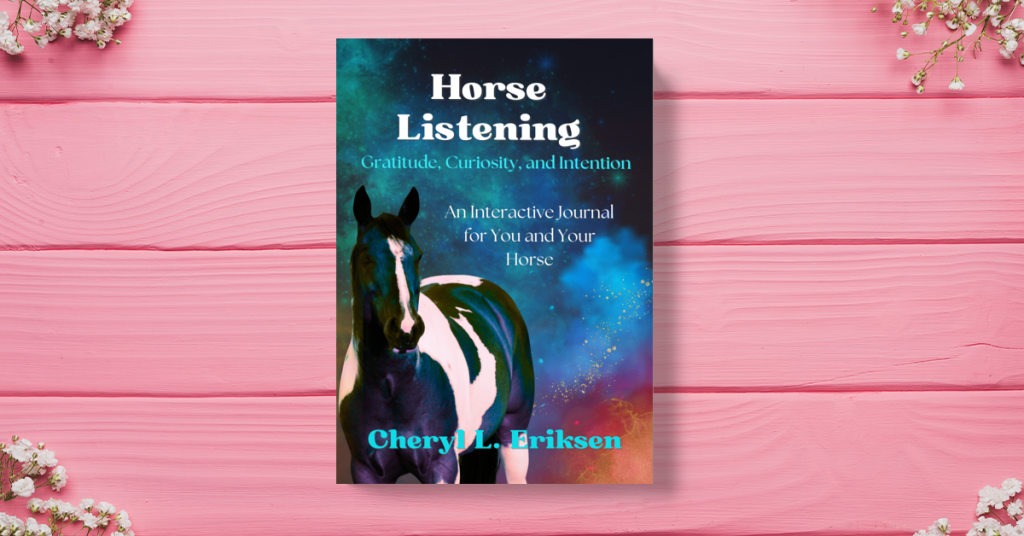
Horse Listening: Gratitude, Curiosity, and Intention is a book unlike any other available to the horse community. Below is an excerpt from the first section of the book. The last section is a 90-day guided journal for the time you spend with your horse, focusing on self-awareness, gratitude, and viewing your horse’s behavior with curiosity instead of judgement.
Excerpt from Horse Listening: Gratitude, Curiosity, and Intention:
I like to think of the horse-human connection in its purest form as a fluid teacher-student relationship where you each have strengths and can learn from each other like a true partnership. Sometimes you are the teacher, sometimes the horse is. In some areas the horse is more skilled than the human—it is from this strength they can teach us. Humans may be excellent at shaping horse behavior and be skilled equestrians, but horses know far more about being horses than we ever will. They know more about instinct, communication, energy, intention, being present, and listening to the music of the heart.
If this sounds a bit “out there” for you, that’s okay. This journal is a tool kit, not a road map. There is not a wrong way to do this practice. These pages provide information, resources, and guidelines. But the journey is yours. I only ask that you approach with curiosity and an open heart. Be open to a different type of relationship with your horse than perhaps you’ve imagined before. And be open to exploring yourself a little, too. We are going beyond training to a deeper level of communication. Deeper perhaps than you’ve ever considered possible. The key to opening this door is to view behavior as communication. Swap judgment, anger, and punishment, for curiosity, patience, and love.
How Did I Get Here?
When my horse, Farletta, first came into my life back in 2006, our relationship was typical of a horse with a human that had been taught a dominance-based training method. I asked her to do things and I expected her to do them. If she didn’t, I increased the pressure (dominance) until she did. Because I asked gently, used “natural” techniques, and communicated with body language, I thought we had a partnership. We did to a degree, but not in the true definition of the word. I like the definition given by marriage and family therapist Leah Travis:
Partnership: two individuals listening to each other and working together to accomplish a common goal. In a true partnership, respect is present and power is shared.
Respect in this instance shouldn’t be confused with the notion that a horse is capable of disrespecting you or your space. Instead, think of it as you respecting the horse for what it is and what it brings to the relationship. “Respect” is a human term that doesn’t translate well to horse behavior because it implies meaning beyond what horse communication entails. Humans too easily associate “lack of respect” with intent to harm or a bad behavior. As we explore the idea of behavior as communication, we understand that by default, behavior is neither good nor bad, it just is.
When I understood that true partnership meant listening and being open to Farletta’s behavior as communication, my relationship with her reached a depth I’d never imagined possible. When I learned to truly listen to Farletta, I became available to fully hear her. I finally realized that Farletta’s role in my life went well beyond riding and competition—her deeper purpose was as my teacher. Not just in how to interact with horses, but in how to love and respect myself.
Part 1
Behavior is Communication
Your horse absolutely refuses to stand still. His behavior is “bad.” Or is it? To a horse, behavior is neither good nor bad—humans assign labels to behavior, horses do not. If a horse doesn’t label behavior as good or bad, that opens up a variety of new possibilities for the human to consider. Remove the good/bad labels and it is easier to see horse behavior for what it is: communication.
This can be difficult to accept. Especially if you’ve been trained in the pressure/force/punishment model of horsemanship. The key here is to learn to view your horse’s behavior with curiosity instead of judgment (good/bad=judgment). It’s a little like the difference between listening to someone with empathy and the intent to truly hear them vs. listening with the intent to respond (which isn’t really listening as you’re forming the response while the person is still speaking). The latter focuses on yourself and usually involves filtering a situation through your own life experiences without considering the experiences of, or relevance to, the other. We do this all the time with our horses—the horse refuses to do something and we don’t stop and ask ourselves why, instead we immediately label the behavior as good or bad. If it is “bad,” we immediately try to stop, fix, or change the behavior—at the cost of leaving the horse unheard.
When working with your horse, viewing behavior with curiosity is a response that has been trained out of us. The first time I saw a horse buck with a rider I was probably ten years old, and I wondered what it was doing. I was curious. The instructor probably said something like he’s just being silly or a brat. Don’t let him get away with that. He’s just being obstinate. I carried this interpretation (judgment) forward and it informed my future interactions with horses. Now I had the belief that when a horse bucked, it was bad. A bad horse needed to be corrected. I soon forgot my curiosity. Why did the horse buck? I already knew—he was bad.
Here you might be struggling a bit—I know I did. Bucking is a bad behavior; isn’t it? Well, it depends on who you ask. From the human perspective, the answer is yes. But what about the horse’s perspective? Bucking is indeed a dangerous behavior (for humans) and one we don’t want to continue. But punishing a horse for bucking doesn’t solve the problem. It may stop the behavior, but if the underlying reason for the bucking is not known or addressed, the horse will find a new way to communicate about it.
Horse’s Communicating About You
Building a strong partnership with your horse (and anyone, really) requires a willingness to look inside yourself. What are you bringing to the barn? What are you asking your horse to carry or sit with in addition to your physical body? Horses are fine-tuned to receive and interpret energy. Whether we intend to or not, we bring energy to every interaction with our horse. For some horses, the energy we bring can be especially uncomfortable which can result in “bad” behavior.
Remembering that behavior is communication, and understanding how your energy and what you carry inside yourself (negativity, anger, fear, limiting beliefs, etc.) influences your horse can teach you a lot about yourself. This was a significant discovery for me and it completely changed how I viewed horse behavior. I’ve written about this at length in Follow Me, Friend and I’ve Never Been to Me, but I’ll share a shortened version of it here because it was such a life-changing moment for me personally. It also brought my understanding of the horse’s role as a teacher to another level.
After I’d owned Farletta for a few years, she displayed an abrupt behavior change that only occurred when I was near her. Normally a quiet and calm horse, she suddenly seemed nervous and uncomfortable in my presence. This was disheartening—she’d been my best friend, I could do anything with her—but now, it appeared she could not stand to be around me. I didn’t know what was going on but I knew my horse. This behavior was not normal for her. I became curious and wanted to figure out what had changed. We’d had a riding accident a couple of years before and I had a lot of fear and anxiety related to this. I thought perhaps that was the issue, so I went to a therapist to help me sort it out.
What I learned about myself completely upended what I thought I knew about my life and how I lived it. What I learned from Farletta has informed my horse interactions ever since. Farletta was responding to my messy energy. I was in the process of recovering repressed memories of childhood sexual abuse and discovering I had post-traumatic stress disorder (PTSD) from that abuse, which had never been diagnosed. I was carrying a LOT and trying to hold it all inside, pretending everything was fine. Farletta couldn’t (or wouldn’t) tolerate the energy I brought to the barn every day. It took many weeks to make the connection between her behavior and how my internal struggle affected the energy I emitted and in turn, impacted Farletta. Once I understood that she could be reacting to my incongruent energy (pretending to be okay on the outside when I was a wreck on the inside), I went to the barn and explained to Farletta exactly what I’d been feeling and the reasons why.
I spoke out loud, and reassured her that fear and anxiety were not about her. I told Farletta we were safe, I was working on myself, and I would not try to hide what I was feeling from her anymore. Her behavior changed immediately. The prancing and constant shifting movement ceased and Farletta went back to her calm self. It was so clear to me in that moment that Farletta had been deeply affected by my attempts to pretend everything was fine when it wasn’t.
This type of communication between us, where Farletta’s behavior caused me to look at myself, occurred multiple times in our years together. Farletta’s behavior became a sort of barometer of what I held internally. An abrupt change to anxious and fidgety behavior (abnormal for her) became a clear sign that I needed to check in with myself and see what I was holding onto. What was I not acknowledging or dealing with?
When reflecting on my experiences with Farletta and other horses in my career, it became clear to me that horses communicated in ways far beyond the simple body language I’d learned about in the early 1990s. Back then, I understood how my body position, stance, and the physical energy I directed at the horse could influence how they moved, but had never grasped the depth of communication available.
Horse Listening is available from Taborton Equine Books, and other book sellers.
Cheryl L. Eriksen is an author, blogger, speaker, MSW, former equine assisted therapy facilitator, a horse midwife, and an eternal student of horse behavior and communication. She is the author of two award winning horse-themed memoirs: Follow Me, Friend and I’ve Never Been to Me. Cheryl writes and speaks about horse-human connection, horse behavior/communication, and the importance of talking about mental health and PTSD, with particular interest in the ways these subjects intersect. She blogs about the horse-human relationship and horse-guided self-discovery at her blog, Peace Horse Journey.
See what Cheryl is up to, including upcoming book projects at www.cheryleriksen.com or find her on Facebook.















