
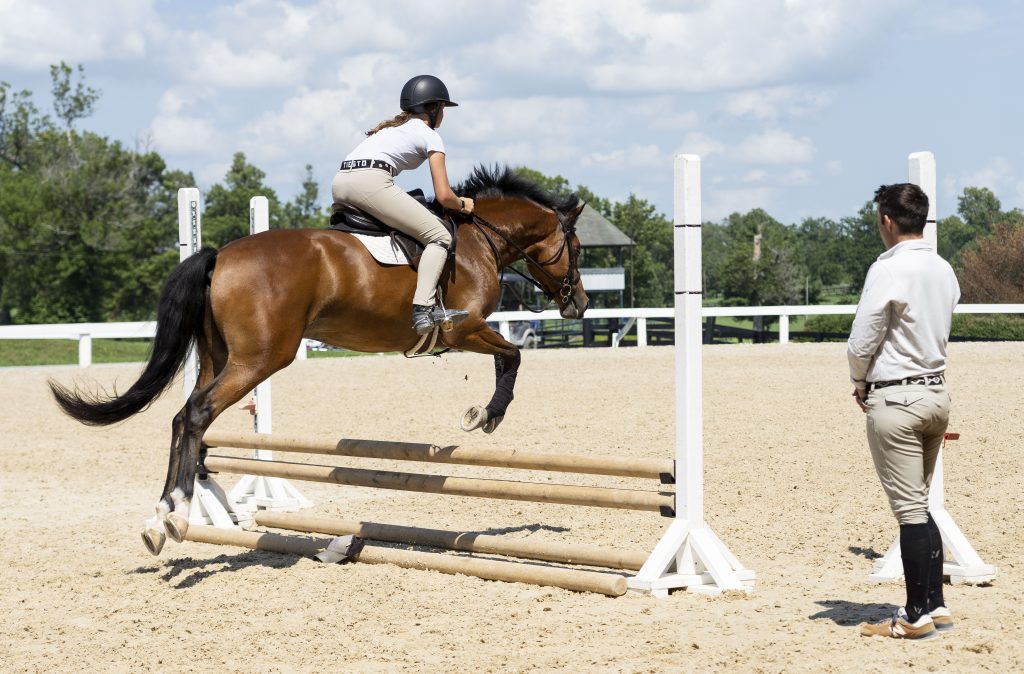
Welcome to Trainer Tuesday! Each week we ask trainers a question and gather their answers for you. These trainers have a range of experience, backgrounds, and focus points of their programs, so the answers have as much variation as you would expect and also probably much more similarity.
This week’s question posed is: When your horse is loose and limber on the flat, on average, how many warm-up jumps do you aim to jump before you walk into the ring to show?
Here are their answers:
“There are many factors to consider with this question: How big is the class? Is it a professional or a jr/am? Is it a proven horse or a young horse? The short answer is as few as possible to be ready for the class, because you want to save the best jumps for the ring.” – Geoff Case
List to Geoff on The Plaidcast here.
“For a Grand Prix horse, two little 2’6 jumps once each lead. Then, two oxers, and the third one a to competition height oxer, and then one taller vertical.” – Lindsay Yinger
List to Lindsay on The Plaidcast here.
“Schooling before entering the ring must be done by feel. There is no science to it. For hunters, I tend to suggest more rather than fewer jumps (10-12) beginning at a height a few notches below the class height and ending a notch higher. For jumpers, I tend to suggest slightly fewer warm-up jumps but with the same cup settings. Once my horse gives the effort I’m seeking, then I stop—even if we haven’t jumped a certain number of schooling jumps. We always begin with oxers and end with a vertical. Remember not to leave your best efforts in the schooling ring!” – Scott Keller
Read more Trainer Tuesday answers from Scott here.
“When warming up for a show I think it is important to remember that you are not having a lesson, and more importantly, you are not teaching your horse anything new at that point. The warmup is just that—a warmup. Your horse should be loose and relaxed on the flat, and depending upon the horse’s needs, the number of warm-up jumps will be minimal. Typically speaking, I like to canter a small vertical from both leads and then move the jumps up to the appropriate show height. I also like to bring flat work back into the equation if the horse is fresh. I do not like to just keep jumping for the sake of jumping. Instead, I will work the horse on the flat until they are ready to jump again.” – Kari Briggs
Read more Trainer Tuesday answers from Kari here.
“Obviously it depends on the horse and rider pair, but I strive not to overdo it—which is temping. I’d say that 99% of the jumps I have them jump in warmup are more for the rider than the horse! I am a fan of a few trot fences just to help the rider and horse stay patient and settle, and I find them more forgiving especially when nerves may be a factor.
When they are trotting a x-rail or small vertical quietly and softly cantering away, then I have them canter a small vertical off of both leads. Then, I like to have a little walk break on a long rein if time allows and let them settle. It is easy to have the rider feel hurried or pressured when you have a ring steward yelling in the background. If that is going well, and the rhythm and rideability is satisfactory, I’ll then put the vertical up to height and we will jump it off of both leads and work the oxer in (usually a few holes lower than height to start with then I’ll bring it up to height).
I try to have them mimic any particularly tricky turns that they may have on their course (a short approach or a quick turn after for instance). We are usually under 10 efforts at this point if I had to put a number to it. I like to have another quick walk break then pick up one more fence at height right before the rider heads to the ring. There is certainly a sweet spot for the ideal number of warmup fences—you need enough to be sure the horse is rideable and the rider’s eye is accurate but not so many that the horse starts to get dull or flat.” – Janna Bankston
Read more Trainer Tuesday answers from Janna here.
“I like to ask the horse to do the least amount of jumps I can while having the horse and rider confidently prepared. I am always jumping less than 10 jumps! Later during the show schedule I would use even less jumps each time we come out or each day. I want the horse and rider to be confident and prepared but this is not the time to teach a lesson. Sometimes I follow a consistent pattern for the horse and rider but an element of the course or the direction of the first fence might adjust how I finish the warm up jumps.” – Merrilee Wroten
Read more from Merrilee on The Plaid Horse here.
“I don’t like to jump too many jumps in the schooling ring, save the good jumps for the show ring! I think this is very horse dependent as some horses may need more jumps for a variety of reasons. Each horse has a little different preparation in the schooling ring to get them ready to show. The type of class you are preparing for also may play a role in your decision of how many jumps, the type of jump (vertical, oxer, or a trot jump), as well as who is riding the horse in the class, the professional or the student.” – Heather Pinnick
Read more Trainer Tuesday answers from Heather here.
“I typically will do a 3-5 in each direction. A lot will depend on the class we are preparing for and how we use those jumps. We need to use the jumps to our advantage and have a plan on when to start the schooling before the class. But, we need to keep in mind the horse only has so many jumps in them, I will not keep jumping the horse because the rider is unprepared.” – Christopher Mitchell
Read more Trainer Tuesday answers from Christopher here.
“As few as possible, especially if there is a schooling round or warmup trip to begin the horse’s day. In my opinion, the warmup ring is not the place for riding lessons or training. We do that at home. I usually begin with trotting a crossrail, then I might jump a vertical off each lead, with the second one higher than the first. From there, depending on the division or the day’s goals, I may go to a larger vertical or go straight to an oxer. If they nail it, my girls hear, ‘let’s go on that!’ and we head to the ring. I have a number of younger horses and once I know I have their attention, I prefer to ‘save’ their attentiveness inside the ring than belaboring the point over numerous warm up fences. Of course our more seasoned partners know their jobs and don’t need to jump a lot of extra jumps, beyond warming up their bodies. I always like to keep it brief.” – Katie Gardner
Read more Trainer Tuesday answers from Katie here.
“I like to keep it simple, maybe 10 jumps at most in the schooling area if they are feeling great, so they save their best efforts for the ring. Now, if they feel like they need a minute, I take my time with the smaller jumps to help them relax and get loose. Once I have the feel I want I go back to keeping it simple and jump 5 bigger jumps and go. But to be completely honest every horse is different and everyday you school it can change. So, I try to just go off of what the horses are giving me. At the end of the day, my motto is less is more.” – Brooke Chasin
“The number of jumps that one does in a warm-up ring depends on so many different variables. Is this a young horse or horse with a lot of experience? Is this a horse that needs a little extra time in the schooling area to be prepared versus a horse that you want to preserve? One must also consider the rider. Is the rider experienced and familiar with the horse, or is this an experienced rider doing a catch ride? Is this a novice rider? Some riders come out thinking they need a riding lesson before they go into the ring. This, to me, is an indication that their homework has not been done ahead of time.
Another piece of advice is to make sure that the rider knows their course and that they are at the ring with their horse with plenty of time to spare and to get prepared. What kind of course are we warming up for? Is it a handy class where you might want to jump a trot jumps? Is it an equitation class with a test where perhaps you have to counter canter? Is there a water element in the course? Be timely and organized! It is unfair to show management, the judges and Ingate staff as well as the other competitors, to keep everyone waiting for a horse to warm up. The schooling area should not be time or place for a riding lesson. Many of our adult riders would prefer to jump two or three jumps and walk in the ring. In some instances, we will have a professional do the warm-up and then put the rider on. For some riders, this puts their mind at ease and they do not have to worry about getting flustered in the schooling area. The bottom line is to know your horse, know your student or rider, and be prepared ahead of time so both the horse and rider can have the best experience!” – Michael Dowling
Read more about Michael here.
“When preparing a horse and rider for the show ring, I tend to have them do a minimal amount of jumping in the schooling ring. For example, if a rider is competing in the 3”-3’3” we may jump four jumps in preparation for the show ring. I do not feel that the schooling ring prior to showing is a place to learn a new skill. At that point, we are making sure the horse and rider feel confident, are warmed up, and have a good feel for the canter and track they will need to be successful in the class. Oftentimes, my adult riders will jump two verticals and a single oxer, on the lead of their single oxer in the class, and then walk to the ingate. When we practice the correct track and pace well at home, we are able to minimize what is needed prior to showing while still being prepared to succeed.” – Belinda Colgan
“As many jumps as they need and as few jumps as they need! I don’t have a specific number that I go for. And it so entirely depends on the horse. The 3* horse I’ve had for almost a decade (and therefore know him like the back of my hand) typically does very few. Maybe 5-6 fences. He’s also an intrinsically lazy horse, which I’ve dealt with in training and know how to fire him up (and train him to be fired up), but that still affects our warmup and not taking too much out of the tank, physically or mentally. Those 5-6 fences typically look like 2 Training (3’3″) fences, then maybe 2 Prelim fences (3’7″). Then a quick walk break, then maybe 2 Intermediate (3’11”) fences. Or sometimes changing one of those for an Advanced fence (4’1″) and maybe adding 1 more if he is in the AI division. On a horse at that level that I hadn’t had quite as long, I might do another fence at each height, with maybe another 2 fences at the competition height. I like to keep it short and simple. Some horses do need longer warmups, but I think generally speaking, many horses are over-warmed-up in regards to number of jumping efforts.
Ideally, I also like to go in after a warmup fence that they knocked. It’s a little bit of a reminder to be cleaner, so I might end my warmup a fence early if that happens. On a younger/greener horse, I might do a few more fences. Maybe pushing double digits, although if I had to guess, probably never more than a dozen or so. Again, the reason I don’t have exacts is because I go by how the horse feels, not by the number. Once they feel confident, straight, energized, responsive to my aids, and clean, I’ll go with that.” – Michael Willham
Read more Trainer Tuesday answers from Michael here.
Read last week’s Trainer Tuesday article here.















