By SALLY BATTON and CHRISTINA KEIM
Reprinted with permission from Trafalgar Square Books
Equicize in Two-Point
Equicize is a program of progressive, mounted exercises that will improve cardiovascular and muscular fitness for riders of all levels. It can be used as part of a rider’s daily warm-up by targeting specific muscle groups, or for a more intense workout once or twice a week, it can make up the bulk of a training session. No matter your current level of fitness or preferred equestrian discipline, Equicize can help you become a better athlete.
Two-Point to Power
To successfully implement several elements of the Equicize program, riders must understand and be able to execute the correct biomechanics of the two-point position, which helps develop balance and stability, no matter what discipline you ride.
For readers of my first book, The Athletic Equestrian, these concepts will sound familiar because I addressed them there in great detail. In Equicize, I review these fundamentals for those riders whose background has perhaps not included much (or any) work over fences. But this will also be a helpful review even for those riders who are already familiar with two-point, as it is easy for bad habits to creep into our execution of this commonly used riding position.
Although two-point is often referred to as “jumping position,” you do not need to be a jumping rider to learn how to do it correctly. In Equicize, two-point is used to challenge a rider’s balance (which causes her to engage her core muscles) and to improve her overall strength. Before tackling any exercises that use the two-point position, the rider must practice it enough to feel balanced, secure, and safe. Without this solid foundation, riders will feel off-balance and uncomfortable.
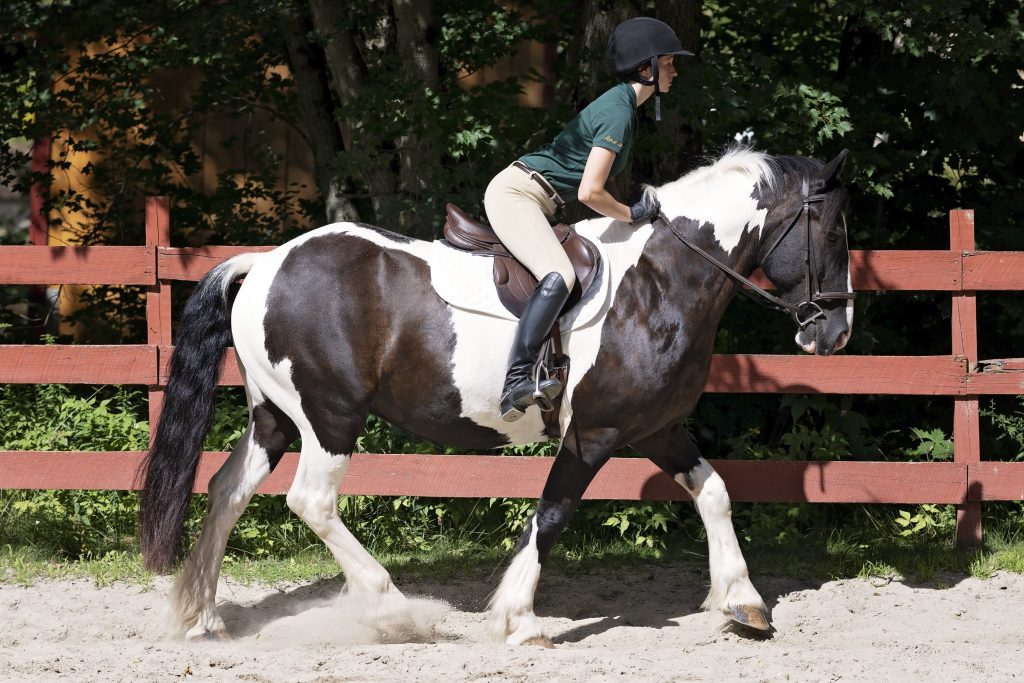
The term “two-point” comes from the fact that while performing it, the rider has two points of contact on her horse—her legs. In two-point, the rider’s seat is totally clear from the saddle, and the angles in her ankles, knees, and hips become more closed than when she is seated or posting. The most extreme example of a two-point is a jockey position, but fortunately you will not need to take it to that level of balance for the Equicize program.
The Athletic Stance
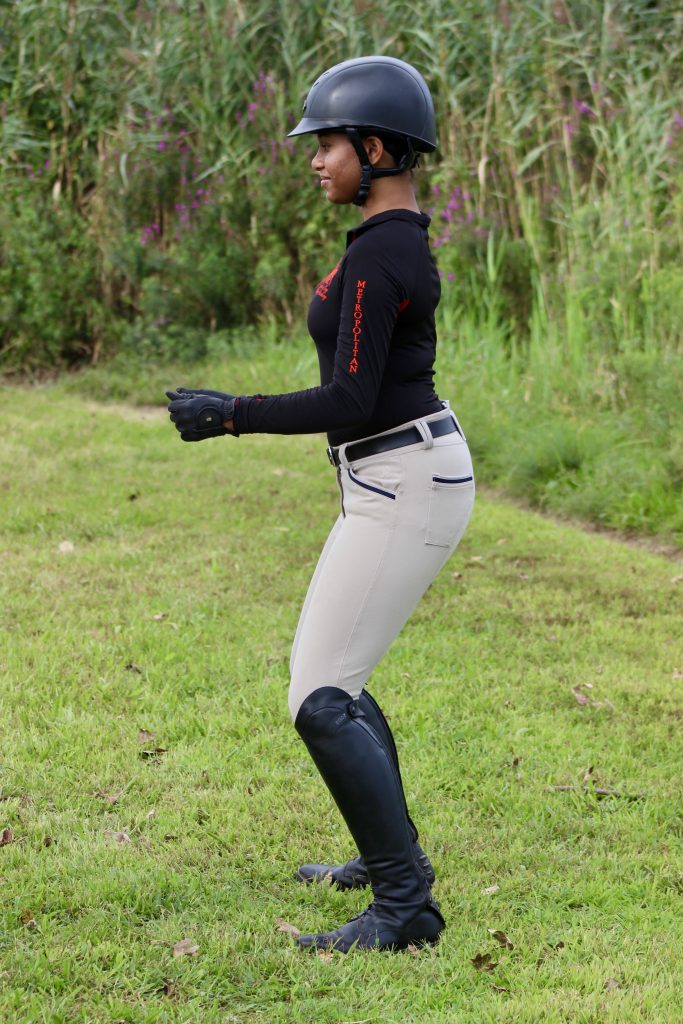
Two-point is a form of athletic stance, a body position utilized in almost every sport where the athlete is balanced over her feet, with a bend in her ankles and knees and a flexible hip. Athletic stance is what allows for the mobility of a tennis player returning a serve, the coiled power of a gymnast landing off a vault, or the balance of a surfer riding a wave. With bent, flexible joints, an athlete can absorb and store energy, helping her to stay balanced and move fluidly.
When they hear me say that their seat should be out of the saddle in two-point, some riders attempt to achieve this by just standing up straight in their stirrups. While this is a good balance challenge, it is not a correct two-point position. In a biomechanically correct two-point, the rider sinks deeper into her lower leg, increasing the depth of the heel, then lifts her seat out of the saddle and slides her hips back, until her “center” (which is just behind the belly button and about an inch in front of the spine) is over the horse’s “center”. Her knee remains centered over the ball of her foot, and her stirrup leather is almost perpendicular to the ground.
In two-point, the rider should never be balanced with her seat over the pommel. The good news, at least for Western and dressage riders, is that the design of your saddle will help prevent you from standing straight up. The horn of a Western saddle and higher pommel of a dressage saddle physically interfere if the rider tries to (incorrectly) come into two-point by standing up and leaning forward in the saddle. The flip side, however, is that these same saddle-design features will limit how closed the hip angle can be in two-point as compared to a rider in a jumping saddle.
If you have limited or no experience with two-point, it is important to build a base of fitness in this position before attempting to add Equicize exercises into the mix. Start by shortening your stirrups two, three, or even four holes. They need to be short enough so you can achieve depth in the heel and a more closed knee, which will allow you to lift your pelvis clear of the saddle. Create enough bend in your joints so that should your horse magically disappear out from underneath you, you would land balanced and centered, on your feet, in athletic stance.
It’s a Gradual Process
When practicing two-point at first, start small—it is a different way of holding your body, and it will take time for the muscles, tendons, and ligaments in your legs to adapt. Start with perhaps half a circuit of the arena, then take a break. Repeat, up to five repetitions. The next day, try for one lap. Continue to check your mechanics: in two-point, you are first sinking down into your leg, then lifting your seat and sliding your hips back. It can be helpful to have a friend take a short video to confirm that you are executing the two-point correctly.
A rider who is well-balanced in two-point should feel fairly stable, but not necessarily at ease—it will take effort to hold this position. If you keep falling back into the saddle, your lower leg has come too far forward. If you are tipping forward or catching your balance on the horse’s neck, you are probably pinching with your knee, and your lower leg has slid back. In either case, return to the correct alignment— ear, shoulder, hip, heel—while seated, and focus on holding the lower leg still and in against the horse’s side as you transition into two-point.
Make sure you keep your heels lower than your toes. This is easier for some bodies than others, and when riders feel challenged (whether in posting trot or two-point position), they tend to tip onto their toes and lift their heels, resulting in a loss of balance. To help keep the heels down, roll slightly onto the inside ball of the foot; this position allows the heel to stretch to its max. To gain confidence, you can practice this position in shorter stirrups before attempting two-point.
Keep practicing two-point until you feel strong and confident enough to maintain the position for multiple circuits at the walk and trot. And for even more stability in two-point, read about the Power Leg, a secure and stable lower leg that supports the rider in two-point.
To order a copy of this book, go to: trafalgarbooks.com/products/equicize