By JENN TIRRELL
After an early morning schooling at a horse show, I felt compelled to talk about something we all know, but don’t always do better at. Safety is of utmost importance for horses and riders. Traffic poses a threat to that, and I mean both kinds of traffic.
As I was walking out from the stabling area to get to the ring, cars were flying by me with no consciousness of me or my horse. In fact, a car even came head on at me and had no intention of stopping, and again on the way back, two trucks cut me off. Luckily, the horse I was on isn’t a spooky one and was unphased by the ordeal, but that could’ve been a really dangerous situation for anyone.
Horses have the right of way and should never have to dodge cars. I know we all have places to be, and we all feel the rush of a busy day, but people in motorized vehicles need to take a moment and be aware of their surroundings, especially when our animals are involved. We are ultimately here for the horses, so everybody can slow down for the sake of safety.
The feeling of danger didn’t stop once I got in the ring where I was left to wonder–in all our rushing, are we teaching traffic rules to riders anymore?
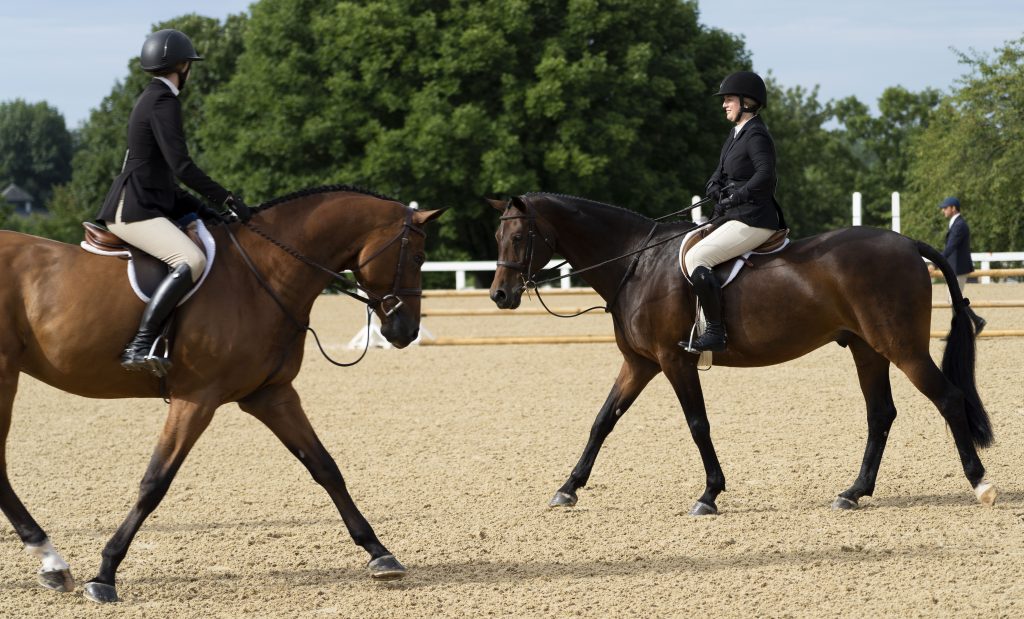
The left-to-left rule–which is standard in cars, on horses, and in foot traffic–is one of the first things I learned as a young rider, and if it’s not being taught as a priority anymore that’s a shame. It’s not some silly rule, again it’s for safety, and it’s so incredibly important to comply when we’re at horse shows, and all the rings are packed, and everyone’s doing a different thing.
Coaching students to learn how to ride is not just about doing up-downs and counting distances; it’s also the time to teach horsemanship, and how to work with others in the ring, to have riding etiquette. Passing left shoulder to left shoulder with a horse coming in the opposite direction, passing on the inside of a horse going in the same direction, and calling out where you’re going does more than create a more productive schooling area, it also prevents accidents and traffic sensitive horses (and people). Riding doesn’t need to be any more dangerous, or harder, for the people and animals around you.
So much of riding with others operates on shared horse sense and shared horse space concepts, which are skills developed over years of intuition and hard to develop in private lessons or quiet rings. The benefit of group lessons shines in this scenario. Navigating a ring with others, even if you’re tracking the same direction and going the same pace, can develop skills of communication and awareness that riding in an empty ring doesn’t necessarily teach you.
The traffic issues seem to point out a general lack of awareness. We can all do our part to remember that we are a community, and that means looking out for each other. Emphasis on looking; you’re not the only one in the road or in the ring. We shouldn’t need more measures in place to manage that, but we do need to care more about the safety of the most important things to all of us: the horses.