An Extraordinary Equestrian Journey from Deadly Diagnosis to the Paralympic Games
By SYDNEY COLLIER WITH HEATHER WALLACE
Reprinted with permission from Trafalgar Square Books
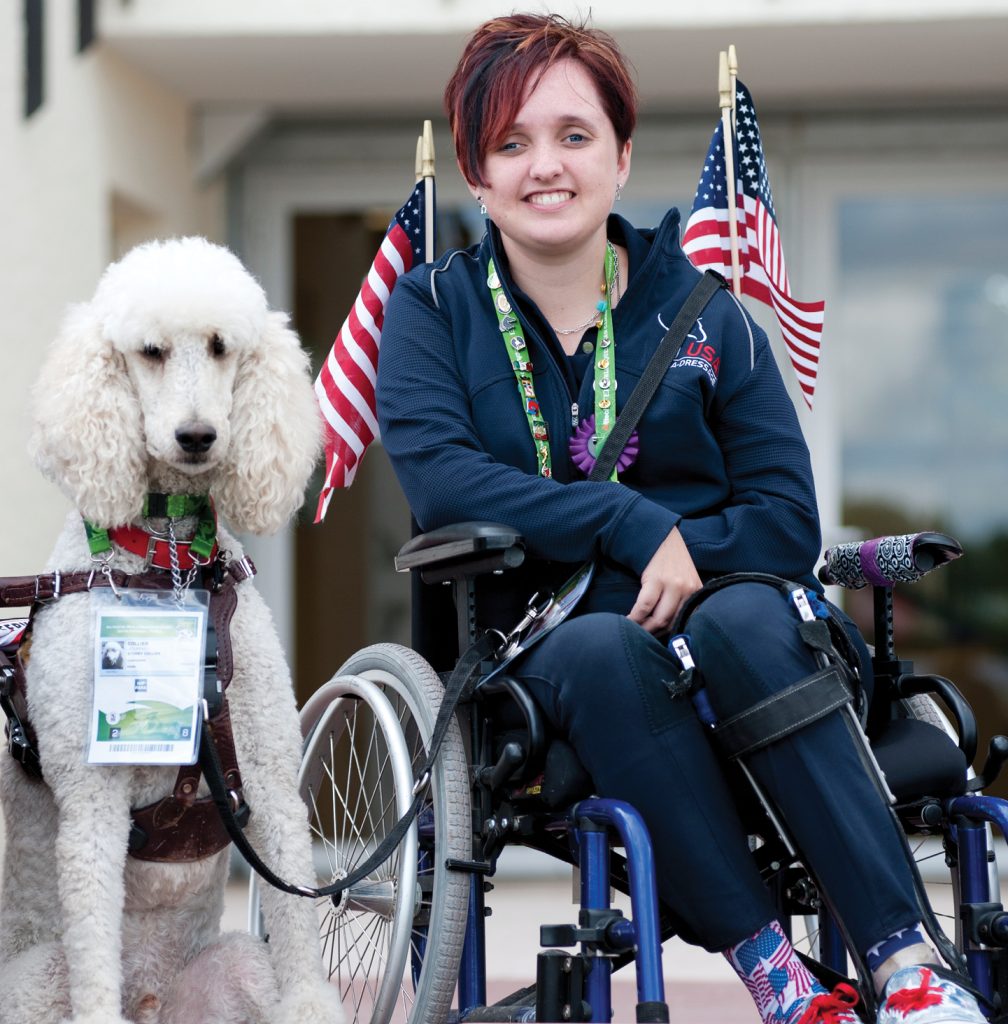
Sydney Collier was told at age 7 that she wasn’t supposed to be alive. A routine eye exam discovered that Sydney had an incredibly rare congenital birth defect called Wyburn-Mason Syndrome. It causes arteriovenous malformations where the veins and arteries in the brain don’t separate as they should through capillaries. Fewer than 100 cases of the syndrome have been reported, most diagnosed in infants following their deaths. During a risky brain surgery at age 11, Sydney suffered a massive stroke, putting her in a wheelchair. As a form of therapy post-stroke, she began riding at a therapeutic riding program. The excerpt that follows tells of her trip to the World Equestrian Games at the Kentucky Horse Park and seeing Para Riding for the first time.
I can’t do justice to the feeling I had when I saw the para riders for the first time. These were athletes with disabilities like me, competing at the upper levels. My earlier childhood goals didn’t seem so far away anymore. For the first time in what felt like years, I felt my inner fire rekindle deep within. It may have been a small flame, but it wasn’t gone like I’d feared.
The rider I remember the most, the one who really affected me, was a woman without arms. She held one set of the reins of the double bridle in her mouth, and the second set of reins with her bare feet, and she rode beautifully. I’d never seen a more striking example of inclusivity as that woman in my life. Nothing was stopping her from achieving her goals, and it made me feel like I could do the same thing.
I had a true epiphany, just like a moment out of a movie! I stood there watching and thought, If these athletes are out there pursuing their goals, then I can do it too. If I really apply myself, it could be me on this team.
It was the most empowering moment of my life to date. Even though I was different, I wasn’t as useless as society seemed to be telling me I was.
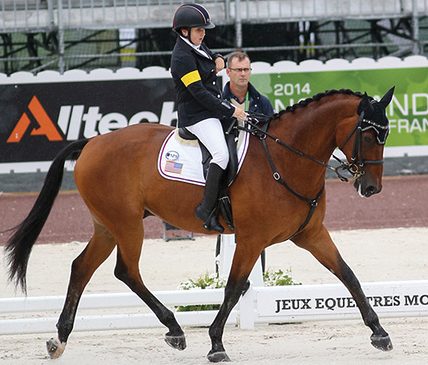
I don’t know if my mother was prepared for how excited I’d be after so many months of depression. She had booked our trip to help me through a very dark time, and like a switch, suddenly, my social self came back to the fore. It made all the difference to be around people who made me feel “normal” once again.
I wasn’t different. I wasn’t the odd one out.
For the first time in a long time, I had hope. My mother thought she’d opened Pandora’s Box, but there was no turning back for me. I’m forever grateful to her for recognizing my need for a community who understood my experiences with individuals working toward goals like mine.
It wasn’t enough to watch others ride at WEG. I wanted to meet as many riders as possible. I went from shuttered, surly, teenage Sydney, to excited, chatty Syd in the blink of an eye. My mom and grandma probably had whiplash. I had an absolute blast!
My mom and grandma stayed in the background and let me explore, giving me freedom. I enjoyed every moment and met as many people as possible. It’s easy to coddle your disabled child and try to protect them from the world, perpetuating dependence. My family didn’t helicopter me or wrap me in bubble wrap like I was some broken thing. Instead, they gave me free rein and let me explore. I’ve always been my own person. I am so grateful to them for allowing that independence to evolve.
That independence allowed me to walk up, limping the whole way and leaning on my cane, to anyone and everyone who was around, so that I could introduce myself and say hello. I knew the sport of para dressage was a way that I could step up to the challenges I was facing and not let life beat me down. It became apparent that it gave me the strength to embrace my new body and my new self. It was the beginning of something exciting.
One of these introductions became life-changing.
I opened with, “You look like someone I should know.”
I am so damn cheeky, but it would be the most important meeting of my life. That rider turned out to be Jonathan Wentz, who would set a cascade of events into motion that led me to where I am today.
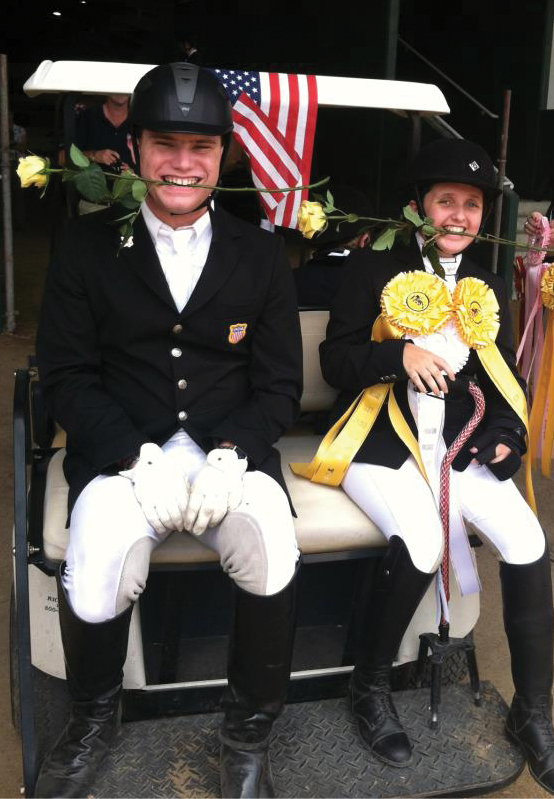
At the time, Jonathan was about nineteen years old and representing the United States at his fi rst World Equestrian Games. He had the sunniest disposition—so friendly and welcoming. At over six feet tall you might think he would seem unapproachable, but he had a presence about him, an energy, a way of making others feel comfortable—something I emulate to this day and hope to provide for others.
Jonathan’s goal to be a positive light and help bring more young riders into the sport of para dressage quickly became apparent. It was his passion, and it was something that really resonated with me. Before I knew it, he offered to introduce me to Hope Hand, founder and (then) president of the United States Para-Equestrian Association (USPEA), so that I could be “classifi ed,” right then, right there—at the World Equestrian Games! (According to the FEI, classification by “Grade” enables competitors to be judged at an international level on their individual skill on their horse, regardless of their physical impairment. “The competitor’s mobility, strength, and coordination are assessed in order to establish their Classification Profile. People with similar functional ability Profiles are grouped into competition Grades. For para dressage, the Grades range from Grade I for the most severely impaired, to Grade V for the least impaired.”)
My grandmother was with me during my chat with Jonathan, while my mother remained on the other side of the arena. As I felt my life suddenly being swept up in a current that might lead to a future I hadn’t thought possible, I hurried back to where my mom was waiting.
“Mom, Mom!” I said, my voice full of excitement and disbelief. “You’ll never believe this but I’m going to get classified right here for para dressage and start doing this! Right now!”
Before she could utter a word, I was off again.
After Jonathan’s ride, he took me to meet Hope, as promised, and get classified. I did not know what to expect. I assumed the process would happen on a horse, where I was most comfortable—I imagined maybe I’d even get to ride Richter Scale, the horse Jonathan had just competed. I was so hyped.
To my disappointment, there was no horse. Watching other riders is never the same as being on a horse myself, so it bummed me out. Any day I can get on the back of a horse is a good day. Later, physical therapists trained as classifiers explained that being on a horse can make someone look more able-bodied than that person actually is, so classifiers base their evaluation on the rider only, unmounted.
The classifiers at WEG led me to a trailer, with my grandma in tow as chaperone. There I did a series of muscle tests to help determine what “Grade” I would be when competing in para dressage, so that I would ride with athletes who had similar abilities on an even playing field.
I remember thinking, Is this actually happening?
I was classified as a Grade II rider, so I would ride tests that included fifty-fifty walk and trot requirements, parallel to a Second Level dressage test, minus the canter aspect. I felt elation. I hadn’t even known this sport existed a month ago! In the blink of an eye, my mindset changed from believing dressage was boring to appreciating all the potential there was for me in the sport.
“Mom, Grammy, next WEG and Paralympics—it’s going to be me on that team,” I announced.
If my change of attitude surprised my family after our trip to WEG, they didn’t show it. In fact, they were likely just relieved I had a new, positive focus. Many kids have big dreams for their futures. I was no exception. And I’ve always been determined and goal-oriented. When I said I was going to work toward a goal, I put all my passion into accomplishing it.
My diagnosis and stroke would not define me anymore. I wanted to write the rest of my story.
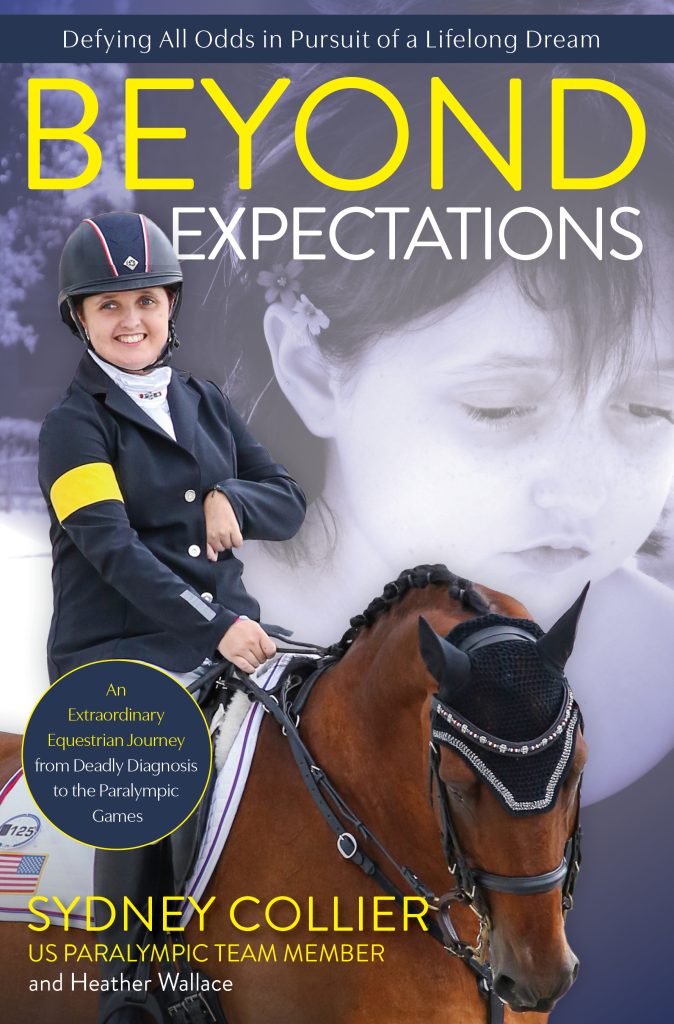
To read Sydney’s whole story, click here to find her book at the Trafalgar Square Books online bookstore.