By ELIZABETH WOOLSEY, DVM
True Story…
When I put on my old work jacket, I’m reminded of my professional career. The lining is almost gone, but the jacket is still warm, and my clinic logo is still visible. It hangs in my closet as a memory of times past. It still smells and feels like my old life in Australia. The stories that jacket could tell…
I was an equine veterinarian who moved from California to Australia. I loved my ‘All Horses Big and Small’ practice. I saw the spectrum of the great and well-bred to the common but well-loved horses in my practice. The variety of horses and their guardians made each day a challenge and a joy. How lucky was I?
I am also a quilter. If I made a quilt for all the memories from my practice life, it would stretch for miles. The fabrics and colors would weave and wave from rough to satiny smooth, and from the gold of palominos to the reds of chestnuts. Here is the story of a Christmas that started with a carrot and ended with a glass of wine. But, in truth, this story never ended and to this day, I cannot talk about it without a failed attempt to harness my emotions.
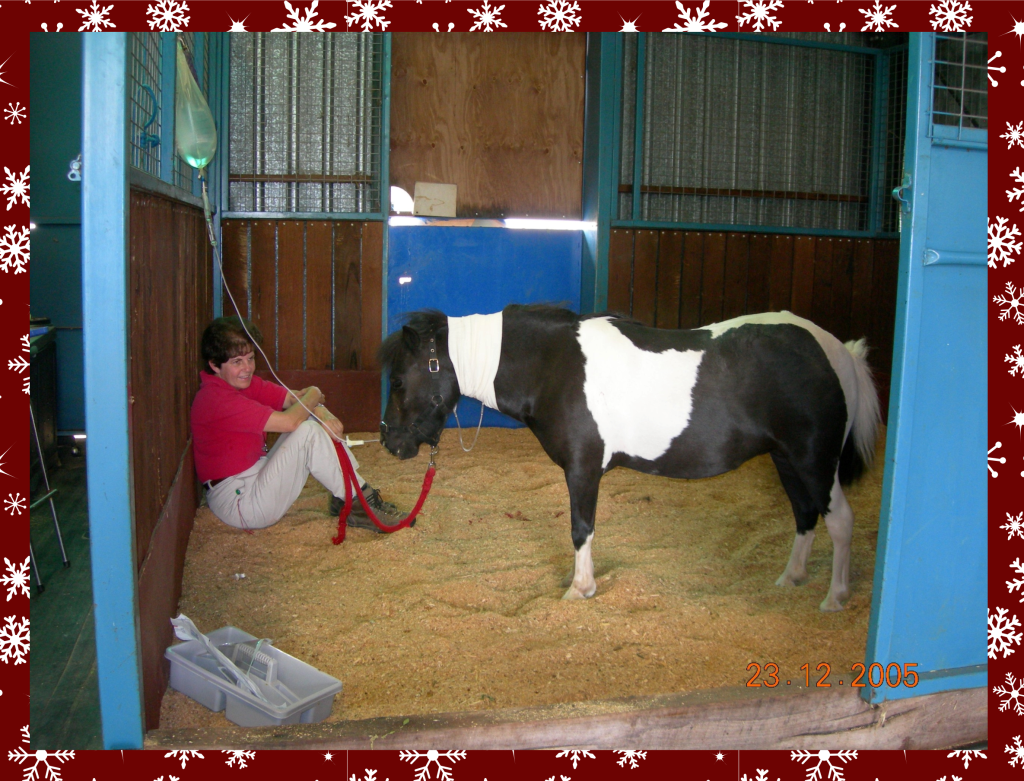
Merve Schutte had given his mini mare a carrot which lodged in her throat, and the black and white paint mare was in strife. A Southern hemisphere Christmas can be enjoyed in your swimming costume in the pool with a Mai Tai in hand. Hot, hot, hot. The heat and the dry conditions of the driest state on the driest continent cannot be overstated.
So, when Merve’s little mare inhaled the carrot, she didn’t waste time chewing it and swallowed it whole. Only her esophagus didn’t play nice—not at all. The carrot became lodged in the middle of her long neck and wouldn’t budge. The technical term would be esophageal obstruction, but the common term is choke.
Horses are unusual creatures. They produce gallons of saliva during the day. So, when they can’t swallow, the saliva has no place to go. Horses often panic and many throw themselves on the ground as they struggle to clear their mouth and trachea from the saliva which eventually comes out of their nose. They appear to be choking, which would suggest the blockage is in the trachea, but it ain’t so…
After a quick visit to the end of civilization where Merve and Maureen live, I had a feeling my Christmas festivities might turn a bit “festy,” as my kids would say. With no relief from my first attempt to clear the blockage, I asked Merve to bring the little mare to the clinic.
Chokes can be tricky. Most resolve without veterinary intervention, but a carrot would not break down on its own, so the plan was to lubricate the esophagus and relax the musculature to allow passage. The esophagus is an interesting thing. One part is surrounded with smooth muscles, which is like the muscles that propel food through your intestines, and the other part is striated muscles like your biceps and triceps. Different drugs work in different areas along the esophageal structure.
My approach is commonly described as ‘everything but the kitchen sink.’ I’d administered sedation, anti-inflammatories, and one that works on the smooth muscle to relax the esophagus, and finally the last medication helps the esophageal muscles push the bolus, or in this case a dry carrot, down the pipe. Since it’s South Australia and stinkin’ hot, and the little mare couldn’t eat or drink, I had to administer intravenous fluids. Kill me now. I had so much to do to prepare for Christmas, and the last thing I wanted was a sick horse at the clinic.
I was on my own for the holidays. This Christmas was the first and only time I could remember I didn’t have a sick horse or an ovulating mare that might need insemination in years. Heck, I had people coming for dinner. I always cooked a turkey with stuffing and all the traditional trimmings from my American heritage. I would often have ten to twenty people come for the Christmas Eve dinner.
Around lunchtime on Christmas Eve, I attempted to pass a stomach tube on this sweet little mare, and, oh joy—Christmas on a stick! The tube went all the way down the esophagus to the stomach. The carrot had passed! I got Merve on the phone and told him if he didn’t come and get her; I was raising the rent. Problem solved, get out the eggnog and let’s get this party started!
About two hours before the guests arrived, my neighbor came over to help with the preparations. Everything was ready. The turkey had another hour or two to cook, and there was nothing to do but set the table and eat Christmas almonds. When the phone rang, I knew this wouldn’t be good.
An elderly couple had a horse that they’d cared for when their daughter grew up and moved away. This was a common occurrence in my practice. I knew many older couples who kept their child’s horse until the now-adult child was able to take the burden away from the parents. The adult children rarely resumed care, and so the parents took responsibility and sacrificed to care for the aging horses. This horse had a large laceration on her hind leg. They couldn’t reach their daughter, and they never handled the horse. They just fed it. They were upset, and their regular vet was unavailable.
“I’m sorry, I’m not able to come. Who’s your regular vet?” I had a pretty good idea who their vet was, and like me, he was probably getting ready for his Christmas dinner.
“Well, good luck. I wish I could have helped,” I said. The all-consuming guilt when I turned down a call reared its ugly head once again.
I had a slight chance they wouldn’t ring back, but I was surprised when their neighbors and my good friends, Fiona and Rodney Warren, called and begged me to come. They were on their way home from their business Christmas staff party and promised to meet me to care for the horse.
My early guests overheard the conversation. As horse owners, they knew how the couple would worry. They insisted I attend the poor horse. They would watch the turkey. I was relieved. I hate myself when I turn down any emergency call. I took my suture kit and headed for the hills. I arrived to see the owners standing on one side of a barbwire fence and the horse on the other. Her legs were scratched and there were two large lacerations on one hind leg.
The owners mentioned she was ancient. They repeated this several times. She didn’t look old, but I got the message. This injury might be the excuse they sought to end their burden. I haltered her and examined her mouth. She was in her late twenties.
That would be enough for most people, but I had three horses in their thirties. The elderly couple’s ability to deal with such an injury was limited. If it couldn’t be done across the fence, it would not be done. The mare frightened them.
I asked them to hold the rope over the fence. Fiona and Rodney were not home yet, and the daughter finally responded and was on her way. I had no time to spare. I cleaned and dressed the wounds. They would heal even if I didn’t stitch them. As I applied the final wrap, the daughter and the Warrens all drove up. They all were shocked.
“What?” I was perplexed. They told me that the mare was wild, and they couldn’t believe I had treated her without even a sedation.
“Well, I did. She was great. I would have preferred to suture two of the wounds, but they will heal. What’s her tetanus vaccine status?”
We all turned to the daughter, who shook her head. “I don’t remember her getting one since I stopped riding.”
I crawled through the fence and got penicillin and tetanus. I returned and tapped her neck to place the tetanus needle into her neck. ‘Needle shy’ would be an understatement. The mare reared up, pulled the rope away from the daughter, and ran to the far end of the paddock, shot through that fence and then a second fence.
I looked at everyone and shook my head. I could do everything with oral meds, but the tetanus vaccine was non-negotiable. I glanced over at Fiona and Rodney, who were experienced horsemen. We didn’t say a word. While this nightmare would go on for the owners, I was about to leave. I handed Fiona the tetanus and said I’d done all I could.
As I walked to the car, the daughter asked me to wait: “It’s time. I can’t ask my parents to keep doing this, and I just can’t get over here to care for her. How did you get the halter on her? I haven’t been able to catch her for two years. She’s twenty-nine and she’s had a good life.”
Fiona, Rodney and I were able to trap her in a small enclosure on their property and she was humanely euthanized. She was well behaved when she knew she had an expert holding her. While I knew the mare could survive, I could see the relief and guilt on everyone’s face. I am a ‘no-judgement’ vet. This horse would have lived, but at the expense of the elderly parents. I knew they would feel guilty, but it wouldn’t come from me. I explained I was already late for my dinner party, and I would send them an account after Christmas.
I left and headed back to the clinic and my home. I needed to get back to my festivities. The regulars were arriving, including people from the local veterinary school and my adopted kids. The party was starting. When asked about the call, all I said was, “one for the books.” I didn’t elaborate.
As I began preparing string beans and potatoes, the phone rang again. It was Fiona. “Just tell me the horse hasn’t returned to life.”
“Uh, no it’s worse.” Fiona paused. “You’re going to hate us.”
I knew my plans for dinner were fading fast. “In twenty minutes, I’ll have thirteen people here for dinner.”
“We hate to do this.” Fiona was audibly upset. Rodney was one of my ‘funeral directors.’ He had a backhoe, and he was summoned at all hours to bury horses. He didn’t hasten their deaths, but he did the nicest burial of all the men in our area.
“Go on.” I was curious.
“There is a little girl whose pony has colic. I’m sure it only needs to be put to sleep, but they can’t get anyone, and the pony is in terrible pain. All you have to do is come up and put her to sleep.”
“How far away?”
“It’s near us. We hate doing this, but…”
My neighbor heard my part of the conversation. She pointed to my car. “I’d hate you if it was mine and you didn’t go. We can all wait.”
Thirty minutes later, I arrived at a small property in the hills above my clinic and the Adelaide Plains. The pony was on her back in a dilapidated old round pen. She rolled back and forth. She was sweating and covered in dirt. Her abdomen was distended, and she was grunting. The young owner was distraught. Her father held her by her shoulders. She was covered in dirt and straw. Her face had two brown lines where her tears had collected the soil, and her blonde hair was full of straw and leaves.
Fiona was there, but Rodney was on his way with the backhoe. She took me aside and told me the story. The pony was recently given to the girl for her twelfth birthday. The parents were what Australians called ‘battlers.’ Money was definitely an issue. Fiona guessed the only course of action was euthanasia. She asked me to confirm this.
Fiona then quietly explained that the girl had asked her parents not to buy her any Christmas presents other than a new blanket for the pony and put any money toward a stay at pony camp, which would start in a few weeks. She had raised most of the camp fee by doing odd jobs in the neighborhood. She only had the pony for a few months.
I climbed into the round pen and had to crawl on my hands and knees to assess the pony. She was violently rolling, and I couldn’t approach her standing as I might have been hit with a hoof. She was bloated, sweating profusely, and her gums were purple. She had the smell of horse vomit, showing the extreme backup of fluid in her stomach. She was dying.
As I climbed out of the pen, the family saw my face. The woman cried as the daughter screamed. The little girl tried to rush to the flailing pony, but her father stopped her. They took her into the house after I explained to the little girl that the kindest thing was to euthanize the pony and stop the pain. Despite this, I knew the child was beyond any comprehension of the gravity of the pony’s medical prognosis.
A few of the neighbors were standing around the pen and whispering to one another. They would stare away and shake their heads. Earth, swallow me now. I hated my job at that moment. I wanted to leave, but I had a duty to this little pony to hasten her death and stop the pain.
I returned to the pen with a syringe of heavy sedation and analgesia. This time, I was able to get a needle into her vein and sedate her. I then ended the poor little pony’s agony. I listened to the heart for several minutes to ensure her suffering was over. I wanted to get out of there and get back to my friends. What I really wanted was to get away before I cried. I try to present as the dispassionate veterinarian, giving professional advice, but not this time. My eyes were brimming and red, and I hadn’t even bothered to clean myself before I returned to my car. Fiona was mouthing, “thank you.” She was crying too. It would be a long time before she and Rodney would get home for their Christmas dinner.
The father raced out as I was driving away. “Thank you. How much do I owe you?”
I knew this was going to be my best and worst Christmas present ever. “Nothing. The people I saw before you paid me a bonus and asked me to pay it forward. I’m so sorry I couldn’t help.” He thanked me and returned his wallet to his pocket.
I suspected this would be this family’s last involvement with horses. I was heartbroken. I didn’t wait for a reply. I drove out of the driveway and down the road, where I stopped and cried. It took several minutes before I could even drive away. I snuck into the back door, changed my dirty clothes, and washed my tear-stained face. I returned to my party, and everyone asked about the call. “All sorted,” was all I said. I don’t think I fooled too many that night. That memory has haunted me for years.
I know my peers and I are a dying breed. Times and values have changed. I accept this and know it is a correction that must occur in my profession. But who will attend the next dying pony or horse when a desperate owner calls?
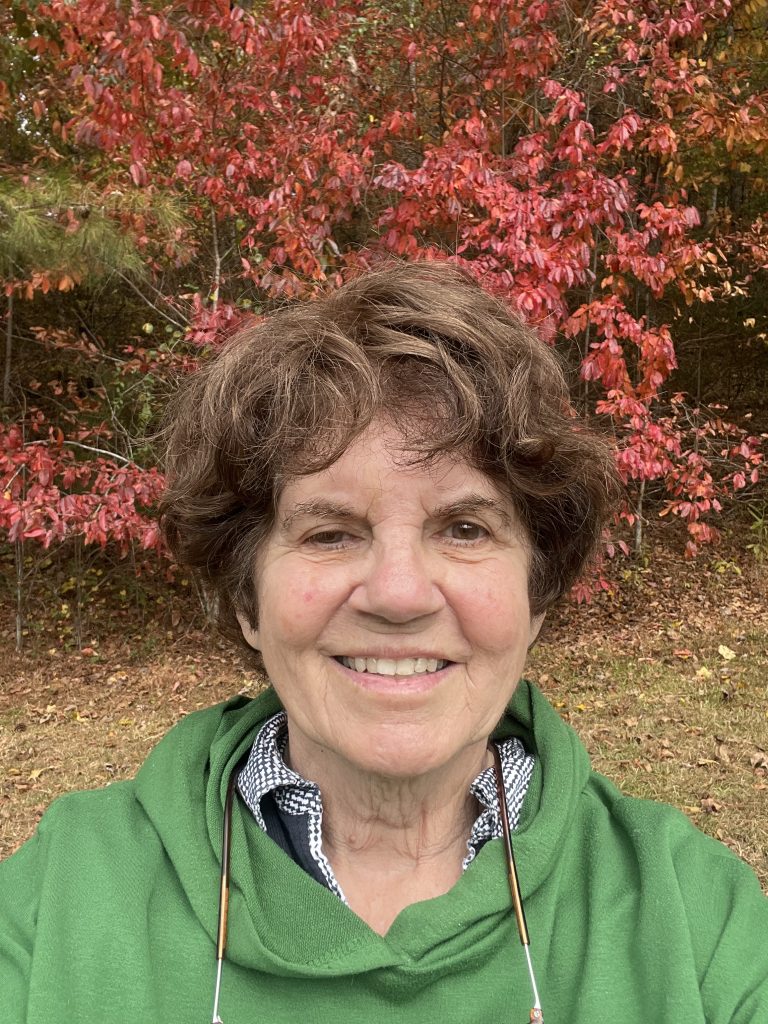
I told the story to a class of veterinary students last year. I received a message from one student who said she wants to be the person who goes to the aid of a sick pony at Christmas. My father was that vet before it was my turn. Maybe I met my replacement? Maybe there is a way for the new generation to fill the void.
While my jacket sits in the closet, and I only occasionally wear it, I treasure what it represents. I wonder if the young veterinary student will look back on her career. Maybe she’ll keep her own garment and remember how this story inspired her.
This was the Grand Champion Prize Winning submission to the 2024 Equestrian Voices Creative Writing Contest sponsored by The Plaid Horse. The goal of the contest is to promote fine, literary prose involving horses and the equestrian experience. This contest is open to writers of fiction and non-fiction, regardless of any previous publications, and awards 16 prizes. To learn more about the 2024 contest click here.