By L.A. BERRY
“The Hypocrisy of the horse world [is that it] pretends to love horses but goes to obscene lengths to get the desired results.” —The Equiery, 2025
A remark within a review for a fictional murder mystery novel set in the world of competitive equestrians may not seem the typical place to invite a discussion about false horsetails, but it does beg an uncomfortable question.
To what lengths will horse show people go?
When it comes to natural false or “fake” tails, the short answer is that it depends on who and how one competes. False tails are banned among some organizations while others see their use as complicit to staying competitive, with the most exceptional and enhancing colors commanding exceptional prices.
It splices hairs thinner than horsetails to examine everything, everywhere all at once regarding—from a regulatory standpoint—their show ring use. In short, the breeds that do not allow fake tails in competition and will disqualify riders using them are the Arabian, Andalusian, Baskhir Curly Horse, Friesian, Lusitano, and Morgan.
On an international level, the FEI has a procedure for requesting the use of tail extensions in dressage, para dressage and eventing competition, whereby riders wishing to participate while using a fake tail need to provide a veterinarian’s certificate stating their horse has injured its tail or has very little hair for other reasons.
Among Western show horses, the American Quarter Horse Association has ruled since 1997 that, “Tails may be lengthened by hair-to-hair attachment only, with no attachments of any kind to the tail bone.”
While you won’t specifically find “tail” or “fake tail” in the index of its more than 370-page AQHA Rule Book, regulation VIO204.14 also oversees the use of “any item or appliance that restricts the circulation of the horse’s tail; use of any item or appliance other than a weighted tail that restricts movement of the horse’s tail; and use of any drug, chemical, foreign substance, surgical procedure or trauma that would alter a horse’s normal tail function.”
But in ranch riding, AQHA prohibits all tail extensions: “Horses competing in ranch riding classes should have a natural ranch-horse appearance from head to tail.”
Head Spinning Yet?
You’re not alone. As recently as January 2023, the USEF Board of Directors and Arabian Horse Association (AHA) sought to resolve rules regarding natural and un-natural tail standards “in conflict with each other, and indefensible,” and to include new amended language to the USEF Arabian Division.
It’s up to competitors to stay atop the rules they must show by, but rules are open to amendment, if a well-informed constituency wishes to present a compelling argument for change.
Understanding where false horsetails come from, where their value is derived, and how and why their demand continues to grow presents a clearer picture of the lengths horse people should or should not go to use them.
Taking Root
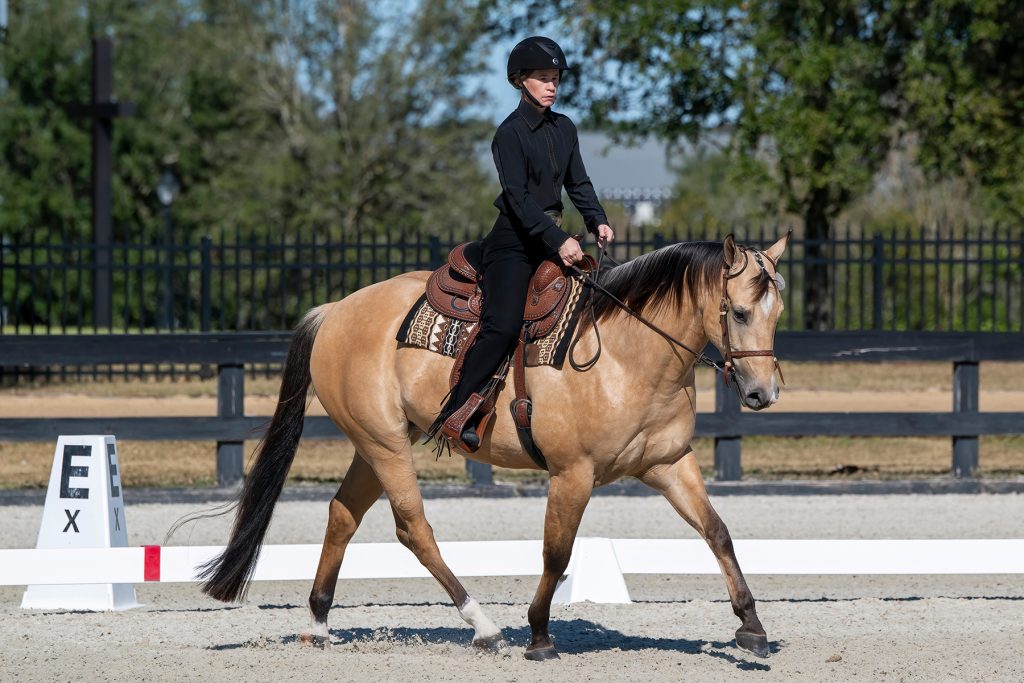
Before she was a USEF ‘R’ Western Dressage judge, four-time AQHA World Championship judge, 14-time Western Dressage World Champion, 34-time AQHA World and Reserve World Champion, and four-time AQHA Superhorse titlist (Skip’s Sierra Nick, Rugged Lark, The Lark Ascending), Lynn Palm of Ocala, Florida was just a kid showing the horses she loved, “rat tails and all,” in local and 4-H rings. Back then, she says, dressing up a sparse tail never entered her or anyone else’s mind.
Then came the 1980s and the first rudimentary tail additions. Palm tells The Plaid Horse, “They had a leather loop at the top to braid it in. It added zero weight. It was just ‘more tail’ to the tail.”
Adding weight came later, when riders discovered an advantage beyond cosmetic enhancement.
“The only reason they started adding weights to fake tails was to stop the swishing,” Palm says. Because a swishing tail may transmit to a judge an unflattering message of stress or resistance and in the 1990s, that ruefully led to a nerving process euphemistically called “tail blocking” that temporarily paralyzed a horse’s muscles around its tail.
By 2012, AQHA legalized weighted tails and tail extensions, and the “big tail look” started showing up in hunter and western pleasure classes. Today, false tails can weigh from a half-pound to two pounds (plus the customizable four-ounce to one-pound allowances within the AQHA Rules weight system).
“It’s a touchy subject, period,” Palm says. “For folks trying to fi t in with the competition it’s hard not to use one. Nearly every stock horse breed and a lot of USEF and USDF classes allow them. Done right, it enhances the beauty of a horse’s hindquarters.”
But when everyone goes bigger and better, “done right” can get overdone.
“Too much or too heavy a tail compromises spine health,” says Palm. “A false tail takes away from a horse’s movement because it compromises communication and balance. When a horse has to struggle to find its balance it can’t perform well. That starts a vicious circle of more weight, harder work and poorer performance.”
“So if a weighted tail becomes a detriment to the horse, makes it struggle to balance and perform, or is impacting spinal health then it’s a ‘No’ from me.”
Weighty Demands
For two decades, one of the world’s chief suppliers of natural mane and tail horsehair has been Yibai Horsehair Supply in China’s Hebei Province. Its output of horsehair— sourced from Mongolia and exported to Asia, Europe and North America for stringed instruments and fabric padding, as well as custom cut and colored hair for horse accessories including tail extensions—adds up to about nine tons a year.
“We often export horsehair to the United States,” says Yibai representative, Helen Lu. Orders since the start of 2025 and new American administration have been on the rise.
“Right after Trump’s election, many customers placed orders hoping to purchase a batch of goods before the tariffs took effect. The entire month of January was our busiest in 25 years.”
“Many customers are companies that do this kind of service [horsehair tails] but our customers are also professional equestrians engaged in show horses and racing services. We did sell a lot of long (40” and above) horsetails in the past year, many of which are used to make extensions and fake tails,” Lu adds.
“Our customers usually require white horsetail hair which is natural and realistic. White horsetail hairs, all natural, are very rare and precious. We can fade black tail hair to white with some processing, but it would be too fake.”
The Color of Money
“Tail extensions have been allowed in the stock horse industry since 1997,” says Barb Delf, who launched Custom Tails in-stock and custom tail hair service in 1999 and today offers over 20 in-stock tail color options, custom blends hair and specializes in hard-to-match tails.
“Demand has grown every year. In the stock horse industry, with hunters and, most recently, in the dressage world,” she says.
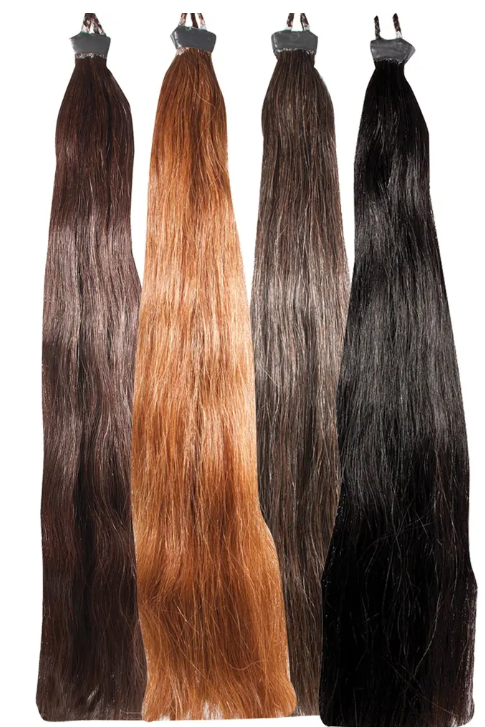
Custom Tail extensions range from $110 to $865 and offers choices in top attachments (braider’s choice single loop, double loop, or tie) and fullness/hair amount, weighing from three-quarters of a pound, progressively up to two pounds. And sure enough, blondes have more fun.
The most valuable custom tail extensions, measuring 30” to 43” long with blunt or tapered bottoms, come in white, silver, yellow and/or blonde color, starting at $200 to $760 for White Flaxen tail extensions up to $245 to $865 for Silver White.
Despite the value of some white tails equaling a car payment, Delf has never heard of nor experienced any thefts or a ‘shadow market’ for such extensions. “We have not been approached by sellers with questionable products [but] have been approached by folks who would like to sell their horse’s long tail hair to us. But since we buy tail hair in large quantities, the purchase of individual tails is not something we do.”
At Schneider’s Saddlery, now in its 76th year, vice president of merchandising Dana Palzkill says it has been offering extensions from 100% natural horsehair for several years, and the product performs well.
“There has been a slight increase since COVID (2020) consistent with normal category growth rates. White tails are harder to source and match, due to so many shades of white. Price depends on design complexity, material quality, and customization. Generally, more basic false tails start in the $100+ range, while premium, hand-crafted, custom options go for up to $350+, reflecting the artistry involved and use of ethically-sourced materials.”
Palzkill added, “Although Schneider’s has never experienced theft on our end, we’re aware that the scarcity of these natural hues can make them a target for those looking to cut corners. We encourage buyers and sellers to stay informed about proper sourcing practices and to support ethical providers.”
Being horsehair-adjacent was all it took for Ruthann Smith, professional braider and founder of Lucky Braids Hair & Skin, to receive a solicitation from Anping County Lijin Horse Hair Product Factory in China inquiring if it might supply her with horsetail extensions of “good quality and best price.”
“Once I spoke to a seller I was appalled,” says the mane and tail care expert, “imagining the life of horses with no tails. She assured me they grow back—if I’m not mistaken—in a year, and no harm is done. Well, I’d like to see images.”
“I have no idea if people buy from these sources, only that they found me. I don’t make tails. But what I think is crazy is when people try to match a stained tail instead of getting a tail snowy white first. To me, integral to the discussion of fake tails is how it’s possible to get a big, flowing tail naturally on almost any horse.”
The Ick Factor
Ethical is a heavy word not lightly thrown. Natural horsetails have to come from somewhere even when they seem to appear nowhere.
We asked Amy Dill, executive director with the Western & English Sales Association (WESA), providers of the world’s largest trade events for equestrian retailers and manufacturers, if the January WESA Trade Show in Dallas, TX, had false tails among its annual assembly of more than 550 product lines and 3,700 retailers. The trade show, she says, “unfortunately did not have any exhibitors with this product nor statistics to offer.”
Delf, who sets a booth up at the All America Quarter Horse Congress in Ohio, is candid. “The tail hair comes from deceased horses. We purchase the tail hair in bulk from a wholesale company in Asia. The tail hair is purchased from all around the world and is then cleaned and sorted according to color and length.”
At Schneider’s, Palzkill says strict sourcing protocols and a transparent supply chain counterbalance any under-the-table trade, as well as advocacy for industry-wide standards that protect both the animals and integrity of the craft.
“Because the United States does not have a tradition of equine tail slaughter, our natural tails are sourced from long-established, ethically regulated suppliers where tails are a byproduct of horses that have been humanely retired or passed away due to natural causes. Relationships with suppliers are built over years of networking and industry events that emphasize responsible animal husbandry.
Palzkill adds, “Being a horse lover, I think it is wonderful when beautiful tails live on, as each and every one of those horses were special.”
Andrea Dixon, who chose last June to invest a decade of horsemanship experience, including showing AQHA, into launching Equine Banding and Braiding by Andrea Dixon says, “I use trusted sources.” Schneider’s tails come from horses that have passed.
“The most expensive and hardest to color match are palomino tails. They can vary in color and some black or grey throughout the tail. I’ve seen one online for $480,” says Dixon, who has seen demand for false tails grow. “Now, people add hair into forelocks for a fuller look. Wish I’d thought of that! I’ve only seen that technique in halter, showmanship and western pleasure classes.”
Ready, Set, Show
Smith, like Palm, feels the line for false tails needs to be drawn at performance.
At least two top hunter barns Smith knows of use a “tiny bit” of hair in their fake tails, “Just a little, to round out the look of the hind end.” Because, as another barn manager declared as they passed a colorful string of them along a tack room wall, “We love our tails.”
Smith asks, “It’s just, what’s really happening? Where is the line? When a horse is going and the tail is getting caught between the legs, we have hit a point of diminishing return. It’s unnatural and, to me, unfortunate.”
“There has been some controversy about weighted tails,” says Dixon. “Some argue that it is cruel to put in a heavier tail since the weight is based on just a thin section of tail that is braided into the fake tail head. I personally haven’t seen a horse bothered by it but I have seen a few step on them and that has been tragic.”
It doesn’t have to be that way. A good tail, applied conscientiously, can enjoy as long a life as a good horse’s legacy. Palm intends to resurrect a light, thin horsetail formerly used on her FEI World Cup Finals horse Rugged Painted Lark (aka Bruce), on a new five-year-old AQHA gelding, Sand N My Botz, she has in training.
“It feels like good luck,” she says, recalling her tobiano partner laid to rest in 2022. “It feels kind of special.”