By BETSY LABELLE
The best trainer I ever had was an amateur-owner mentor whose mindset encompassed a daily dedication to horse and rider development. She opened a portal for me to reach an ‘aha’ moment; It was that one experience we all find with a horse to see, feel, and find a positive way forward—a program to strive for what works—finding our vision and direction.
Louise Otten, known as Weezer, was the mother of my step-siblings. I grew up in a bubble of extended family, friends, and a community involving horses. My stepfamily was always larger than life in my mind.
By the time I was nine, our family operated in two separate six-month timelines. My three step-siblings, all of similar ages to my brother and me, spent six months living with their mom, Weezer. The other six months, they lived with our dad and my mom.
Our house included a four-stall backyard barn of fox hunters; we’re talking comfy sofa chair-type draft crosses, a hodge podge of Thoroughbreds, Pintos, Appaloosas, and whatever landed there for the summer and fall Minnesota foxhunting season.
Only two miles away, Weezer owned Alpine Farms–where my three step-siblings lived half the year. It was a hunter/jumper farm in a huge red building with stalls on both sides of the vast indoor arena.
Often, I would go with my mom or stepdad to pick up my siblings at Alpine Farms, wander around, and watch what I could watch.
As soon as you entered the building’s door and walked through the small hallway, familiar faces greeted you with a grin. Everyone there was glad to greet you as they rustled through tack trunks to change some equipment for their next ride.
The air was mostly of clean, fresh shavings, yet a musty, true-to-only Alpine smell sometimes met you when entering one side of the barn aisles. The creaky door’s spring screeched when pushed open, and the spring thumped back into a shut position once you walked through.
Two stories of lounges overlooked the indoor area. On the first floor, tack trunks were packed in a maze and a wall rotary phone seemed to ring as if possessed with parents wanting to connect with someone, anyone in the barn, wondering if their daughters or sons would ever want to be picked up for dinner, or what time to drive over, or how to arrange a carpool. It was long before cell phones.
One could sit on a trunk and watch real things be accomplished between the horses and riders developing in that arena. Alpine had a program, something to work for, and everyone strived for outstanding foundation-building balance and rhythm exercises. My older sister and youngest brother began their indoor equitation preparations for the Medal and Maclay Finals at around fourteen or fifteen.
Every day, like clockwork, their mom was on a tight schedule to get all their string of horses out. Each horse had a routine, and the daily schedule always revolved around motoring from one horse to the next like a smooth wheel.
I was always in awe of the simple exercises she and my siblings did in the arena. The exercises were always basic, like two poles on the ground or a line of two jumps with a certain number of strides between them.
Every few months or so, Leslie Burr-Howard would come to teach my brother and sister for a few days. I remember watching her give them an exercise for their horses that included counting out strides over poles with a simple change and a counter-canter. Every exercise was something to master; the simpler, the more difficult.
One day, my sister said at the kitchen table on a Saturday morning, “Get your riding gear on; we have too many horses. My mom asked if you would like to come over and ride a horse.”
“Are you kidding?” I replied. “Are you serious? Me? She wants me to ride one of her horses?” I fumbled the words out.
“Yep, let’s go.” And off we went in a parents’ car, fresh with her new driver’s license—me with my semi-off-color breeches, helmet, and gloves, trying to look proper enough.
I was in awe for the next hour as I rode this beautiful brown warmblood with perfect balance around the ring at a walk, trot, and canter. I fit in perfectly with the smooth, harmonious ease of knowing where I was in spacing with others in the indoor. It was epic.
Once you have that feeling that connects harmony and balance with a horse to your body, you cannot undo it, and you can’t get it out of your mind. Once you can feel what you can do, you can dream for it, manifest it, search for it, and find a program to work for that balanced connection. In essence, I was hooked on that strength and balance. The horse had developed muscles within each side of its body over time, and I wanted to help my horse have that from that moment forward. I was so amazed by Weezer’s horse’s strength, balance, and collection—that was a total eye-opener for me.
Listening to and watching Weezer, my sister, and my brother over the years was life-changing. Their horses’ energy mirrored their own. Together, they were a team, with the horses’ biomechanics working smoothly and effortlessly over the fences. My siblings knew how to move up if they had a long first-line jump or to slow down if the horse jumped too close to the first fence in the line. They counter-cantered and did simple changes through the canter that looked invisible, as if they were telepathically telling the horse what to do.
The equitation program included learning intuition (inner mindset) over ego—the inner thoughts being the challenge over the outer praise or acknowledgment. Focusing on their internal self, not comparison or the outer world, was a lesson.
My siblings began to incorporate a daily lesson of mind-centering exercises because when you only had two minutes in the ring and there were a hundred others in your class, a rider must be open, trusting, and trained to see and know themselves. In the ring, a rider must surrender a piece of themselves to their coach, trust 100%, and neutralize their inner voice to hear their intuition’s guidance on rhythm and striding.
Equitation is a sport of inner growth, and even though riders are constantly compared in the hunter or equitation ring, the basics have to be established in some way. Quieting the inner mind chatter and the mindset must be understood to get there. If you do not win, that is okay; you are being set up for long-term success in the arena and the general world, including the corporate scene or with a family, for a life of inner growth.
Your worth as a human being is not measured by external factors. You are valuable just because you exist. The mountain to climb is you, your self-mastery over yourself.
Weezer’s leadership and high standards over the stables helped day-to-day horses and riders develop for the big equitation classes. As a teenager, I attended a Maryland boarding school and constantly followed where my siblings were showing: Harrisburg, Devon, or Washington International. I would drive to meet them and join the cheering squad. I was always welcome and always in awe.
Whenever I returned for a vacation to Minnesota for a visit with my parents, I first went to Alpine to see how everything was taking shape over there. There was always some new challenge for a sibling, with one brother (not one of the two equitation riders) spending time training and driving a pair of grey horses with a combined driving carriage for the local cross-country competitions. The two horses were inseparable. My brother once asked if I could hose off the legs of one of the horses. I went to walk his horse to the main barn shower stall, and it suddenly stopped, never having been apart from the other carriage horse–I remember my brother laughing at me and saying, “Oh, I forgot to tell you that they can’t be separated. Wait for me; I’ll bring the other.”
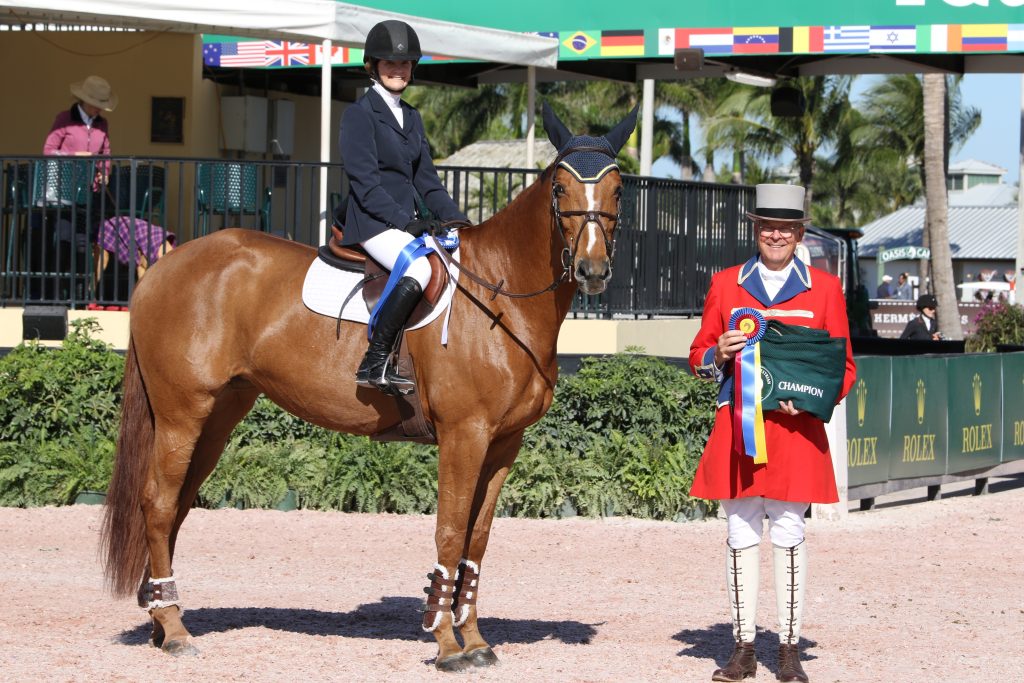
Later in life, as a PR writer and magazine article writer in Wellington, primarily for dressage, I had to interview a show-jumping official one Sunday morning in 2018. I saw Weezer looking at the order of go chart, dressed up and ready to ride. It was like seeing a familiar celebrity in action, and I was excited to cheer for her. She was riding in a large fences amateur jumper class. I watched all the rides that Sunday; it was surreal to watch rider after rider make a mistake after mistake. Then Weezer entered, making the entire round look effortless, mistake-free, and beautiful.
I praised and celebrated her, blurting something silly: “Weezer, you were by far the best rider in that class.” I don’t know why I should have been surprised, perhaps because it was in the big stadium ring in Wellington, and I was so in awe.
In her excellent, humble way, as always, she said, “Yep, I know.”
Of course, I should have known she would be amazing to watch because I watched, listened, and questioned my siblings thousands of times growing up about what they were working on with their horses and what they were struggling with. I had forgotten how amazing their mom’s mindset, inner control, intuition, and balance were as an athlete, a preparation mastermind, and the master of horse biomechanics over fences.
At that time, as a PR writer in the horse world, I noticed two different mindsets an equestrian athlete could adopt. Each athlete has to make a mindset choice somewhere on their journey. Either they take the easier outside-of-themselves mindset and take the short-term outer praise–the it’s all about me mindset–or be the other type of athlete who humbles their inner self, knowing they have yet another horse to figure out–a for-the-horse type mindset.
I often saw a first-time winning athlete during press conferences say, “I’m going to be the best in the world.” They had a mindset of ‘I’m on top of the world,’ with outward expectations because they had ‘made it.’ Often, those who said these statements never returned with another top horse; of course, we never published these statements. But it frequently made me pause.
Weezer inspired what would serve the horse from its point of view. Asking “How can the human body and mind balance a horse to strengthen its mind and muscles first?” Not asking “What am I going to do to my horse today for me?” Never me first, them first. How is the horse seeing the world? How are they feeling as an athlete?
Her achievement with each horse is from inward, humbling growth. The sport of working with horses is about the development of the human being, body, mind, and soul. I am forever grateful for all the life lessons, especially learning that thoughts of comparison mean nothing, and of how to put the horse and a quiet mindset first.
Louise Otten now lives in Ocala and continues to develop horses and inspire us all.
This was a submission to the 2024 Equestrian Voices Creative Writing Contest sponsored by The Plaid Horse. The goal of the contest is to promote fine, literary prose involving horses and the equestrian experience. This contest is open to writers of fiction and non-fiction, regardless of any previous publications, and awards 16 prizes. To learn more about the 2024 contest click here.