By MARLEY LIEN-GONZALEZ
Unlike most products people sell, Holly Johnson hopes hers is never used. The founder of FireHorse Rescue Kits, Johnson specifically designed each to combat barn fire risk and escape fire emergencies when horses are involved–and ideally sit on the shelf forever.
In the same way that firefighters wish for uneventful workdays, Johnson wants FireHorse Rescue Kits to serve as peace of mind for equestrians and a symbol of re safety awareness rather than be used as the life-saving instrument it is.
When FireHorse Rescue Kits are called to action, they’re fully equipped with elements carefully designed for barns by a horse professional in collaboration with real firefighters. The kits fortify barn safety and guard over equine lives when faced with unpredictable crises. While many have fire safety in their home barns, the kit allows easy portability on the road and extends access to life-saving tools when in unfamiliar places.
A Lifetime of Protection
FireHorse Rescue Kits are in a market of their own–bridging a gap between emergency responders and horse knowledge. Johnson says, “Most firefighters are not horse people. They don’t know anything about horses or have the training to handle them.”
A disconnect that was a problem, Johnson realized, when Johnson brought FireHorse’s co-founder, a re department Battalion Chief with more than 20 years of experience, to the barn for the first time and the fire risks immediately jumped out at him. From fans running to thousands of pounds of ammable materials stored in open air, his natural response to add more fire safety to the barn gave birth to the Rescue Kit.
“Ryan lives in Wellington full time, so he knows how hot it gets, especially in summer, but the fans really threw him off. When fans run 24/7, it’s a huge imposition on the electrical circuits, meaning there’s a fire risk,” Johnson explains.
Coupled with the fact that flammable materials like hay are being stored, a barn is a firefighter’s worst nightmare. Factor in that horses don’t always follow the plan, and barn fire rescue could unfold as a disaster.
FireHorse Rescue Kits is establishing programs to help train firefighters on what to do when horses get stuck–with the eventual goal of holding seminars as well–grounding a legacy of informedness in areas densely populated with horse farms.
For those who keep horses in more rural areas, who might not get an emergency response as quickly as somewhere like Wellington might, the FireHorse Rescue Kit is designed for ease of use–for anyone to be able to get their horses out of danger.
“You should call the re department as soon as possible, but you don’t always have the luxury of waiting for them,” Johnson says. “FireHorse Rescue Kits can help you evacuate your horses and put out a fire that just started. Sometimes, the only person in the barn might be over 60 or a child, and maybe they can’t operate a re extinguisher. Our two extinguishers in the kit are like hairspray cans; they’re super easy to use–point and shoot–and lightweight, single-use cans that are easily replaced.”
Together with Nemesek, Johnson anticipated everything that could go into the kits to make the best outcomes possible–addressing what barns might not have on hand or in a functioning condition. The contents of the FireHorse Rescue Kit are sealed against the elements by its resilient case, promising customers close to a lifetime warranty. Says Johnson, “There’s no chance of you opening the kit and not having the tools you need.”
All In One Place
Crafted in the USA, the FireHorse Rescue Kit is thoughtfully laid out with items to extinguish small flames and remove and secure horses. “Our goal was to make a multifaceted kit that addressed several threats, whether it be preparedness for the worst case scenario, to putting out a fire, or then after the fire, being able to manage the horses, especially if you don’t have a structure anymore,” says Johnson.
The FireHorse Rescue Kit case is impact-resistant and very sturdy. Johnson says, “It has custom-cut foam inside for every piece, so there’s little intrusion for dust or water. Wind and rain don’t pose any issue.”
Inside the kit, two fire extinguisher cans are right on the top for easy access. There’s a 2000-lumen smoke ashlight that pierces even thick smog at nighttime, a hay thermometer that goes up to 220 degrees Fahrenheit (when reached, you’d need to call the re department), and an industrial-strength glass breaker.
The innovative fire blanket can help put out small fires, and Johnson added fire gloves to touch hot metal. “There’s a story of one equestrian center, where people rushed to let horses out of their stalls but found the fire had melted or superheated the latches,” says Johnson. “Our gloves are designed to open stall doors or touch hot door handles and knobs.”
A tie line might be the most versatile tool in the kit–Johnson’s forethought is that it’s crucial to tie horses up in the absence of a structure or create a makeshift paddock to hold horses if fencing has been destroyed so they don’t run back into the barn or a more dangerous situation.
“We want to make sure barns have everything all in one place,” Johnson says.
Education and Outreach
When barns have experienced a fire, they usually rebuild with stronger fire safety skills. That doesn’t have to be the case, explains Johnson–anyone can place preventive measures and have a well-established contingency plan among staff. Tragedy doesn’t have to strike before you prepare for it.
Johnson is planning to release an educational book about barn fires and how to prepare. She lists staff training, practicing fire drills, and planning evacuation routes as helpful options to lay the groundwork for an emergency but stresses that one of the most important things you can do is reach out to your local fire department.
“One great thing to do is to call your local re department on the non-emergency line. They can come out and give you what’s usually a free evaluation–analyze your fire risk, make sure you’re storing your hay correctly, and things like that.”
Johnson is currently focused on spreading awareness and outreach to the community. Inspired by how the equine community came together during the California wildfires, FireHorse Rescue Kits donated $100 from every kit sale starting in January 2025 to the people devastated by the natural disaster.
Their partner facility, the Los Angeles Equestrian Center, took in horses and livestock who sought refuge. Since Johnson sent them a kit, the LA Equestrian Center has strongly advocated for FireHorse Rescue Kits and for spreading fire safety awareness.
Across the country, other showgrounds have adopted FireHorse Rescue Kits as their Official Rescue Kits–”We’re not disparaging anything that these facilities are already doing for fire safety, but we’re bringing that next level security and preparedness,” says Johnson.
Wellington International is one, and their staff and night-check teams can quickly locate and are familiar with the kits. At the Kentucky Horse Park, FireHorse Safety Kits hang in the Mounted Police barn and stables with up to 70 horses living in them.
“The Kentucky Horse Park is a state-run facility,” says Johnson, “They don’t take just any sponsor. They have to have a good reason behind it, and they were open to the idea of our kit. It’s been exciting to have a chance to work with them.”
The kit is an investment with the promise to perform up to the power. “We’re just a startup now, but we’re hoping to make FireHorse Rescue Kits more affordable for everyone down the road,” says Johnson.
She’s already working on expanding the product line–on one hand, in partnership with vet clinics and pharmacies to get life-saving medication in the case of an emergency colic, and on the other, making a compact FireHorse Rescue Kit for small barns with just a handful of horses. Johnson says, “We’re pushing hard on the educational side and working to hit every need.”
Being the first rescue kit to emerge in the horse industry, FireHorse Rescue Kits have endless possibilities to evolve–keeping people, barns, and, most importantly, horses as safe and informed as possible.
Says Johnson, “When you equip your barn with a FireHorse Rescue Kit, you feel more safe seeing our logo in the breezeway, the tack room, or wherever you’re putting them up. In the event of a fire, you know exactly where to go, and exactly what to do.”
What’s Inside:
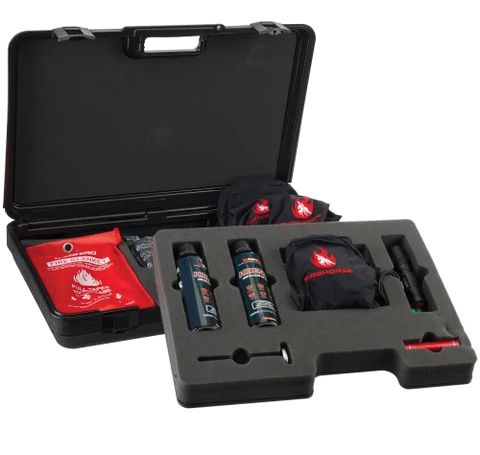
Handheld Extinguishers: Each kit includes two (2) easy-to-use, point & spray extinguishers for small fires, especially hay, shavings, or feed room flames. An excellent alternative to more cumbersome, full-size extinguishers, these also require less maintenance and will be readily available in the case.
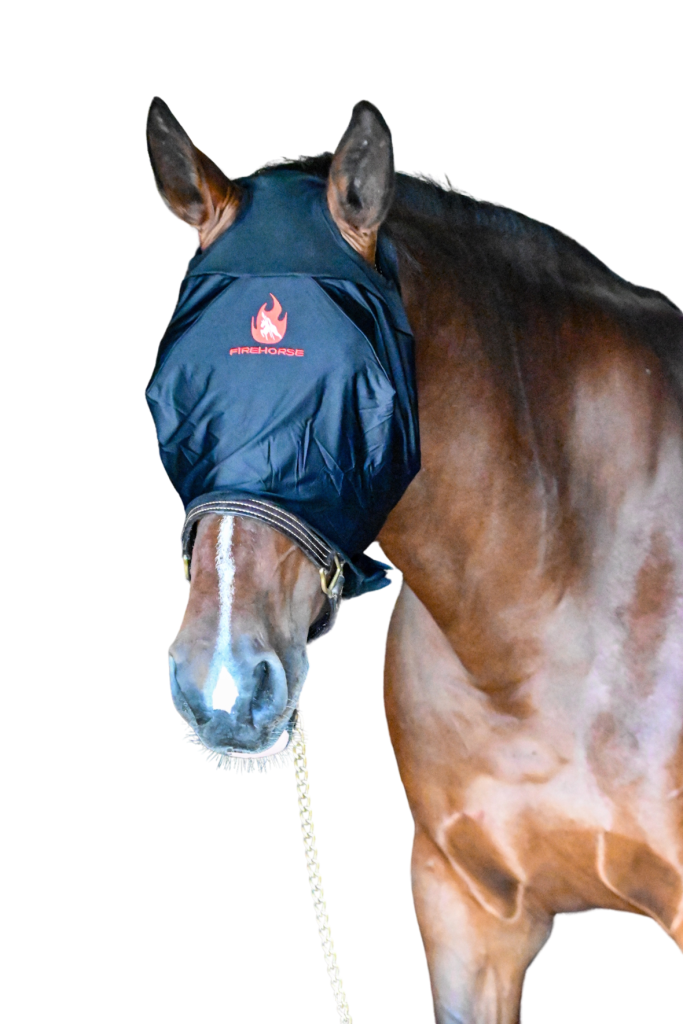
Firehorse Equine blindfolds: Specially designed for our Rescue Kits and found nowhere else, these horse blindfolds wear like a y mask and restrict the horse’s vision up to 80%. These blindfolds are intended to allow equestrians or first responders to remove animals safely and reduce injury risk and panic by removing visual stimulation. Velcro closure, 5 per case.
Fire Gloves: Heat resistant to 1472 degrees and flame retardant, these gloves are made of a mix of breathable cotton knitting and double-layered rubber with silicone for grip and fire resistance. One pair per kit.
2000 Lumens Flashlight: Whether piercing smoke or darkness, this handheld light is easy to operate and lightweight. Constructed of high-quality aluminum alloy and reinforced for exceptional water resistance in inclement weather, this light will shine bright in all conditions. Powered by 4 AAA batteries (included). One per kit.
Fire Blanket: Industry standard safety tool rarely found in barns! These blankets provide easy and safe fire suppression when water or
water-based extinguishers aren’t an option (i.e. for electrical res). One per kit.
Hay Thermometer: Stored bales have been known to catch fire spontaneously, especially in exceptionally humid conditions. A hay thermometer is a great tool to monitor at-risk bales. This thermometer is constructed of stainless steel, measures between 0-220 degrees, and provides a simple, effective way to check if bales are heating up. Any bales measuring over 175 degrees are at risk, with anything over 200 reason to call the Fire Department. One per kit.
Handheld glass breaker: This handheld glass breaker features a built-in, high-pressure spring that is operated by a single finger pressing the button to shatter window glass quickly and easily. It also has a U-shaped, stainless steel knife edge, which is safe to touch but will easily cut through fabric. One per kit.
Rescue Rope: This 32’, 1/3 inch rope is composed of nylon rope skin and an inner core designed for durability and lower static elongation, meaning it won’t stretch or fray. Stainless steel thimbles are reinforced at each end with easy-to-use, secure snaps. One per kit.
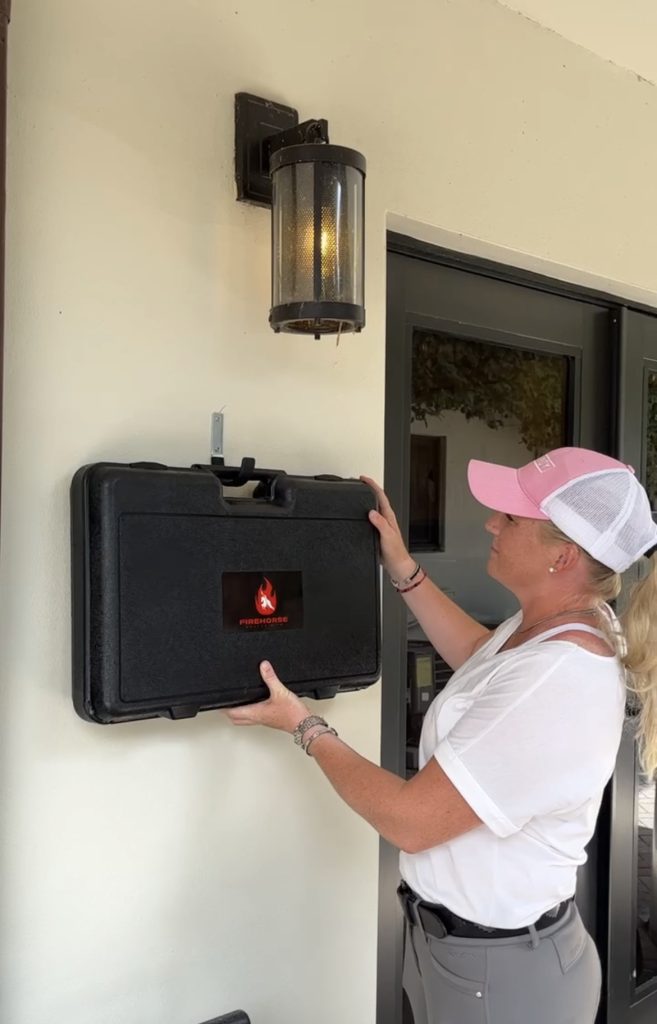
Heavy Duty Hook: Each kit includes a rubber-lined steel hook rated to hold up to 50 lbs and the hardware to mount it. Intended to be highly visible and in an easily accessed part of the barn, use this hook to secure your kit so everyone knows exactly where to go in the event of an emergency. One per kit.”