
Brought to you by The Plaidcast
For many junior riders, the equitation ring can feel like the pinnacle of their youth careers. With high-pressure finals, technical tests, and polished presentations, it demands focus and dedication. But for riders like Baylee McKeever, equitation was the beginning. Now a senior at Auburn University and a rising Grand Prix competitor, Baylee credits her foundation in equitation with preparing her for the highest levels of the sport, both mentally and technically.
A Strong Foundation for Bigger Goals
Baylee competed extensively in equitation as a junior, earning a top-10 finish at the Washington Equitation Finals. She believes the discipline instills essential skills that carry over to the jumper ring. “I think the equitation is really good for building up to bigger events and other aspects of show jumping,” she said. “They really give the rider the strong base to what’s later on to come down the road.”
In particular, she emphasized the value of the “top four” testing format. “I think that’s a great way to start putting pressure on young riders,” she explained. “It doesn’t have to be like make or break, but I think it’s like a slight amount of pressure… you feel nervous, but then you learn how to comprehend that and work from that.”
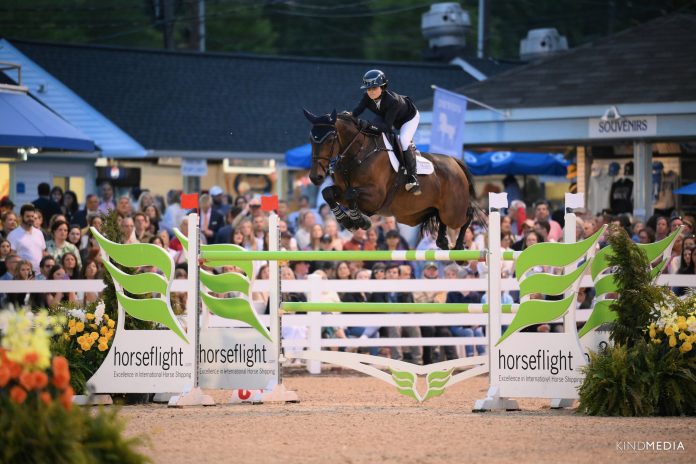
These early lessons in pressure management laid the groundwork for Baylee’s ability to deliver in high-stakes environments like the U25 Grand Prix or the Sapphire Grand Prix of Devon.
Rethinking the Pressure
While the equitation ring is often viewed as a requirement on the way to professional competition, Baylee acknowledges that the pressure surrounding it can become overwhelming. “I think a lot of riders put themselves in a high-pressure situation like the equitation is end all, be all,” she commented.
That mindset, she explained, can be limiting. “If you’re able to just realize there’s more to come after that, and that’s not the end of your career… because I feel like that’s what I said to myself. I was like, this is what it must be like, the expectation of everything. But there’s so much more other than that.”
Now competing successfully in international classes, Baylee sees the equitation years as one piece of a much longer path, and encourages young riders to keep perspective on their progress.
Watching and Learning from the Best
In addition to her formal training, Baylee has spent her life learning by observing. Growing up around McLain Ward and Castle Hill Farm gave her insight into how the sport is analyzed at the highest level. “Whenever you ride a horse, you can take something away,” she said. But she also emphasized the value of simply watching others ride. “I think when you watch, you can learn so much when you watch a horse versus getting on.”
Baylee makes a habit of studying the horses her teammates or competitors ride, noticing how different horses respond to certain situations. “Maybe if they’re drifting a certain way or if they’re weaker one side or if they look like they’re strong one side or if they’re a little flowy or if they’re looking at something,” she said. “I think growing up, being able to be around and watch the sport a lot… you can learn so much before you even get on the horse.”
The Small Details That Change Everything
One of Baylee’s most important takeaways from working with McLain has been the ability to recognize and act on extremely subtle details in course design. “McLain’s always paid attention to such small details,” she said. “Even if it’s like how a certain jump is set, if it’s a few inches closer one way, or if the timer’s a little further back to go this way instead of that way. He picks up on everything.”
She recalled watching rounds at Upperville where one element of a combination was shifted slightly, and how it made a major impact. “It was amazing to watch how many people had issues with that. They didn’t maybe pick up on it or plan for it well enough.”
These tiny factors—barely visible to the untrained eye—can separate the clear rounds from the four-fault ones at the top of the sport. Baylee shared that McLain even studies the grade of a ring to anticipate how a course will ride. “He’ll tell you about the crown of the ring and how the course designers will always set like a vertical there and how you kind of have to respect it more than other verticals.”
Applying It All in the Grand Prix Ring
Now competing at the highest levels with her horse Formidable (“Form”), Baylee applies everything she’s learned from equitation, observation, and mentorship to each new challenge. From choosing her lines to walking the course, she approaches competition with a careful eye and thoughtful plan. “I think he picks up on such small things,” she said of McLain, “and I think being around that my whole life has taught me a lot about things most people won’t notice.”
It’s that attention to detail, combined with a foundation of solid basics, that helps Baylee continue to rise in the sport. And it all started in the equitation ring.
To hear the full conversation with Baylee McKeever, listen to episode 439 of The Plaidcast. Subscribe and follow The Plaidcast on your favorite podcast platform to hear more inspiring stories from across the equestrian industry.