By MARLEY LIEN-GONZALEZ
Following a career in the business world understanding how to support and motivate people, lifelong equestrian Kaitlin Hendry decided to bring trait theory–the psychological science often used in corporate offices–to the horse barn.
She founded Equine Performance Identities, or EqPI, a uniquely formatted personality survey for owners, riders, and caretakers to deeply analyze and better recognize the needs of their four-legged partners.

Why Horses?
It was an experiment that brought Hendry’s keen eye for behavior patterns to the horse world; she was body clipping a horse for someone, and out of curiosity, started listing probable traits of the horse based on her short interaction with it. The owner and a friend stood by, shocked by the accuracy of her assessment.
Still working her full-time corporate job, though spending any spare time grooming or being around horses, Hendry decided to play around with designing a first-of-its-kind personality assessment for horses. Her trial run included over 300 profiles that tested her system, offered feedback, and showed an interest in this kind of knowledge.
Trait theory has always been an underlying human curiosity, but it wasn’t until the 20th century that it was adopted by the professional marketplace. As psychology became a larger tool in understanding employees and their work ethic, ambitious employers began to develop psychometric models to measure personality types, like the Myers-Briggs Type Indicator (MBTI), DISC Assessment, and more.
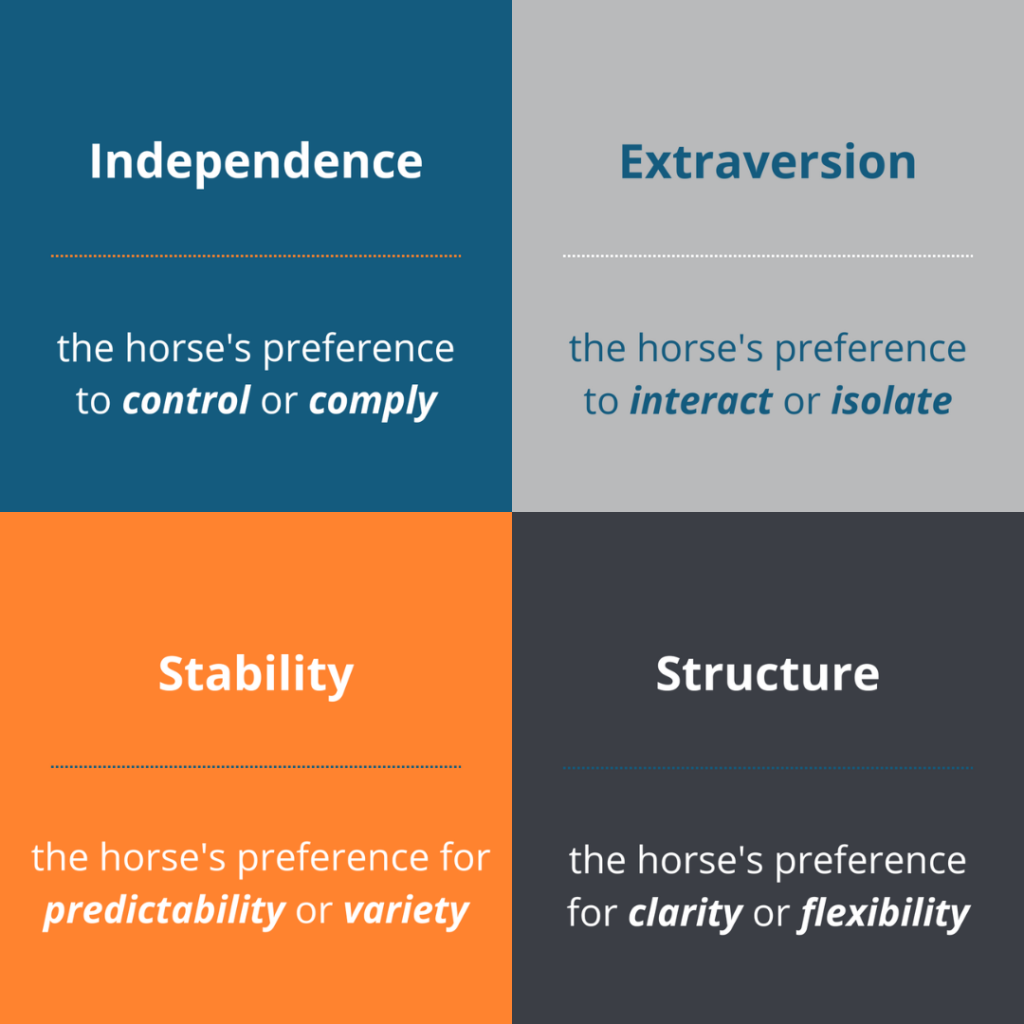
It was one of these models, the Predictive Index (PI), that Hendry was trained in. “My corporate experience in human resources was understanding what people were motivated by and how to support them in the ways that they needed. Do they need an agenda in advance, or do they prefer to just wing it? Are they more collaborative or do they prefer to do work more individually?” says Hendry.
“The science of trait theory already existed, I’m just applying it to horses,” she adds. “EqPI helps people understand how a personality impacts what a horse needs from their environment and how we can support them better to reduce stress, which reduces ulcers and injuries, as well as the risk of injury to grooms, trainers, farriers, and vets.
It’s also used for matching horses and riders for sales or leases, even lessons. There are so many different applications for EqPI to make sure that we’re setting horses up for success, and ultimately, for happiness, which is the goal.”
Helping Horses Communicate Their Needs
When horses get labeled, Hendry says those could be surface-level assumptions that put the horse and people around it in danger. Maybe they’re indicating pain somewhere, or tack not fitting, or ulcers. Too often, a horse’s behavior is consistently ignored, and they get characterized as being lazy, difficult, or stubborn, when in reality, those are symptoms of their needs not being met.
“Horses can’t speak words, so their behavior is a form of communication. If you look at the big picture of how all of their behaviors fit together, it can tell you what you’re missing and how to support your horse better,” says Hendry.
When using EqPI, equestrians are asked to name characteristics of their horse’s personality. It can feel like labeling, but where it differs is that the program is looking at trends across a number of characteristics. “Even if the horse is called lazy, EqPI is not using that term to dismiss that behavior; it’s using it to understand that behavior,” Hendry says.
Through her growing community of EqPI users, Hendry is finding more ways to help equestrians not only better understand their horses but also make the best choices for them going forward. On her podcast channel, Inside Equine Minds, Hendry talks to top equestrian athletes–including Laura Kraut, Anna Buffini, and John French–who’ve used EqPI on their horses and addresses questions like, “How do you account for your horse’s personality when you manage them at shows, prep them for shows, with any quirks that they have at home or when you’re riding them, and what techniques and tips do you find work well?”
EqPI’s services mirror Hendry’s desire for solution-based investigative problem-solving. The two main options for EqPI customers are the Equine Performance Identities Personality Profile–which is a comprehensive yet easy to read and understand behavioral summary of your horse’s personality–and a Horse Personality Consultation with Hendry herself for costumers who want to talk more, who have specific questions, or who are trying to work through a specific problem with their horse.
Always seeking to grow her innovative and versatile brand, Hendry is already planning an exciting future for EqPI. “I’m creating a new assessment, the EqPI 360 report, that would form a profile from multiple inputs–the trainer, the groom, the owner, whoever is involved–with the goal of mitigating individual bias, because you’re getting inputs from more than just one person,” says Hendry.
On a large scale, Hendry believes EqPI can help the equine world make more informed, ethical decisions on breeding, training, aptitude, and sales–all while the well-being of horses lies at the forefront of its mission.
In an industry where transparency isn’t always a strength, Hendry says, “As I’m evolving EqPI, I’m always thinking about how to help people with their horses and relay as much information back to them as possible.”
Learn more about EqPI and Founder Kaitlin Hendry at their website by clicking here.
Listen to the Inside Equine Minds Podcast by clicking here.
And be sure to follow EqPI on Social media: Facebook, Instagram, YouTube