Welcome to Trainer Tuesday! Each week we ask trainers a question and gather their answers for you. These trainers have a range of experience, backgrounds, and focus points of their programs, so the answers have as much variation as you would expect and also probably much more similarity.
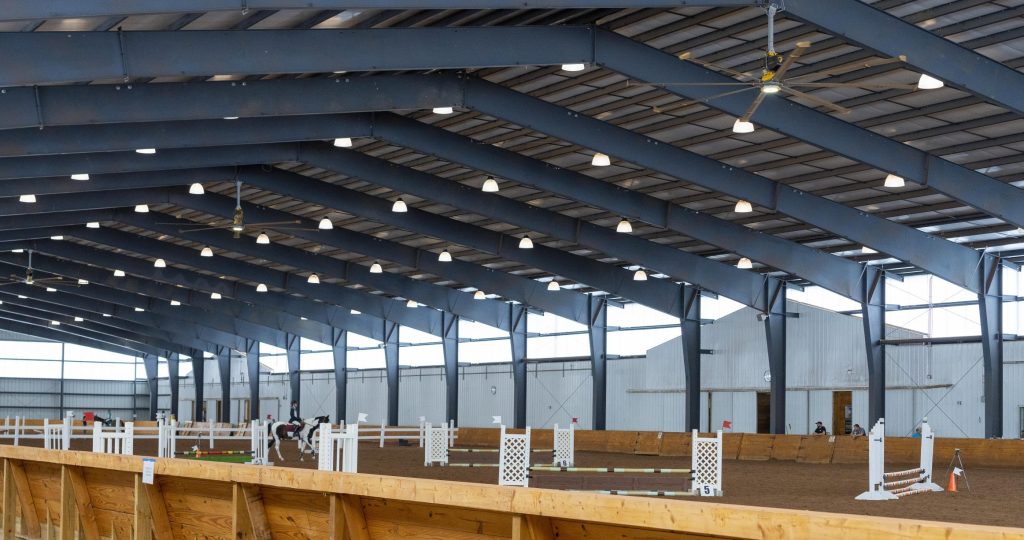
This week’s question posed is: What’s the biggest mistake you’ve seen riders make as they transition from riding and showing outdoors to being in indoor arenas, and how can they avoid it?
Here are their answers:
“My training focus, as I transition from outdoor to indoor riding, is on the inside leg to the outside rein. A rider’s contact is exposed as excellent or not, as the corners and questions come up faster. Look at the World Cup finals to understand the focus of contact on both a gallop and short stride, all while maintaining impulsion…that is the key, whether riding indoors or outside.
So I focus on exercises that improve rider balance and then horse balance, as the walls of an indoor tend to push a horse to the inside even more than their natural tendency.
A simpler answer would be riders are slow with their eyes, late to see, and then late communicating with their horse.” –Diane Carney
Read more from Diane and listen to her on The Plaidcast here.
“As riders transition from outdoor riding and showing to indoors, I feel that a common mistake is that we tend to forget that not all coursework is created equal. Riding an outdoor track is very different than riding an indoor track, and getting used to the difference is more than just setting up a simple course of lines and angles inside.
I like to spend the first month or two of indoor schooling working exclusively on grids. I want my horses and riders to remember how to adjust their balance, their eye, and their ability to rate corners and turns. Gymnastics, both poles and jumps, are a great way to readjust your eye to a different ring (smaller, spookier, etc). Grid work also helps your horse rock back and use their bodies more efficiently in a smaller space.
I always look forward to the first few weeks of cold weather in the Midwest, so I can refocus my riders on basics and foundation work too.” -Ariel Univer
Read more from Ariel here.
“Riders’ brains need to work faster when they are riding inside. Jumps come up faster than in a big outdoor ring. There is a lot that needs to be done before they get to the next jump or line–get a lead change, rebalance the canter, make sure they are on the right pace for the next part of the course, etc. And they need to do all of this in a short amount of time.
I do a lot of exercises at home that make my students think on the back side of the jump. Maybe a sit trot transition, circle, or something else. I work on getting their minds on the next part of the exercise over the jump. They can’t take 2 or 3 strides after the jump and then think about what they are supposed to be doing next. By then it’s too late! Especially in these technical equitation courses we see during the fall season.” -Johanna Hyyppa
Read more Trainer Tuesday responses from Johanna here.
“The biggest mistake I see riders make when they transition from outdoors to indoors is losing their pace and rhythm. Being enclosed makes them feel like they’re going faster, but really, they’re not, and then they lose what they have and the rhythm they need.
I always just tell students to keep going through the corner, ride through the corner, don’t back off as you come through a corner. Count a rhythm in your head or out loud, and if you hear yourself slow, then you’re making that common, easy mistake. Just keep going!” -Cara Wheeler
Read more from Cara here.