BY BERKELEY BARNHOLDEN
When it came time for me to move off ponies, my family and I started looking for my first horse. Searching for a horse without a huge budget can be hard. Like many others without bottomless pockets, I ended up with a “loveable weirdo.” In my opinion, these horses labelled “quirky” or “problematic” can be the most valuable—especially for juniors. They teach a young rider how to truly ride and persevere, even if it’s not always easy.
I was over the moon when my horse, the gorgeous bay gelding named Maverick, arrived at my barn. I was super grateful to be able to find a horse with experience that had been there and done that. Still, his experience didn’t mean he was the easiest. I discovered he was very crooked and hard to put together on the flat, something I was excited to work through with my new equine partner.
A year after we started our partnership, following a barn switch, we discovered that Maverick had EPM or equine protozoal myeloencephalitis, a neurological disease that affects the horse’s central nervous system. Maverick was known for being more than a little wiggly and sometimes playing giraffe with his neck, so the EPM diagnosis came with little surprise. We all hoped his treatment would mean that not only would he feel better, but that it would translate into him becoming a straighter and easier-to-put-together ride.
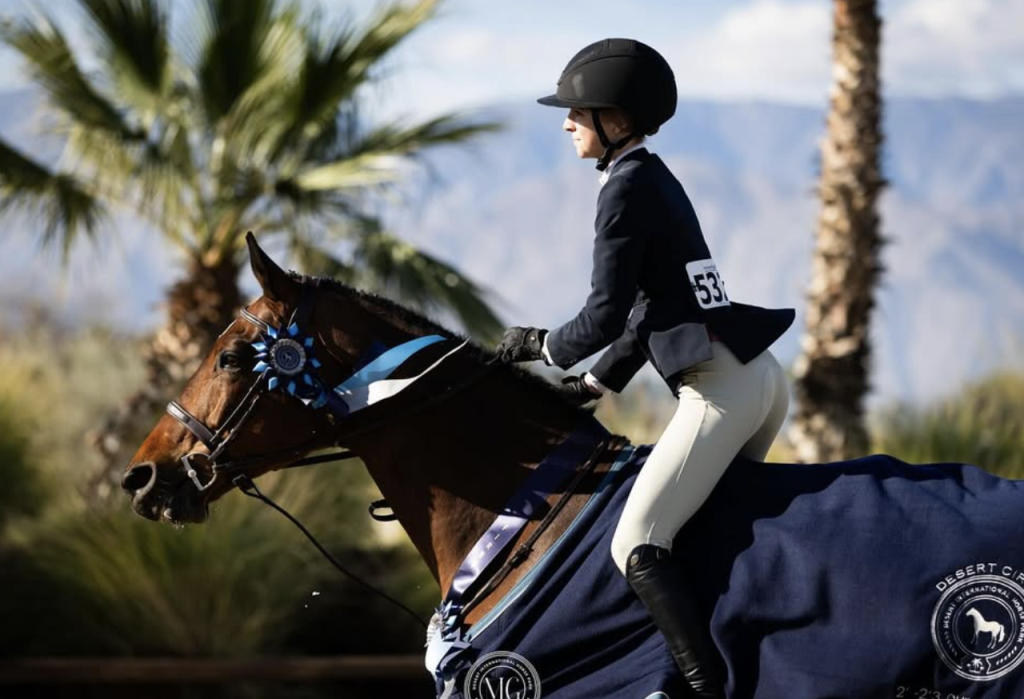
A month later, his treatment was done, and as I swung my leg over the saddle, I crossed my fingers that he would be feeling his best. I noticed immediately what a difference his treatment had on his gaits and straightness. Even though I still struggled with his frame, he felt like a completely new horse. Once we started jumping again, everything had been going well, and we were excited for the next show on the horizon, the Desert Horse Park.
During our two weeks in the desert, everything went well. We even won our first derby together, but something was bothering me. Maverick had refused out of a low class, something he’d never done. I pushed the worry to the back of my mind, blaming it on the distances or perhaps the fact that it had been our first time in the ring, and my bad show anxiety had kicked in.
So, for the rest of the early spring, we focused on preparing for our next show of the season, May Thunderbird, and I put my refusal worries out of my head. The show went well, and I hoped the success would continue on to our show in June. But that’s when our success streak was unfortunately over.
Warm-up day had gone so well, and we’d decided we were ready to show in the 2 ‘9. Of course, I was feeling my typical mix of excitement and fear. I’ve always had an irrational fear of oxers (and to be honest, any jump bigger than 2’6). So this, coupled with the crushing pressure I put on myself to perform well—not only for myself but to make the expense of shows “worth it”—didn’t have me feeling very confident as I walked into the ring.
The first few classes went well, and we found all our distances no problem. We entered the ring on the second day, and I found the distance a bit tight to the first fence, which was no problem for Maverick to jump, as the jumps were so small for him. But instead of adding leg, I leaned forward, praying he would jump it. Ah, the lean forward and pray technique… the way of a typical nervous rider who forgets how to ride in the show ring, is a universal experience for anxious riders!
Of course, to no one’s surprise but my own, he stopped. I tried to calm myself down and circled to jump it again. We finished the course, but that stop was engraved in my mind. The stop didn’t sit well with me, the ever-perfectionistic rider.
The rest of the show season went this way. I was so nervous to enter the ring, and my desperate attempts at coping included asking a million and one questions to my trainer and not being able to eat anything before I showed, even though my division often went late in the afternoon.
I knew that my rounds would either be amazing or horrible; I would either find all the distances and end up with top placings, or we would stop, and the round would end up worse than a dumpster fire. Maverick was smart. He knew I was too nervous in the ring to ride fiercely, so stopping became easier and easier for him, and my confidence level sank below sea level. So we decided it would be helpful to find another horse for me to ride and become more confident on, and my mom would take over the ride on Maverick.
As school started, I began trying horses, but none of them felt right. As I tried them, I found myself comparing them to Maverick. My loveable weirdo had set the standard pretty high. Even though he sometimes stopped, we had such a strong bond. I loved spending time in his stall, grooming him, taking funny pictures together or baking him horse cookies. When I was behind his ears, or heck, even in the vicinity of him, I felt the most at home. As cliché as it was, he truly was my best friend.
One day, I was trying a horse at my barn. We had him on trial for a week, and unsurprisingly, I wasn’t feeling very confident. We were having a jump school, and the horse was extremely lazy, so I applied pressure over a jump, a small crossrail, in hopes he would land more forward. Instead, he took off bucking across the ring. I was half-halting, but he still wouldn’t stop. So, I turned him into the wall, a foolproof way to get a bolting horse to stop, but instead of stopping, he dropped his shoulder and ducked the other way. I didn’t go with him; I went face-first into the arena wall.
I immediately jumped up to let everyone know I was okay, but I wasn’t. My helmet’s visor had snapped off completely, my whole face was swollen up, and my nose was bleeding, plus my arm was in so much pain. I tried walking over to the horse to grab his reins and stop him, but I could barely walk. The dizziness in my brain was persistent, and I felt like I was going to pass out. My trainer immediately grabbed the horse and told my mom I needed to go to the hospital, so we did.
While I was waiting in the hospital, sitting in my uncomfortable paper gown, I reflected on how much each ride truly meant. If I had fallen at a different angle, it could have been my neck taking the impact instead of my face, but what my reflection truly made me uncover was how grateful I was for my own horse. He may be quirky, but the most important thing is that I feel safe with him—safer than I’ve ever felt on another horse.
Sure, he stopped, but never in a mean way. Instead, he told me, “If you don’t want to jump that 100% why should I?” A lesson that inspires me to be confident not only for myself but for him. He needed me to assure him that he was doing the right thing. After all, horses aren’t the ones who came up with this silly idea of jumping over sticks. We did, and so it’s only fair we hold their hand and guide, not vice versa.
I carried this eye-opening lesson with me as I got on Maverick again after my fall. I finally told my coach about my fear of jumping higher, and we worked together to get me feeling more confident for the show season. Except this time, we were showing in the jumpers in hopes of alleviating the stress I associated with the perfectionism of the hunters.
As I reflect on this year’s show season, I’ve noticed so many changes in both Maverick and me. I’ve felt so much less pressure on myself to be perfect in the jumpers. It makes me able to be a more focused and stronger rider in the show ring, which has translated into stronger rounds with no stops. The growth I’ve noticed in myself, not only in my physical skill set as a rider but also in my mental skill set, is something I’m proud of.
If you don’t have the biggest budget, or even if you do, don’t be afraid to take on the horse with quirks. I’m not saying it’s the easiest path to take, because it’s not, but it’s the most rewarding. Remember, the ribbons don’t determine your success as a rider; your growth does, even if the path to success isn’t linear. Setbacks teach you the most. I believe that if I’d gotten the “easy” horse, I’d never be the confident and grown rider I am today.