
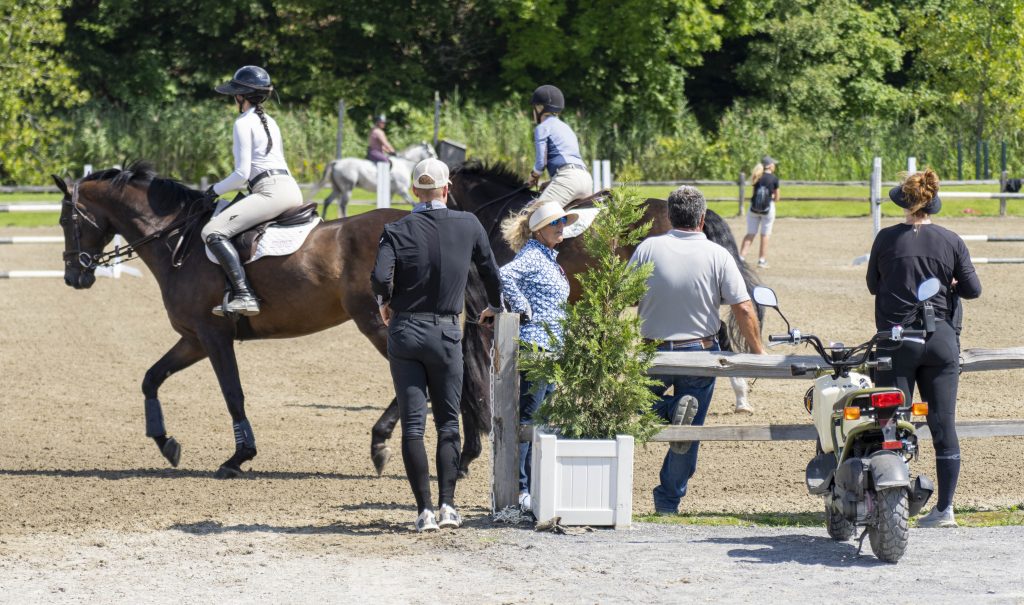
Welcome to Trainer Tuesday! Each week we ask trainers a question and gather their answers for you. These trainers have a range of experience, backgrounds, and focus points of their programs, so the answers have as much variation as you would expect and also probably much more similarity.
This week’s question posed is: If a rider doesn’t have quick reactivity, are there exercises in or out of the saddle that can help build their reflexes and response time?
Here are their answers:
“Reactivity and response time can absolutely be trained, and many riders work on this deliberately both in and out of the saddle. Reflexes aren’t just natural talent, they’re a mix of neuromuscular speed, balance, anticipation, and decision making.
For in the saddle …
1. Rapid Transitions & Gait Changes
Purpose: sharpen brain to body response.
Walk, halt, walk every 3–5 strides.
Trot, canter, trot on unpredictable cues.
Have a trainer/ parent/ friend call transitions randomly.
Focus on instant reaction, not perfection.
2. Unexpected Direction Changes
Purpose: improve split-second decision making
Ride a pattern where someone calls out “LEFT,” “RIGHT,” “HALT,” “CIRCLE” without warning
Practice rollbacks or turns off the rail on command.
This mimics moments like a horse drifting, spooking, or leaving long/short to a fence.
3. Poles With Variable Strides
Purpose: faster adjustments
Set ground poles and change the number of strides on the fly.
Example: ride 5 strides → adjust to 6 → then 4 strides.
Trains instinctive leg, seat, and hand reactions.
4. No-Stirrups With Quick Tasks
Purpose: quicker core engagement.
Drop stirrups and do:
Sudden halt → trot
Posting → sitting → two-point on command.
Forces faster balance correction without reliance on legs.
5. Jumping “Decision Lines”
Purpose: reaction under pressure.
Set 2–3 jumps and decide in the line mid-canter.
Trainer calls which jump you’re going to late. This simulates jump-off or equitation tests.
Out of the saddle exercises…
Reaction ball drills, balance boards, agility ladders for footwork (forward, lateral, crossover), juggling, ball toss, fast sit to stand drills, medicine ball throws.” –Becca Zimble
“I think understanding what reaction is needed at a given time is best helped by a constant attention to strengthening feel and sense of rhythm.
We use lots of exercises for this, many with pole work and cavaletti. Right now we have a normal 5 (stride) off a curve set to a shorter 2. Using this, we can practice trusting a continuing pace out of the turn to the 5 and how to plan your track and shorten to execute the 2 nicely. In the other direction, riders can practice patience and straightness to the 2 and how to flow up nicely to get the 5 accomplished well.
Little things like this over poles or very small obstacles can help riders respond more quickly to questions that arise on course.” – Claire Bangert
“In my opinion, reflexes and faster thinking come with time and doing it over and over again so your brain gets comfortable enough that it can think even faster than normal, only practice can help that.” –Dana Hart-Callanan
“I’ve had a problem of some riders not focusing ahead of the jump. Instead they look down at the jump while jumping. What I do is stand in front of them and have them focus on me letting them feel the horse go up and then they know to go forward in a two-point position.” – Pearl Running Deer
“I have one exercise that I love to do with our students to help sharpen their reaction time and focus. I’ll have my rider pick up a canter and I’ll call out random jumps. They must go to the next fence using the most direct path. The exercise starts out slow and then progressively gets more challenging as time goes on and everything starts to happen very quickly. It forces the rider to stay calm enough to hear my instructions while figuring out their plan and make adjustments if things start to fall apart. It can get frustrating but if you master an exercise like this, then nothing should feel overwhelming in the ring which will help make quicker reactions and hopefully better choices. –Caitlin Boyle
“An exercise I have found to be extremely effective for riders who tend to react late is setting up a simple seven-stride line. I begin by having riders jump the line smoothly in the intended seven strides several times so they can establish the feel of how the line rides. During this phase, riders are required to count the strides out loud, which helps increase awareness and timing. Once the rider can consistently ride the line in seven strides, I ask them to adjust the number of strides on each pass, typically six, seven, eight, and nine, while continuing to count aloud. This exercise requires the rider to respond promptly with their aids in order to achieve the correct striding. Riders quickly recognize how much more effective it is to apply leg or collect the horse immediately after landing from the first jump, rather than waiting until the third or fourth stride to react.
We also discuss how the quality of the approach and the distance to the first jump influences how the line rides. For example, if a rider enters the line from a slow pace or jumps in deep while planning to ride a forward six strides, they must apply significantly more leg pressure to achieve that result. Conversely, approaching the first jump with adequate pace and a forward, flowing distance makes riding the line in fewer strides far more achievable. This exercise helps reinforce the importance of early decision-making and strengthens the rider’s ability to respond effectively to what is occurring on course underneath them in the present moment.” –Alexandra Arute-Kacheris
“I’m going to come at this a bit differently. I talk often about riders being at first reactive. This being that something happens when riding or on the ground and they react.
Then riders move on to being parallel. This means as horse does something they respond at the same time.
Finally riders hopefully achieve being proactive. They know what’s going to happen and address it before it does. Proactive can be tricky, because it doesn’t give the horse the chance to do the right thing without intervention. That intervention can have unintended consequences. So being proactive before someone is ready to be is tough.
All this being said I think instinct and exposure will progress people through this the best.
Yet this conversation about reactive, parallel, and proactive often has to happen for people to be able to move from one to the next.” –Mark Aplin
“One exercise is working a line back and forth. I make the line a couple feet long, like a 5 or 6 stride with 2 extra feet. I have the rider gallop in to get the forward stride, then gallop in and add the step, back and forth. The rider has to react to go forward and immediately react to get the add.
Another exercise is working turns. I put four jumps across the ring in a line. Straight, angle, angle, straight. Jump turn, jump turn, etc. A bit like a serpentine. Start with big loops and bring them in as the rider gets quicker to recover and be organized.” –Joie Gatlin
“Of course you want to do this in a safe way under saddle, but adding quicker flat work or small jump patterns to keep focus and thinking ahead is great. I also encourage all of my riders to hit the gym and love exercises that involve both balance and movement. Catching while sitting on a bouncy ball or standing on a BOSU ball and doing exercises on there.” –Mackenzie Gwin
“Response time is an important part of training for the horse and rider. For riders that may need to work on their response time, I have them do lots of transitions. I give them focus points around the ring (a jump standard, a post on the ring fence, a pole on the ground) to have the transition done by. This also helps mental focus. We work upward and downward transitions until they are seamless. I refer to the USEF equitation tests for the advanced riders and the IEA tests for the less advanced riders for practice.
I think core strength and over all physical ability has a lot to do with how well you can respond to something too. In the saddle, lots of no stirrups. Out of the saddle examples would be balance on an exercise ball sitting in the middle and lifting one leg at a time, or planks to strengthen core. Also calf raises on a step or stairs to build control over where your leg is and how you can control your ankle and heel. Light weight training can be helpful for the upper body. Being in charge of where your body is and what it is doing can have a lot to do with how well or how poorly your horse responds.” –Daphne Boogaard
“A delay in rider reactivity can be categorized into two parts; whether it’s a physical delay or whether it’s a hesitation based on understanding. Firstly, you have to have an understanding of what you want to do and how you should be doing it. Let’s use the example of using an opening rein in the air to help a horse stay centered. A rider has to understand when it’s appropriate to use an opening rein and how that affects the horse’s jumping path. Applying the opening rein while flatting over very small obstacles can help you influence the horse’s flight path.
Off the horse, the rider can perfect the movement through stretches and making sure that they are evenly able to move their arm to apply the signal or aid to the horse. Next time you are at the gym try doing a seated row, try holding the handle by the nylon strap as if it were a rein—then with a light weight try and raise the weight very slowly concentrating on a smooth movement, for comparison try a burst type movement where you lift as quickly as possible (this is the motion you want to avoid on the horse!). You are recreating the action of a rein aid and building the neurological pathways for this action. Now envision jumping boldly into a six-stride line, and as you land you recognize you have to shorten the horse’s stride. Smoothly draw back on the “reins”..6..5..4….and then soften, begin to lower the weight as you approach the 3…2..1. and jump out of the line.” –Dustin Cossaboom
“Play different sports that require you to think quickly on your feet! Try or at least watch baseball where you have to make a split second decision of whether to bat or wait, or steal a base! Pickleball is another good option of a fast-paced activity that demands the player to think and constantly move their feet and make quick decisions.
And remember in riding, any decision is better than no decision. In most cases, a horse would rather you tell him something, even if it is not necessarily the “correct” choice, as opposed to sitting still and doing nothing. If you want to leave out a stride, then ride up and commit every step of the way!!” –Jodie Camberg
“My favorite exercise for building reflexes and response time is to put one pole or jump with a jump in a straight line from it, one bending left and one bending right. As they jump the first pole or jump I tell them which one to go to next.” – Leslie Janiak
“For riders with poor or slow reflex I’ve asked them to try other sports like tennis or hand ball or even dance to work on coordination and timing. Things we can and do work on at home are swinging a rope/lariat to teach mobility and coordinated movement, or working with their horses loose in a round pen to relate movement and tracking of their posture to their horse’s movement. Another great thing for slower reacting students is groundwork with a lot of lateral movement that needs to be done with quality timing to achieve it.
Once back in the saddle I can relate the movements from the ground to their leg or hand and connect the dots for them.” –Brittany Massey Listen to Brittany on the Plaidcast here.
“Fall off a lot. And exercises across the short end of the ring.” –Emily Elek Listen to Emily on the Plaidcast here.
“Short course trivia! Make a short course of poles, cavaletti or jumps. While the rider is on course, ask them short quick questions (what’s your favorite color? How old are you? What grade are you in? What’s your teacher’s name? What color are your eyes? Etc.) it not only helps with reaction time but also with relation, breathing and multitasking. Start with a simple course and make more turns and increase difficulty as you go. –Liz Redding
“To encourage the right reactions at the right times I think taking it back to the fundamentals is key, pole work as well as cavalletti work. This keeps the horse and rider interested without too much jumping. You can set many different questions with your poles and cavallettis to help with your reactivity and it becomes muscle memory without over facing or over jumping the horse and rider.” –Tommi Clark
“I think riders have a problem with responding in real time because they are nervous. If you can do exercises outside and inside the ring to calm the nerves, then the reactivity time is better in the ring.” –Kristen Carollo Read about Kristen here.
“Lots of core strength exercises. No stirrup work, finding their balance. Gaining confidence etc.” –Karen Glover-Raach
“I think a lot of our riders today have slow reaction and reflex time due to always riding with their trainer. The trainer is telling the rider what to do and what not to do every step of the way. The rider doesn’t learn to think for themselves, to react, to read their horse, to feel what their horse is going to do etc. We have manufactured riders that listen to instruction from their trainers at all times.
Lessons are wonderful, training rides are wonderful. Never stop learning!! (You AND the horse) BUT if you don’t come to the barn and ride on your own and start having to understand your horse and react accordingly quickly, you’ll never learn. You also won’t be successful in the show ring where your trainer cannot coach you every step of the way.
I tell my students… “MAKE A DECISION!” I’d rather [them make] the wrong decision than no decision because you cannot react quick enough.” – Melissa Collins
“If this is about reaction time in front of a fence, I would spend a lot of time with this rider on the mechanics of pace and track over poles and cavaletti so they can practice seeing a lot of approaches without taking a big toll on the horse. Sometimes I find that rather than lacking a quick reaction, riders are paralyzed out of worry of doing the wrong thing. Starting over poles on the ground, I will ask this rider to try anything that they think might improve the approach even if it’s the wrong result. I want them to miss, because a pole is relatively safe to miss at. After the rider has made several errors, through exposure to the result of their choices, they start to improve and then have the confidence to react to what is happening on the approach to the fence.” –Shaun Clark
“With all my riders, especially ones working on their reaction time, I will set three poles down the long side of the arena. One pole halfway down the long side and the other two poles set on an angle so that it rides as two bending lines. The rider would be required to add and subtract strides within both bending lines. I don’t call out numbers until they are approximately five strides away from entering the exercise. They would be required to react to the numbers I call out. With any adding and subtracting style exercise the rider must react promptly and correctly, especially if they are only given the number just before entering the exercise when they are approaching. This also requires them to understand track. Because I do this with poles and/or cavalletti, this can be done quite a bit without taxing the horse physically.” –Rob Van Jacobs Listen to Rob on the Plaidcast here.
“I find it’s most important to learn how they learn. Not every student learns in the same way find out whether they are visual, aural or oral and then you can work from there to find out the best exercises to help them decrease their reaction time.” –Missy Roades
“What I like to do with all my students to keep them on their toes and thinking on their own, especially someone that might be struggling with their response time while riding is at home, is instead of making them learn the course in advance and go over it, is calling out a jump for them to go next and switch up the direction they go so they stay ready and their eye ahead so they can spot where they need to go while keeping their horses engaged.
Similar concept is setting three poles or cavalettis either on a straight away or bending snake type line 45 feet apart from each other and call out to them the number of stride they do, either 3-3, 3-4, 4-3, 4-4 so they stay ready to adjust their horses stride and react correctly without having too much planning ahead. – Isadora Duhaime-Trowbridge
“To help sharpen up a riders reaction time, I like to do exercises where they have to do some short turns that force them to think quickly over poles or small cavaletti. Be sure to keep it very small, especially in the beginning, so the horse doesn’t get in trouble if the rider makes a mistake. Exercises like the classic “circle of death,” with four poles on a circle, 15-20 m serpentines over poles, or anything where the rider has to land and think quickly about the approach to the next part of the exercise can be helpful. On the flat, you can do quick transitions, throw in lots of circles of various sizes, changes of direction, etc. to get a similar effect if the rider is not comfortable with cavaletti work or as a warmup for the cavaletti exercises.” –Allyson Hartenburg
“Riding takes coordination and learning how to coordinate our aids takes proper practice and time. One of my favorite exercises to help develop quicker response times is creative courses. I allow my students to choose their course while they are schooling over jumps. This helps create a sense of connection and thinking on their own. Making decisions and feel immediately without having to memorize a set course.” MaiLin Beckman
“My favorite exercise is 2 up 2 down (or variations of numbers) at the trot. Gets the rider quick and balanced!” –Susan McArdle
“The exercise can be almost anything, but learning to use your eye is the key. For example while jumping a low line of fences, in the turn you’re looking for the center of the in jump, because you’re looking for the center, your body will likely react more quickly if you lose straightness, then once you see and lock in (react however is needed) your distance to the in, your eye changes to the center of the out of the line. Because you’ve changed your eye to the out likely before even jumping in, you’re measuring the related distance almost before landing, your body is already getting ready to make an adjustment if needed. Top of the out, your eye changes again to where you’re going next-likely straight to the end of the ring, once again your body’s reacting if there’s a loss of straightness.
Obviously there are other things to react to in addition to straightness, but if the rider is always looking ahead and planning ahead with their eyes/mind they will learn to react faster.” –Sirena Liggett
“Knowledge and saddle time is key. Before you can react quickly and properly, you have to understand when something is happening. There are some riders with the natural ability to feel, for example, that their canter has lost some of its energy in a corner, but any rider can learn feel if they are willing to put the time in. It’s simple repetition under a good trainer. As the instruction leads to understanding and muscle memory; the reaction will become part of the riding. As in anything that is worthwhile, there’s no quick fix. It’s hours in the saddle, taking lessons until it becomes a part of your skill set.
I will add, however, that being fit will always, always help you ride better and be more stable in the tack. There are some great rider exercises that help balance that I often see come across my feed, and I always try them to determine how my core strength is. I would encourage all riders to implement some level of exercise outside of riding.” –Ashley Sinke-McCarthy
“To be able to react quickly when required, a rider must train both in and out of the saddle. Without fundamental strength and balance, the intention to react cannot be put into action. I firmly believe that all riders should train as athletes out of the tack. This can look like weight training, agility and speed work, or simply running and biking. Making the body strong is the only way that it can react appropriately when needed. This will also give the rider confidence, knowing that their body is ready for whatever comes at them.
In the saddle, I like to set up pole exercises that ask the rider to make frequent transitions in a timely manner. I’ll set up a line of trot poles to enter with a break in the middle and canter poles out of the line. The rider has to work on straightness to be able to pick up the correct lead, pace to keep the trot or canter when asked, and impulsion to aid in the transitions. We will do this line back and forth making both upward and downward transitions. There’s not much time to set the horse up, so the homework needs to be done before entering the line, and the horse and rider need to be in tune with each other.” –Carolyn Minardi
“Transition work! Frequently changing when, where, and what transition you’re doing is great for improving both horse and riders’ response timing.” –T’Neil Wise
“Improving riders’ reaction times is crucial for enhancing performance in riding. One of our methods is setting a pole or jump and then instructing the rider on direction and strides when they leave the ground is an effective way to develop their agility and responsiveness.
Physical and mental factors—adding hydration, sleep, nutrition, and overall fitness—into your training regimen is important. Each of these elements can significantly impact a rider’s ability to react quickly.
Additionally, addressing psychological factors, such as nervousness or fear, through breathing techniques is a great strategy. These techniques can help riders calm their minds, focus better, and ultimately enhance their reaction times.
You might also consider adding drills that simulate competitive scenarios, allowing riders to practice reacting to various situations under controlled stress. Combining physical conditioning with mental preparedness can lead to well-rounded improvements in riding performance.” –Tamara Hall
“To help them react faster I like to put three poles in a row, about three strides apart. Riders then trot first pole, walk over second pole, trot over third pole. You can mix it up with different transitions as well, canter-walk-trot. Sometimes waiting until the rider is approaching to tell them which transitions so they have less time to think. Moving poles further apart or closer together, depending on skills.
Another thing we do is to set a crossrail on the centerline and have riders turn the direction of the lead the horse lands on. More advanced riders can ask horses to land a lead that we tell them on the approach, and then continue to a second jump, either to left or to the right.
With the lesson kids to develop quick responses, we incorporate games like redlight/green light to keep things fun.” –Ginny Dvorak
“For riders that need to ‘think’ long and hard on an exercise before executing, I will have them jump a course, but I won’t tell them the course ahead of time. I call out the next jump or element so they have to listen and react immediately. This tends to sharpen the response time, not allow for second guessing, and reduces anxiety! I find this exercise very useful for nervous riders and riders that don’t trust their instincts.” –Lainie Wimberly Read about Lainie here.
“Mastering the basics through repetition is essential. To achieve good timing, a rider must understand how and why different aids are given at specific times. This understanding enables the rider to execute the aids with the right amount of pressure. As these foundational basics become second nature, the rider can react instinctively. If poor timing persists, it may be due to a lack of presence. To address this, try incorporating breathing exercises into your riding routine, breath during challenging sections of a course. This will help you stay present and focused, allowing you to develop your timing through experience and not thinking your way into it.
Feel is developed over time not overnight.” –Nick Latina
“Reactivity is very trainable, and it doesn’t have to come solely from time in the saddle.
For outside of riding, I place a lot of value on exercises that challenge the nervous system through varying tempos, speeds, directions, and external stimuli. This can include controlled plyometrics, change-of-direction drills, reactive balance work, and tasks that require responding to visual or auditory cues. The goal isn’t fatigue, but improving reaction speed, coordination, and the ability to stay composed when conditions change.
When this carries over into the saddle, riders tend to demonstrate better timing, quicker and more appropriate corrections, and greater confidence when something unexpected happens. Instead of tightening up or overreacting, they’re able to stay organized and respond efficiently, which leads to smoother and more consistent riding.” –Kamerra Brown Read about Kamerra here.
“Equestrian athletes can help to improve their reactivity by working on drills both in and out of the saddle to help improve reaction time, balance, coordination, and agility. These can be done out of the saddle through general practices or in the saddle using sports-specific drills.
Out of the saddle simple drills such as tossing a tennis ball to a wall and catching it can help to increase hand-eye coordination and, in turn increase reaction times. This should be done standing in fairly close proximity to the wall so that the athlete must think quickly to catch the ball. Start simple by tossing one tennis ball to the wall and catching it with both hands as it bounces back. Once this is mastered try doing the same exercise using one hand. Then try doing the same exercise with two balls bouncing back and forth at the same time.
Core work is also extremely important for riders. These exercises build slow‑twitch endurance that keeps the rider still and balanced so fast aids can be clear and independent. A stable core allows legs and hands to react quickly without pulling on the mouth or gripping the horse with the leg. Planks and squats can help riders build a strong, stable core.
Training with explosive movements can also help equestrian athletes to improve reactivity. Short sets of sprints, jumps, or medicine‑ball throws recruit fast‑twitch fibers, helping riders deliver quicker, sharper leg or hand aids when needed.
On the horse, it is important to train movements that happen quickly at a slower speed so that the rider builds balance and muscle memory. An exercise for hunter/jumper riders is to start in a two-point position and then slowly transition into a standing position and then back to the two-point. Mastering this exercise at the walk and then the trot will help riders with the motion of the two-point over fences while cantering.
Using these exercises not only improves an equestrian athlete’s reactivity but also their overall fitness and equitation, which in turn helps with injury prevention and builds confidence in the athlete.” –Kelsey Lesh
“Unlimited perfect practice is the only way to knowledge. and knowledge turns into muscle memory. Make sure your body is healthy and fit for the purpose, then ride as much as you can. Your time is best spent in the saddle.” –JJ Lavieri
“The first thing to consider regarding reactivity in the saddle is potential underlying issues related to the rider’s overall physical and mental health. Proper nutrition, hydration, and consistent sleep are essential for focus, coordination, and quick response times. Without them, reflexes suffer, which is only magnified on horseback.
General fitness also plays a key role. Core strength, balance, and cardiovascular conditioning all support a rider’s ability to react efficiently and stay effective in dynamic situations. Incorporating stretching, strength training, and light cardio into a regular routine helps riders stay mentally sharp and physically prepared. This allows their reflexes and response times to improve naturally in the saddle.” –Sophie Johnston
“I love a flat warmup with lots of transitions called out to get a rider’s reactivity up. I also think a simple line of two poles and not telling them how many strides until they are in the line will help get them learning to adjust quicker and react quicker.
And of course the more your position is solid and you don’t have to be thinking about that, the more your brain can focus on other things and your body can actually react because you’re in good balance.” –Serah Vogus
“In the saddle, frequent transitions, lateral work, and pole exercises force the rider to process information quickly and respond without overthinking. Off the horse, balance and proprioceptive training (such as agility drills) improves neuromuscular response, allowing the rider to react faster and more effectively while maintaining stability and feel.” –Cassandra Keith
“Any mental exercises are great for all of us. I make sure the students are in lessons. Typically, during warmup, I’ll ask questions for them to answer. But my favorite is give them the first two jumps and then they are to follow directions the rest of the way around. You might throw in a rollback, or broken line or circle. It helps riders to focus on the quick mental reactions while being smooth with their horse.” –Lindsay Yinger
“Like any sport, time, mileage, practice and repetition increases reactivity.
In martial arts, the athletes repeat various “Kata’s” over and over until the movement, flow and thoughts are second nature.
Riding various courses—fences do not need to be set high—are useful in my training program. Often, I’ll call out jumps for riders to jump in an unknown series. They have to think on their feet while remaining on the correct track, keeping in rhythm, and directing their horse. They have to do this all while staying effective, focused and engaged. I use this exercise to teach the rider how it feels when a surprise shows up for their horse. If they really love their horses, they sharpen up and start telling them where to go using all the aids while staying focused and listening for the next call out.” –Michele Goodrich Listen to Michele on the Plaidcast here.
“I find when a rider’s response time appears slow, ironically it comes from thinking too fast about the course before they go. When we go over the course with the rider, we say it slowly and calmly rather than quickly and have the rider do the same. This allows the rider to process the steps and details of the track, rather than just course and strides.
Looking ahead, rather than down or staring straight ahead gives the riders brain time to process what’s coming up and the body to react to what’s happening at that moment. We do exercises that give the rider focal points during the course so they are looking and thinking ahead, or simply a single small jump on a circle while looking at our raised hand in the middle of the circle.” –Devon Gibson
“I teach a lot of small children, and their reaction/processing time can be very slow. It’s a skill they need to learn. I set all kinds of visual aids to help them and make a game out of it. We may do the ‘circle of death’ (in a larger version!), and once the child is at the pole they are going over: I say Look to The Next One! (That gets shortened to “Eyes!” ). I will also stand at the end of a line of jumps—holding up my hand—and hold up fingers and keep changing how many fingers I’m holding up. They have to call out how many fingers while they are jumping the line.” –Jennifer Pigue
“I would set up a few poles on a circle or in a line and practice doing the normal number first, for example, 5 strides, then do 6, then do 4, then back to 5 etc. so you have to keep playing with the track and length of stride to know where you are.” –Vanessa Mazzoli
“I believe the most effective way to improve a skill is through consistent repetition until it becomes second nature. In riding, this means creating exercises that replicate the quick decisions our horses ask of us while on course. One effective approach to improve reactivity is to give riders real-time verbal commands during lessons—ranging from simple transition requests to more advanced challenges such as adding or leaving out strides in a line, or calling out portions of a course as the rider navigates the arena. This helps develop quicker reaction time, adaptability, and confident decision-making under pressure.” –Kaitlyn Boggio
“I believe that a rider’s ability to react has a lot to with balance, which I believe comes from leg position and strength. I truly believe the stronger a rider’s legs is, the better the balance. I think that two-pointing correctly, I say again correctly, is a strong start in a lesson. It helps with leg position and strength. Riders must not pinch at the knee, turn their toe out so far that they are hanging on with their lower leg for balance, they should not shove their heel too far down, and they should be in a squat position during this exercise. Pinching at the knee cheats the leg and balance from getting stronger. When a rider turns their toe out too far and wraps heels around the horse’s belly or shoves heels down to far leg is not worked correctly. Improper leg position does not allow rider to recover after the jump and does not allow them to react to the next question presented by the horse or the course. Standing up to high in the two-point does not work the leg correctly. Think of it like squatting in you exercise classes. Same strengthening idea.
I believe in no stirrups, but not at the expense of the horse. Just bouncing on a horses back is painful for them. I believe in short amounts of time and getting longer as rider gets stronger.
I also often use what I call a German cross, four poles laid on the ground on a circle at 12 o’clock, 3 o’clock, 6 o’clock and 9 o’clock. Trotting and cantering in this circle helps the rider to be able to react quickly. Not as easy as it sounds and different exercises can be added in for more experienced riders.
Strengthening your leg is very important to reaction time.” –Stephanie Russell Free
“Reactivity is a skill that can absolutely be developed. Off the horse, simple coordination and reaction-based exercises help train the nervous system to process information and respond more quickly.
In the saddle, frequent transitions, stride adjustments, and polework encourage riders to stay mentally present and react with better timing rather than anticipation or delay. Over time, these exercises build confidence, sharper instincts, and clearer communication with the horse.
An example is riding a line of four ground poles set in a straight line or a circle on a normal stride, then asking for subtle adjustments—quietly shortening or lengthening the stride between the poles without changing tempo. The rider should feel the horse’s step, react quickly, and make small corrections, which sharpens timing, balance, and reflexes without adding pressure. These are especially good to do since it limits the amount of jumping, and the rider can practice without overuse of the horse.” –Vinissa Blinn
“Weightlifting Exercises That Improve Reaction Time for Equestrian Riders
In equestrian sport, reaction time is critical. Whether adjusting to an unexpected distance, responding to a spook, or maintaining balance after a mistake, a rider’s ability to react quickly and effectively can influence both performance and safety. While riding itself develops feel and timing, targeted weightlifting can significantly enhance neuromuscular response, core stability, and coordination—key components of fast reaction time.
1. Squats (Back Squat or Goblet Squat)
Squats improve lower-body strength and proprioception, which directly translate to quicker leg reactions in the saddle. Strong quads, glutes, and hamstrings allow riders to stabilize their position rapidly when a horse changes pace, jumps awkwardly, or lands off balance. Goblet squats, in particular, encourage an upright posture similar to correct riding position.
2. Deadlifts (Conventional or Romanian)
Deadlifts strengthen the posterior chain, including the glutes, hamstrings, and lower back. This exercise trains riders to react efficiently through their seat and core, improving their ability to recover quickly when a horse slips, stops, or jumps unexpectedly. Romanian deadlifts also enhance hip control, which is essential for subtle, rapid adjustments.
3. Split Squats and Lunges
Unilateral exercises such as split squats and lunges improve balance and left-to-right coordination. Riding requires independent leg control, and these movements train the body to react quickly on one side without compromising overall stability—particularly useful when correcting a drift, maintaining straightness, or adjusting a horse’s shoulder.
4. Overhead Press and Push Press
Upper-body strength plays a role in maintaining steady, responsive hands. Overhead presses build shoulder stability, while push presses introduce an element of speed and power. These exercises help riders react quickly through their arms without tension, improving rein contact and balance over fences.
5. Core-Focused Lifts (Plank Rows, Pallof Press, and Loaded Carries)
Reaction time is driven by core engagement. Anti-rotation exercises such as plank rows and Pallof presses train the rider to stabilize instantly when the horse moves unexpectedly. Loaded carries, such as farmer’s walks, challenge posture and reflexive core activation—closely mirroring the demands of riding.
6. Explosive Strength Movements (Kettlebell Swings or Power Cleans)
Explosive lifts develop fast-twitch muscle fibers and improve the nervous system’s ability to respond quickly. Kettlebell swings, in particular, reinforce hip drive and timing, which supports quicker reactions through the seat and leg without creating stiffness.” –Amy Lambert Ochoa
“Jumping into a line and on landing I advise to add a circle in the line or counting straight.
Setting up a straight line down the center line with bending line attached left and right and have horse and ride jump in and being advised on landing to continue straight or bend left or bend right.
These exercises entice the rider to look ahead at what’s in front of them and not focus on just the jump that they know they are going to so they are focused on the track and pace and make an efficient decision which will help them with tougher jumping tracks that they encounter late.” –Haley Eagan

















