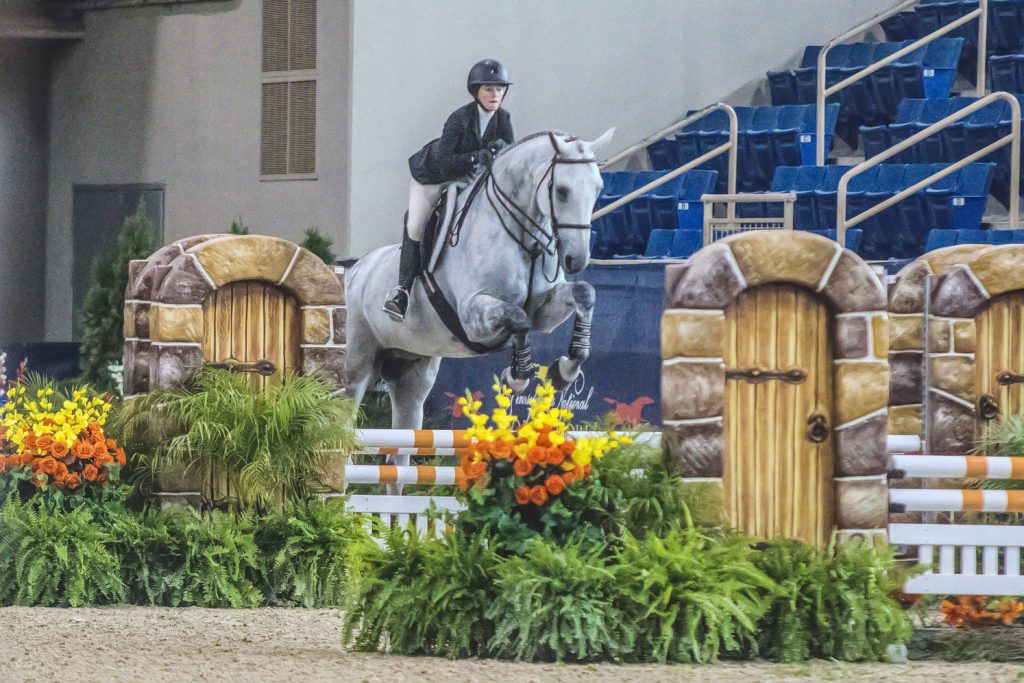
Equitation classes are often misunderstood, even by riders who compete in them regularly. Because the horse is present. Because the jumping questions can look similar to those in the hunter ring, it’s easy to assume that equitation judging blends the two disciplines.
Understanding that distinction is essential for anyone who wants to ride effectively in the equitation ring. Riders who misinterpret what is being judged often focus their effort in the wrong places, polishing the horse while overlooking the very skills the class is designed to reward.
The Purpose of Equitation
Equitation exists to develop riders. Unlike hunter classes, which evaluate the horse’s way of going, equitation focuses on the rider’s position, balance, poise, and overall horsemanship. The division was created to emphasize correct basics and to build a foundation that will support a rider for a lifetime.
As Geoff Teall explains in Geoff Teall on Riding Hunters, Jumpers, and Equitation, equitation classes are judged subjectively, with “an emphasis on the rider’s position, poise, balance, and horsemanship.” Everything about the class is designed to evaluate how the rider functions, not how impressive the horse appears.
This purpose shapes every aspect of equitation judging. Riders who understand that goal ride differently from those who approach equitation as a style-based showcase.
In equitation, the horse is not judged on its conformation, movement, or inherent ability. However, that does not mean the horse is irrelevant. Instead, the horse serves as a reflection of the rider’s effectiveness.
If the horse performs poorly, it reflects on the rider’s ability to manage, influence, and present the horse correctly. Teall makes this point clearly: the horse’s performance matters only insofar as it demonstrates the rider’s skill. Even jumping faults are not penalized unless they result from the rider’s influence.
This distinction can be difficult for riders to accept, particularly those on greener or less naturally polished horses. But equitation is not about rewarding the most beautiful mount. It is about evaluating how well a rider can ride the horse they are on.
Position, Control, and Responsibility
At its core, equitation judging centers on control and correctness. Riders are expected to maintain effective position and quiet authority throughout the round. This includes balance over fences, stability on the flat, and the ability to influence the horse without visible effort.
Certain faults are considered especially serious. Teall notes that riders must have their horses “under control at all times.” Equitation demands responsibility as much as refinement. This emphasis reinforces the division’s educational purpose. Riders are not rewarded for flash or risk-taking. They are rewarded for correctness, consistency, and thoughtful riding.
The Role of Tests
Equitation classes may include tests, and riders are expected to be prepared for them. Teall emphasizes that the approved tests are readily available and should be incorporated into regular schooling at home. Riders who treat tests as surprises often reveal gaps in their preparation.
Tests exist to further evaluate the rider, not to trick them. They assess adaptability, accuracy, and understanding of fundamental skills. Whether a rider is asked to halt, counter-canter, ride without stirrups, or perform a simple flat exercise, the judge is looking for clarity, control, and correctness. Preparation for tests is about developing skills deeply enough that they can be executed calmly under pressure.
Riding for the Right Reasons
Perhaps the most important lesson equitation offers is philosophical. Because the focus is on the rider and not the horse, equitation invites riders to take ownership of their skills. Success cannot be outsourced to talent, movement, or luck. It must be earned through preparation and discipline.
Teall reminds readers that equitation is intended primarily for junior riders, with the goal of developing tools that will serve them for life. That perspective reframes results. A ribbon is secondary to the habits and understanding built along the way.
When riders understand what equitation judges are truly evaluating—and what they are not—the division becomes clearer and more rewarding. It stops being about perfection and starts being about progress.
Equitation asks riders to show who they are in the saddle. It rewards correctness, responsibility, and quiet competence. And when approached with that understanding, it fulfills its purpose: creating better riders, not just better rounds.
Read more of Geoff Teal’s riding philosophy in Geoff Teall on Riding Hunters, Jumpers and Equitation: Develop a Winning Style on Audible and Kindle.