Brought to you by With Purpose: The Balmoral Standard
Most riders believe their horse is straight because they can ride down the rail without drifting. But straightness is not about staying between two fences. It’s about alignment through the body, from poll to hind foot. That alignment directly affects performance, confidence, and long-term soundness.
Carleton Brooks returns again and again to fundamentals. In discussing conformation, he reminds readers plainly: “Form is function, so a horse is going to hold up better if their body is more correct.” If the body is not aligned correctly, whether due to build or training, the function suffers. “The way their legs line up underneath their body is very important.”
That statement applies not just when the horse is standing still, but when it is moving, landing, turning, and pushing off the ground.
Straightness means the hind feet follow the line of the front feet. The shoulders and hips stay aligned with the direction of travel. The horse pushes evenly into both reins. There is no drifting shoulder, no escaping haunch, no neck bent one way while the ribcage falls the other.
Almost every horse is naturally crooked. That’s normal. What matters is whether we address it or allow it to become habitual compensation. When crookedness becomes a pattern, one hind leg works harder. One shoulder carries more weight. Over time, uneven loading affects muscle development, jump technique, and durability.
Brooks illustrates structural imbalance with a simple analogy: “If your table has one leg that’s not straight, it is not going to be sturdy.” The same principle applies under saddle. A body that is not aligned cannot remain sturdy under athletic demand.
How Crookedness Shows Up Over Fences
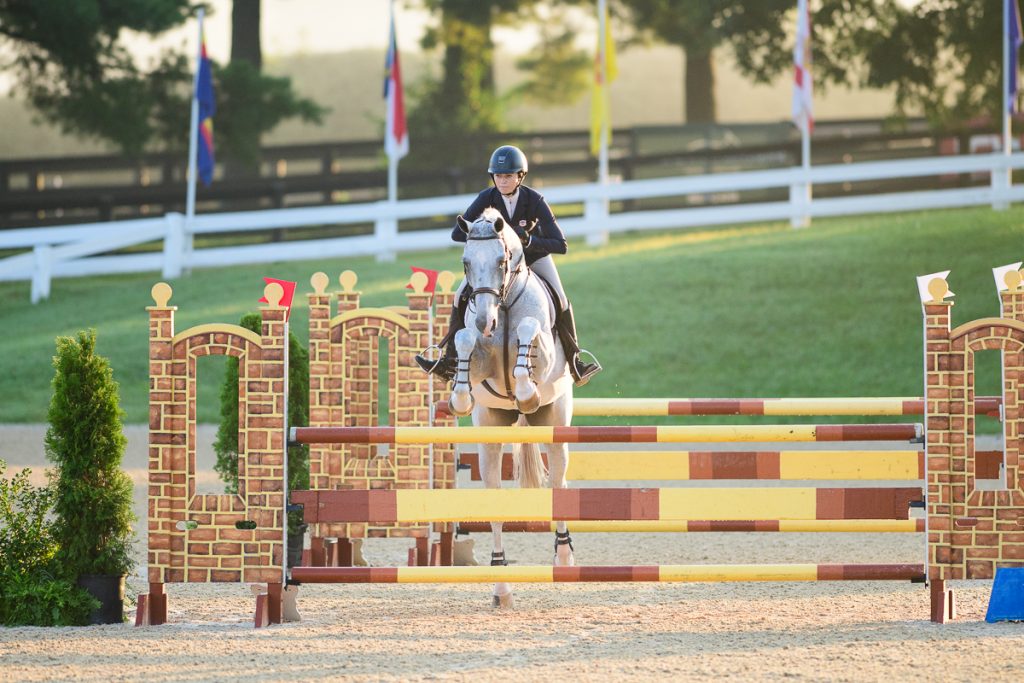
Crooked horses rarely jump straight. The signs are often subtle at first:
- Drifting left or right in the last three strides
- Hanging a leg in front
- Landing unevenly behind
- Swapping late or cross-cantering
- Rushing after the fence to rebalance
Many riders instinctively grab the inside rein to correct drift. But crookedness rarely begins in the front end. It starts behind the saddle. If one hind leg is not stepping evenly underneath, the push off the ground will not be symmetrical.
When landing forces are uneven, horses compensate. When they compensate repeatedly, tension builds. Straightness, in this sense, becomes a matter of responsibility. Even loading supports durability.
The Rider’s Contribution
Riders are rarely symmetrical. We collapse one hip, brace one stirrup, or carry uneven contact without realizing it. If “the way their legs line up underneath their body is very important,” then the way we sit over those legs is equally important.
If a horse drifts consistently to one side, ask:
- Are you weighing one stirrup more heavily?
- Is one rein shorter?
- Does one leg clamp while the other floats?
- Are your shoulders aligned with your horse’s shoulders?
Quarter-line work is one of the simplest diagnostic tools. Without the rail to hold you in place, true alignment is revealed immediately.
Practical Work to Improve Straightness
Straightness is developed patiently, not forced.
Focus first on control of the shoulders and engagement of the hind leg. Ride transitions within the gait and feel whether both hind legs push evenly. If one direction feels easier or longer, that is information—not defiance.
Incorporate subtle shoulder-fore before attempting more dramatic lateral work. Use poles on straight lines to expose drift. After every jump at home, ride straight for several strides before turning. Make alignment the default, not something you correct only when it becomes obvious.
Most importantly, straightness should feel even in both reins. The contact becomes symmetrical. The horse feels centered rather than leaning.
Straightness is one of the quiet, daily ways we live that principle. It may not win a ribbon immediately, but it protects the horse’s body over time. When alignment improves, distances become more consistent. Lead changes clean up. Turns feel balanced. Confidence increases.
Straightness is not stiffness. It is the evenness of effort. It is balance distributed fairly through the body. And when the body is aligned, brilliance is sustainable.
Want to take your riding and horsemanship to the next level? With Purpose: The Balmoral Standard distills decades of wisdom from Carleton and Traci Brooks into practical, thoughtful lessons you can apply every day at home, in the schooling ring, and in the show ring. From training philosophies to mental game strategies, the book offers riders of every level a blueprint for success built on empathy, structure, and purpose.