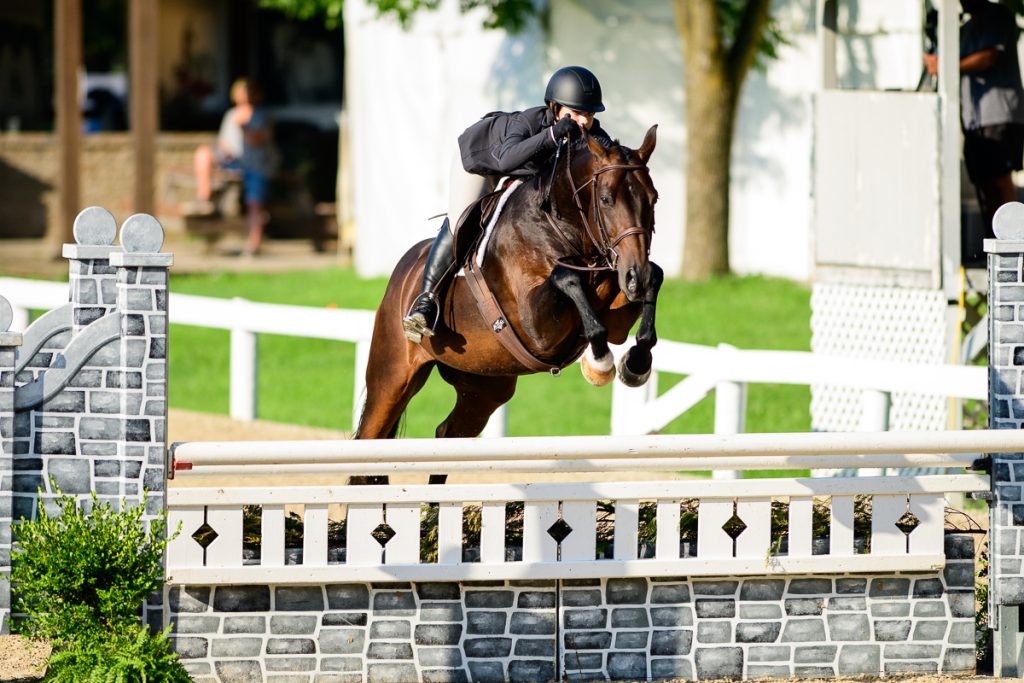
For anyone competing in USEF-recognized Hunter competition, understanding the rules around tack and equipment is essential. The regulations are specific, and the consequences for getting it wrong can range from a judge’s penalty all the way to elimination. Here’s a breakdown of what’s permitted, what’s restricted, and what will get you sent out of the hunter ring.
Bridles and Bits: The Basics
When it comes to bridlework, USEF rules are clear: snaffles, pelhams, or full bridles are required, and all must be fitted with a cavesson noseband. This is a non-negotiable baseline for Hunter competition.
That said, not all snaffles, pelhams, or full bridles are treated equally. Judges have the discretion to penalize, but not eliminate, a horse or pony shown in an unconventional version of an otherwise legal bridle type. Hunter gags and kimberwickes fall into this gray zone. They’re technically snaffle or pelham variants, but unconventional enough to invite scrutiny.
Where things get more serious is with illegal bits and nosebands, which carry mandatory elimination. Three-ring bits, gags (other than the hunter gag), drop nosebands, flash nosebands, and figure-eight nosebands are all explicitly prohibited. A judge has no discretion here. If the equipment is illegal, the horse or pony must be eliminated. This same tack rule applies when horses return to the ring for conformation or soundness evaluations.
Curb chains or straps, when used with any leverage bit, must be constructed of loose links, joints, or lie smooth against the jaw. They must be free of twists, sharp edges, or anything inhumane. Curbs may be wrapped or covered for the horse’s comfort, but may not be used in conjunction with wire, metal, rawhide, metal keepers, or any other material beyond what’s needed to attach the curb to the bit.
Martingales: Fences Yes, Flat No
Martingale rules depend entirely on what type of class you’re in. Standing and running martingales, used in the conventional manner, are permitted in all over fences classes. However, they are completely prohibited in under saddle, hack, and tie-breaking classes. Any martingale outside of a conventional standing or running style is considered illegal across the board, and a judge must eliminate any horse or pony competing in one. Cable and metal tie-downs are prohibited in all circumstances.
Equipment and Appointments
Light pads and bar shoes are permissible under the rules, though bar shoes are noted as an indicator of weakness and may be penalized in Conformation classes. Beyond that, the list of prohibited artificial appliances is broad: nasal strips, nose nets, belly bands, boots, wraps, and bandages are all off limits. An exception exists for bell boots during inclement weather, at the discretion of competition management.
Whip rules are straightforward. No competitor may carry a whip longer than 30 inches (75 cm), whether jumping or schooling over fences. Riders are limited to one whip, and weighted whips are prohibited. (Exceptions apply for Ladies Side Saddle and appointments classes.)
As of 12/1/2025, spurs must be made of smooth metal or plastic. Rowel spurs with serrated edges are not allowed, but hammer spurs, impulse spurs with round hard plastic or metal knobs, and “dummy” spurs are all permitted, provided all contact surfaces and edges are smooth and rounded. Riders may wear only one spur on each boot.
On the subject of stirrups: any rider found competing or riding anywhere on the competition grounds with a stirrup, leather, or foot tied or secured in any manner faces automatic elimination from the entire competition.
Electronic Devices
Mounted exhibitors may not wear or carry any electronic communication device, including cell phones, pagers, or earbuds, while in the competition ring. The penalty is elimination from that class. Coaching via electronic devices from outside the ring is also prohibited. Riders with chronic conditions may apply for a Presidential Modification exemption, though this does not extend to over fences classes.
The rules governing Hunter tack and equipment exist to preserve safety, fairness, and the traditions of the discipline.