Brought to you by The Plaidcast
Riders spend a lot of time thinking about strength, fitness, and soundness. But there is another part of athletic performance that is just as important: whether the horse knows where its body is in space.
“Proprioception is an awareness of where the body is in space,” Dr. Julie Vargas, founder of Limestone Equine Performance Medicine in Lexington, Kentucky, explained on The Plaidchat.
It affects everything from balance to how high a horse picks up a leg over a pole or fence. And when proprioception is weakened by injury, neurologic disease, or deconditioning, rebuilding it can become an important part of rehabilitation.
What Does Proprioception Actually Mean?
Vargas offered a simple human example. Stand on a firm surface, close your eyes, and see whether you can maintain your posture without swaying. Without vision to help you orient yourself, your body has to rely on its own internal sense of position. That is proprioception.
For a horse, the concept is similar.
The horse has to know where each limb is without looking at it. That awareness helps the horse negotiate poles, fences, uneven ground, and changes in terrain. “How does the horse know how high to pick up his legs as he passes over a pole or a fence?” Vargas asked.
If that body awareness is impaired, the signs can become more obvious. Vargas said poor proprioception can contribute to tripping or stumbling. It becomes especially important when a horse has experienced neurologic deficits or has changed the way it moves.
During recovery, sometimes the horse needs to relearn a movement pattern. Vargas explained that sensory input can be used to encourage a limb to move differently. “Even just a bell boot could act like that sensory input to change the movement,” she said.
That altered sensation may temporarily encourage a different movement pattern. The effect does not last indefinitely. Vargas noted that the horse eventually habituates to the sensation and stops responding as strongly. But repeated use can help retrain the pathway.
“You do that enough times in a row that you form a new pathway,” she said. That retraining can involve the nerve, the muscle, and even joint range of motion.
Foam Pads Can Challenge Body Awareness
One of the simplest proprioception tools Vargas discussed was the foam pad. A horse stands on the pad, and the changing surface forces the body to work to maintain stability. The exercise can begin with a firmer pad and gradually progress to softer pads as the horse becomes stronger and more capable.
“As you stand on them, you have to engage your core,” Vargas explained.
In weaker horses, that challenge can create visible postural sway as the horse searches for balance. As the horse improves, the pads can become softer or even be stacked to increase the difficulty. At Spy Coast Farm, Vargas also used larger pads for hind feet in horses with neurologic weakness, allowing handlers to create the exercise while minimizing the need to manipulate the hind limbs closely.
Although water treadmills and specialized rehabilitation tools can be useful, Vargas emphasized that proprioceptive work does not have to be expensive.
Ground poles are one example. They require the horse to recognize where the legs are and lift them appropriately. Different surfaces can also provide different sensory information. The goal is to give the horse opportunities to process changes beneath its feet and adjust the body accordingly. That can make proprioception work relevant not only for injured horses, but for healthy athletes as well.
“These are inexpensive tools, and they are good for every single athlete in the barn,” Vargas said.
The Foot Is Part of the Conversation
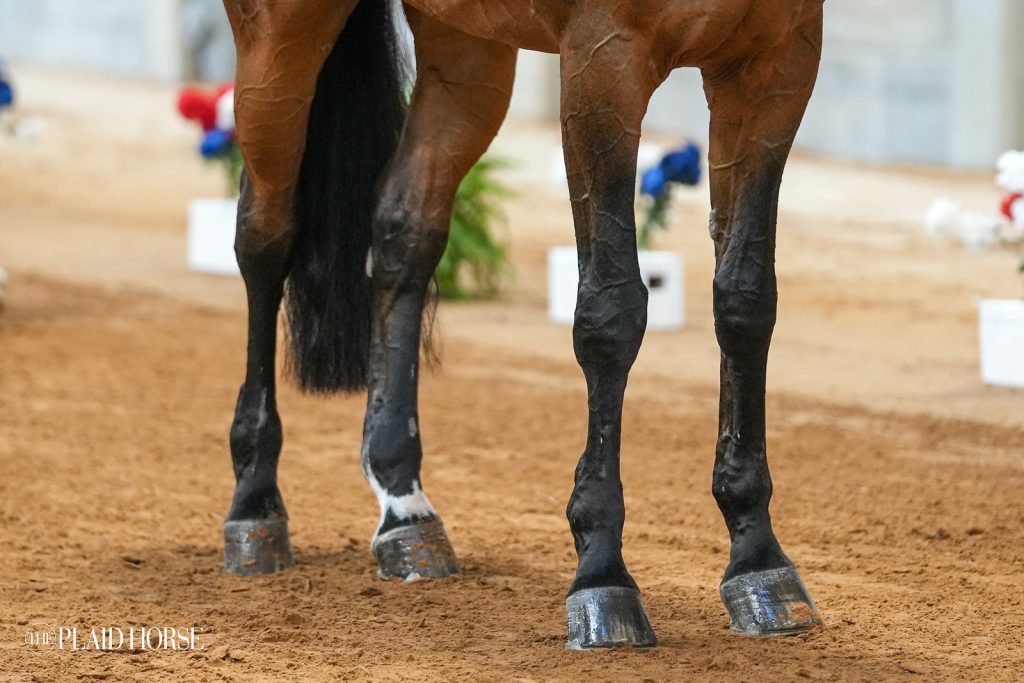
Vargas specifically mentioned the frog as a sensory structure. “We don’t think about the horses having feeling through their feet,” she said. Therapeutic shoes, pads, and other materials may be necessary in some cases, and Vargas was clear that they can serve an important purpose. But she also emphasized the value of the frog eventually being able to interact with the ground when appropriate.
That contact provides sensory feedback about where the limb is in space. In other words, proprioception starts all the way at the ground.
It is easy to think of proprioception as something that matters only after a neurologic diagnosis or during rehabilitation. But Vargas sees the concept more broadly. Every time a horse negotiates a pole, adjusts over changing terrain, or organizes its body for a fence, proprioception is involved. That is why the tools used to improve body awareness can also be useful for healthy horses.
The purpose is to help the horse become more aware of its own body. Strength tells us how much force a horse can produce. Fitness tells us how prepared the horse is for sustained work. Proprioception helps determine whether the horse knows where to put that strength.
To hear the full conversation with Dr. Julie Vargas, listen to The Plaidchat. Subscribe and follow The Plaidcast on your favorite podcast platform for more conversations that support horse health, performance, and longevity.