BY CHARLEE HILLEY
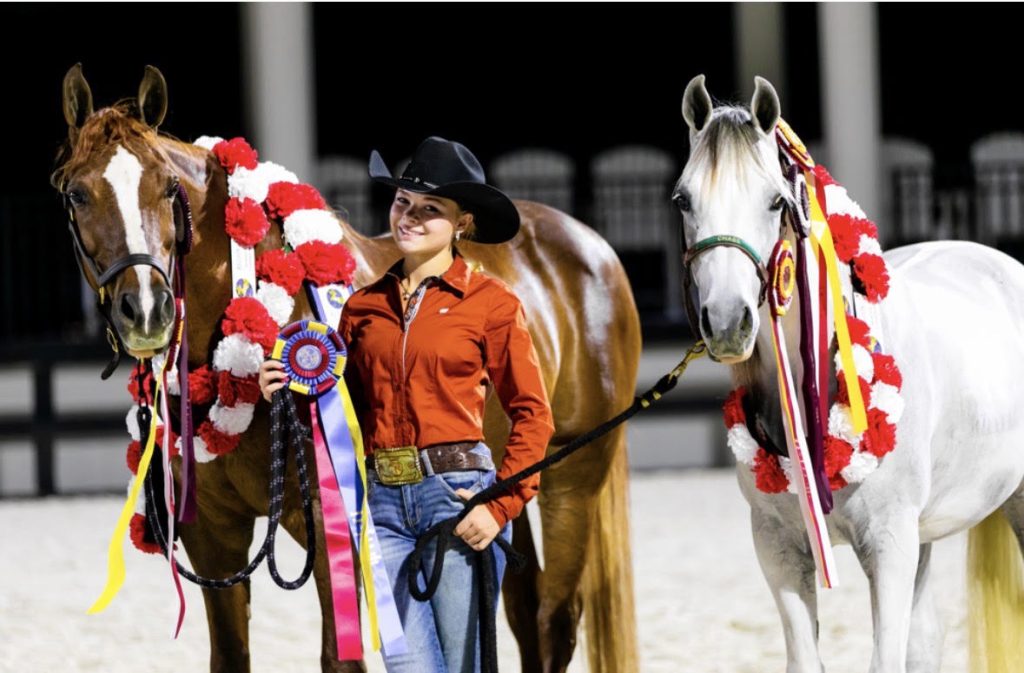
The equestrian world is often defined by numbers. As a fourteen-year-old, third-generation youth rider, my 2026 show season has been filled with numbers that make me incredibly proud. At the Raleigh, North Carolina show in April, I walked out of the arena with twelve first-place ribbons and a 72.5 score in All-Breed Reining. Leading up to the major championship run, I even laid down a flawless, elite score of 81 in a Dressage pattern class. Then, at the Region 12 Championships, I stood as the Dressage Champion and Reserve Champion, and later took home a Top Five finish in a deep Ranch Riding ATR class.
But if growing up inside a professional training barn has taught me anything, it is that the most important moments in the horse industry do not happen on a scoreboard. They happen in the grooming stalls, along the arena rails, and in the quiet spaces where the next generation of riders is born. While I love the thrill of sliding stops on my reining mare, Majestic Miss Peppy, or navigating a precise pattern on my family’s home-bred Dressage superstar, Should’ve Been a Cowboy, my real passion at horse shows is looking out for the little kids.
As the oldest of four siblings and the oldest of six grandkids, taking care of younger children has always come naturally to me. Outside of the barn, I regularly volunteer at church camps helping pre-K children navigate their big worlds. Inside the barn, I have realized that teenage riders have a unique, powerful opportunity, and a responsibility, to act as the ultimate mentors for the youngest kids entering our sport.
The Power of Peer Mentorship
The horse industry can be incredibly intimidating for a beginner. Walking into a massive show facility filled with roaring tractors, galloping horses, intense trainers, and strict judges is overwhelming for an adult, let alone an eight-year-old holding the reins of a pony for the first time. Often, professional trainers are completely focused on managing their clients, preparing upper-level horses, or executing show schedules. They do not always have the time to sit with a nervous child and explain how to read a class sheet or calm their show-ring jitters.
This is exactly where teenage riders need to step up. Kids tend to naturally gravitate toward older teenagers. To a young child, a professional trainer is an authority figure, but a teenage rider wearing a champion ribbon is a real-life superhero. We speak the same language. We understand the current pressure of the youth divisions, and we can bridge the gap between grassroots beginners and elite competition.
Training under the elite team at Jesse Chase Performance Horses has taught me firsthand how life-changing a great mentor can be. Jesse is more than just my idol; he is a second father figure to me. I have quite literally grown up in his program, and the patience, kindness, and discipline he invested in me as a toddler is exactly what I try to pay forward to the kids around me. When I am at a show, I naturally find myself walking over to the walk-trot and leadline kids. Jesse can strongly vouch for the fact that making those kids feel welcome, confident, and genuinely excited about riding is my favorite part of any weekend.
Creating a Kinder Culture
Horsemanship is about so much more than riding capability. It is about character, empathy, and community. When teenage riders actively step into leadership roles, we can completely reshape the environment of our local show circuits.
Mentorship does not have to be complicated or formal. It can be as simple as standing by the gate and giving a young rider a high-five after a tough class where they didn’t place. It can mean helping a child polish their boots before they walk under the stadium lights, or teaching them how to properly clean a hoof back at the stalls. I will never forget the pride I felt leading my little sister to her very first blue ribbon, with my mom right by our side. Sharing that special moment in the arena made me realize that our generation has the power to make horse sports inclusive, safe, and deeply kind.
If we want our sport to flourish, we have to look past our own stable doors. Showing a nine-time National Title winner like my ranch horse, Baikals Platinum, or breaking into new speed disciplines like Breakaway Roping and Barrel Racing requires immense focus. But true sportsmanship means pulling your eyes off your own horse long enough to notice when a younger competitor is struggling or feeling left behind.
A Call to Action for Youth Riders
We need to actively dismantle the idea that horse shows are cutthroat environments where everyone is an enemy. The future of the equestrian industry relies entirely on the kids who are currently entering the leadline and short-stirrup divisions. If they feel welcomed, supported, and cheered on by the older teenagers they look up to, they will stay in the sport for life. They will grow up to be the future trainers, judges, barn managers, and advocates that our industry needs.
Teenagers are the heartbeat of the youth equestrian community. We have the physical stamina to help, the riding experience to guide, and the social connection to make learning fun. I want to challenge every youth rider preparing for their next show season to think beyond the ribbons. Set a goal to find at least one younger child at every show and make them feel like they belong. Answer their questions, look out for their safety, and share your love for horses with them.
When my member spotlight launches on the Arabian Horse Youth Association (AHYA) Instagram page on July 3rd, and as I prepare to independently enter my very first season with the Interscholastic Equestrian Association (IEA), my goal remains exactly the same. I want to be a supportive, compassionate leader. I want to leave the dirt better than I found it, ensuring that the little girls and boys watching from the rails know that they have a big sister in the sport cheering them on every single step of the way.
Charlee Hilley is a 14-year-old youth performance rider training under Jesse Chase, specializing in reining, ranch work, and whatever discipline she can go in! As a third-generation equestrian and the oldest of four siblings, her true passion at horse shows is stepping into leadership roles to mentor and support the youngest exhibitors entering our sport. When she is not in the saddle, she balances her heavy riding schedule with cheerleading, theater productions, and volunteering.