
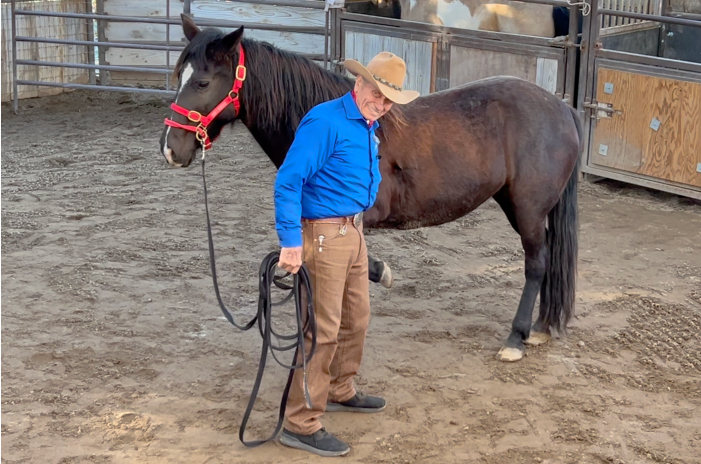
Monty Roberts, the internationally known horseman who became famous for Join-Up and for advocating a less force-based approach to training and communicating with horses, spent a lifetime teaching people to listen to horses. Even late in his life, though, he never spoke as if he had finished learning how.
That may be one of the most revealing parts of Roberts’ legacy.
The renowned horseman died last month at age 91. But in a 2020 conversation with Tonya Johnston on The Plaidcast, Roberts did not sound like someone looking backward on a completed body of work. At 85, he was still deeply curious about what animals could teach him next.
“In my last three years, I think I’ve learned more than virtually the whole rest of my life,” Roberts said.
After more than eight decades around horses, he was still watching, questioning, and revising what he thought he knew.
A Lifetime as a Student
Roberts told Johnston that his learning curve had never really leveled off. He began working with horses as a very young child and could have easily divided his career into periods when he was learning and later periods when he had mastered the work.
But he rejected the idea of mastery. Roberts described each decade as bringing more learning than the one before it. At 85, he joked that it was unfair he could not live to be 200 because there was still so much left to discover. The comment was funny, but he made clear that the idea behind it was serious. “I don’t mean this to be a story,” he said. “It is the truth.”
At the time of the interview, pandemic restrictions had unexpectedly kept Roberts at home instead of traveling internationally. He used that interruption to spend more time observing the animals around his California farm, including horses, deer, and even pygmy goats.
“I have a group of horses that are just, they should be wearing the cap of a professor,” he said, “because they’re teaching me every single day things that… I’m 85. I should have learned.”
That humility was central to the way Roberts talked about animals. “I have had so many good teachers, mostly with four legs,” he said.
He was especially fascinated by the deer living around his farm. Roberts had observed the same family group for decades and believed their sensitivity as flight animals could teach him even more about communication, pressure, intention, and behavior. One doe, whom he called Lulu, had once been among the most sensitive animals in the herd. Over time, Roberts said she became comfortable enough to approach him, allow him to touch her, and even let him clean around her eyes.
For Roberts, the point was not that he had conquered or tamed her. It was that close observation had helped him understand how to communicate with an animal on its own terms.
That same willingness to watch before acting shaped the philosophy that made Roberts famous. He believed humans often underestimate the intelligence of horses because they evaluate animals according to human definitions of intelligence. Horses, he argued, possess a different kind of intelligence, particularly as prey animals exquisitely aware of body language, intention, pressure, and their environment.
“Think. Watch us, and you will learn,” Roberts imagined the deer telling him.
From Making the Horse Do It to Helping the Horse Want To
When Johnston asked how his work applied to show jumping, Roberts drew a distinction between making a horse perform and creating a situation in which the horse wants to perform.
“If the horse wants to do it, he will do it better,” Roberts said, comparing the horse’s motivation with the difference between a person doing meaningful work and simply doing something because they are forced to.
His practical example was what he called “incremental uplift.” A jumper may begin with poles on the ground and gradually progress to larger fences. The problem, in Roberts’ view, comes when that progression becomes too much for the horse and the response is simply to apply more force.
If the horse stops, Roberts’ answer was not to escalate.
“Go back,” he said. “Go back to your incremental uplift. Go to the thing that he can do. Don’t make him do the thing he can’t do. Wait until he wants to give it a try himself.”
Roberts also believed listening to horses required riders to pay attention to what they themselves were communicating. He and Johnston discussed diaphragmatic breathing, adrenaline, tension, and intention. Roberts believed a horse could feel when a rider tightened physically or became fixated on forcing a particular outcome.
He shared a lesson from his own competitive riding. A horse named Black Bart had a habit of stopping short of a designated marker. Roberts originally saw it as the horse’s problem.
His mentor Don Dodge disagreed.
“It’s you,” Roberts remembered Dodge telling him.
Roberts was focusing so intensely on the stopping point that his body was preparing to stop before he actually reached it. Dodge encouraged him to breathe, relax, look farther ahead, and ride as though he intended to continue beyond the marker.
Roberts said the problem disappeared.
“Intention is everything,” he told Johnston.
He Still Admitted When He Got It Wrong
Perhaps one of the strongest moments in the interview came when Roberts acknowledged that all his experience had not made him immune to mistakes. “I still make that mistake because I’m obsessed with getting it right,” he said.
He described moments when that desire could make him push too hard, tighten up, or become too forceful.
“I shouldn’t ever do that,” he said. “At least I’m aware of it, and I keep working on it.”
For someone whose name had become synonymous with a particular philosophy of horsemanship, Roberts presented learning as a lifelong obligation.
“Learning how to accept instruction is a super, super talent that a lot of horse people don’t have,” he said. The closed mind, in his view, was the real obstacle.
The Listening Continues
Roberts’ legacy is also the example of a horseman who, after more than 80 years with horses, still believed he had more to learn.
He remained fascinated by why animals behaved the way they did. He continued changing his own approach when the horse showed him something different. He remained willing to recognize his own tension and mistakes. And he continued treating animals not only as subjects to train, but as teachers capable of correcting the humans around them.
At 85, Roberts sounded almost frustrated by the limits of one lifetime. There were still more questions to ask and more animals to watch. That curiosity may be one of the most valuable things he leaves behind. Horsemanship does not end when we know enough to give the right answer. It deepens when we remain willing to ask another question.
Monty Roberts spent his life asking horse people to listen more carefully. The best way to remember him may be to keep listening.















