BY CHRISTA N’DURE
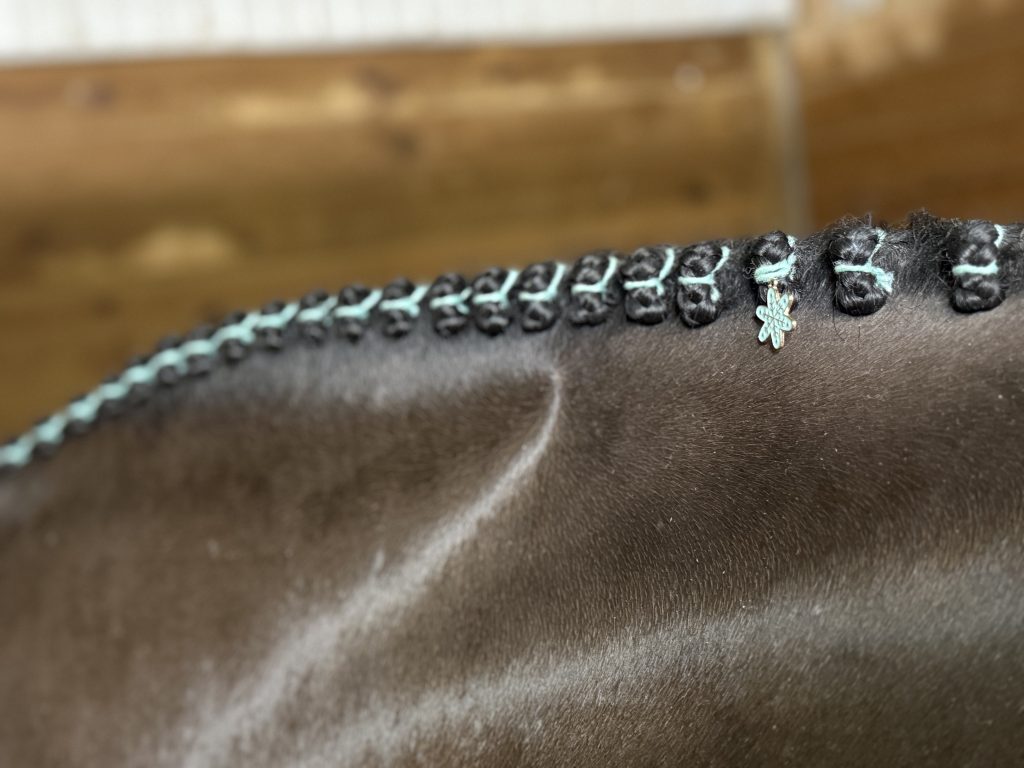
At first glance, professional horse braiding seems like a pretty simple business: you show up at the horse show. You braid some manes, get paid, and go home. Except, of course, it isn’t quite that simple.
A professional braider isn’t just selling a row of neat braids. They’re selling years of practice, speed, consistency, reliability, early mornings, sore hands, long drives, and the ability to walk into a stall with a horse they’ve never met and know what to do with its mane.
For many professional braiders, this is the reality of making a living in a profession most people outside the horse world don’t even realize exists.
Ask a professional braider how they got started, and there usually isn’t a straightforward career path. There isn’t exactly a college degree in professional horse braiding or an apprenticeship program. Most people learn by doing.
Many braiders started braiding their own horses. Then a friend’s horse. Then a friend’s friend’s horse. Eventually someone offered to pay them.
My own way into braiding was an accidental one, as it very often is for braiders. I’ve worked as an FEI groom for years and braided dressage horses and jumpers as a part of my grooming duties. Once, a rider walked up to me while I was braiding my boss’s dressage horse and asked if I would braid hers. After that day, I started slowly branching into braiding hunters and offering braiding as a standalone service.
What separates someone who occasionally braids from someone who can actually make a living doing it is everything that comes afterward. You have to become fast and consistent. You have to learn how to work around difficult horses, bad manes, bad weather and clients who need their horses finished five minutes ago.
As a professional braider, your work is highly visible, but you are not. A rider walks into the ring with a beautifully turned-out horse and nobody in the grandstand knows who braided it.
Within a show circuit, braiders develop reputations. People know who is fast. They know who is meticulous. They know who can handle a difficult horse. They know who will show up when they say they will. And they remember who did a good job.
Repeat clients are the foundation of the business. Eventually, someone might call and ask if you’re available six months from now. That’s when you realize you’ve stopped looking for work and started managing demand.
The easiest thing for someone outside the profession to see is the price. The harder thing to see is everything behind it.
A professional braider’s income isn’t simply the number of horses they braid multiplied by the price per horse. There are supplies to buy. Travel to pay for. Show fees in some cases. Hotels. Meals. Equipment. Taxes. Insurance. Cancellations. Slow weeks. Long days.
And then there is the seasonality.
A braider can have a completely packed weekend followed by a much quieter stretch. Certain shows may be worth traveling hundreds of miles for, while others don’t make financial sense once the time and expenses are calculated.
Creating the glamorous picture might involve waking up at 3 PM, driving to the show while the sun is setting, drinking coffee while standing beside a stall, and realizing that your first horse is already running late.
A busy night can be relentless. One horse is done. Then another. Then another. You don’t necessarily have time to stop and admire the finished product because there is another mane waiting.
The physical demands are easy to underestimate, too. Braiding means standing on the ladder for hours, bending, reaching, gripping, separating hair and repeating the same movements over and over. Your hands and shoulders know exactly how busy your calendar has been.
And then there’s running the business. There are texts to answer. Appointments to schedule. Clients to confirm. Travel to plan. Invoices to send. Supplies to replace. Show dates to track.
And then there are the inevitable messages that arrive at the last minute.
“Are you available tomorrow?”
“My horse changed classes.”
“Can you fit in one more?”
“I’m so sorry, I forgot to book you.”
Professional braiders spend a surprising amount of time managing logistics. At a certain point, being good at braiding isn’t enough. You have to be good at running a business.
There is a moment when professional braiding stops being something you do for extra money and starts becoming your livelihood. It may be at your first major show, the first full day of clients, the first time they realize their bookings are filling faster than their free time. And that transition changes the way you think about the work.
When you’re braiding your own horse, you can take as long as you want. When you’re being paid, time matters. When you’re responsible for ten horses, time matters even more. When someone’s championship ride is coming up, everything matters.
A huge part of your value is being the person who shows up. Ask riders why they use a professional braider and the answer isn’t always “because I can’t braid.”
Often, it’s because they don’t want to think about it. They have a class to ride. A horse to warm up. Tack to check. A trainer to talk to. A schedule to manage.
If their braider is there at the agreed-upon time and the horse is finished when it needs to be finished, that’s one less thing to worry about. Reliability becomes part of the product. So does trust. A client is handing you their horse, often on a very important day, and trusting you to make the right decisions without needing to stand over your shoulder. That trust takes much longer to build than a good braid.
From the outside, professional horse braiding can look like a very small niche, and it is.
But within the horse-show world, it is a real profession, with its own business models, reputations, routines, challenges and personalities.
The best braiders aren’t simply people with good hands. They’re business owners. They’re travelers. They’re horsemen and horsewomen. They’re early risers, problem solvers, schedulers and, sometimes, unofficial therapists standing quietly beside a stall before a big class.
The braid is only the finished product. The real business is everything that has to happen before it.
Christa is a professional horse braider and 5* FEI groom with 20 years of experience working with horses in Europe and the USA. She loves a well-turned-out horse, attention to detail, and spending time with horses, whether it’s in a competition setting or just at the barn brushing and grooming. Find her at www.braidedbrilliance.com