Brought to you by The Plaidcast
For young riders, it can be easy to think of progress primarily in terms of what happens in the saddle. Moving on to more difficult divisions and bigger goals. But Roxane Durant, co-founder and executive director of the Interscholastic Equestrian Association (IEA), believes equestrian education has to extend beyond riding.
Over the years, IEA has increasingly incorporated horsemanship into its programming, giving riders opportunities to learn not only how to compete, but how horses are cared for, how horse shows actually function, and how much work happens before anyone ever walks through the in-gate.
For Durant, some of those lessons are built directly into the structure of the program.
Learn How the Horse Show Works
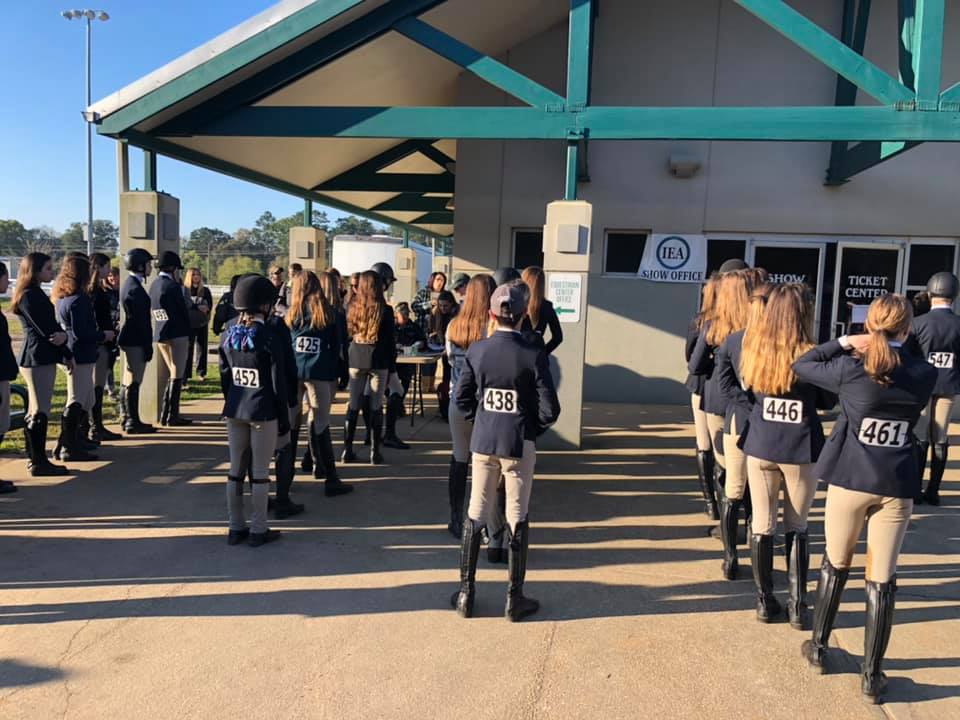
After an IEA team has been in the program for a few years, it is required to host or co-host horse shows. That means the coaches have to come together to organize the event, but it also means their students become part of making that event happen.
The riders may help prepare horses for competition or set courses before the show. They may learn what happens at the in-gate, help with announcing, or work around the concession stand. “All the pieces that go into running, you know, just a small schooling size horse show,” Durant said. “All those learning pieces are happening inherently as part of participating in IEA.”
For riders accustomed to arriving at a show with everything already prepared, seeing the other side of the operation can offer a very different education. Someone has to make sure horses are ready. Someone has to know which rider belongs where. Someone has to set the course, call the class, organize the gate, and keep the day moving. The horse show does not simply appear when the first rider enters the ring.
There is also something valuable about having to make an event work. A student helping set a course, work the in-gate, prepare horses, or handle another show-day task gains first-hand experience with how a competition functions behind the scenes. Those are practical skills that may become especially important for anyone who eventually wants a career in our industry.
Not every IEA rider will become a professional. But for those who do, knowing how horse shows function from the ground up can be just as useful as knowing how to ride around one.
Horsemanship Is More Than Riding Skill
IEA has also developed a more formal hippology program that expands education beyond competition. Durant describes it as a deeper study of horses, horsemanship, and care. Riders learn about subjects including first aid, wrapping, equipment, and other areas that may not always be covered in depth during a traditional riding lesson.
IEA puts out learning and testing modules throughout the year so students can build that knowledge alongside their riding skills. A rider can become technically effective in the saddle without necessarily having the same depth of knowledge in areas like horse care, first aid, wrapping, and equipment. IEA’s approach increasingly treats those things as connected rather than separate.
One particularly useful aspect of the hippology program is that it is available to non-riders as well. If there is not an IEA team available to ride with in someone’s area, that student can still participate in hippology and testing. That creates another pathway into equestrian education for young people who may be interested in horses but do not currently have access to regular riding.
Durant said participation in the program has grown significantly over the last several years, and IEA is continuing to explore ways to expand it. The organization has also been looking at how to add more hands-on components so that hippology is not limited to online written testing. Durant discussed the possibility of demonstrations and more practical testing that would give students a chance to show what they can actually do.
The Barn Requires Everyone
Traditional showing can sometimes encourage riders to focus very narrowly on their own horse, their own class, and their own result. The IEA structure asks students to take a broader view. When the team hosts a show, everyone has a job. The day works because riders, coaches, volunteers, and families contribute to the larger operation. That experience can help young riders see that the horse industry depends on far more people than the rider in the ring.
There are coaches, grooms, managers, announcers, gate staff, course designers, organizers, and countless others whose work makes competition possible. Learning to appreciate those roles is part of horsemanship too.
Durant describes IEA as something that has continued to evolve since its earliest years. As the program has grown, so has its understanding of what young riders need. Competition remains a major part of IEA, but competition alone is not the entire education.
The rider who can get on an unfamiliar horse and perform well has learned something valuable. The rider who also understands horse care, knows how to wrap, can help organize a show, and appreciates everything happening behind the scenes has learned something broader.
To hear the full conversation with Roxane Durant and Piper Klemm, listen to episode 486 of The Plaidcast. Subscribe and follow The Plaidcast on your favorite podcast platform for more conversations from throughout our industry.