
Brought to you by The Plaidcast
Most riders know that watching good riding can be educational. You notice a rider’s position, the track they choose, or the way they organize a horse through a turn. But according to mental skills coach Tonya Johnston, purposeful observation may do more than simply give you ideas. It may help prepare your own brain and body to perform.
At the beginning of episode 483 of The Plaidcast, Johnston shared how she used what she calls “video boot camp” while preparing to return to competitive volleyball after rehabbing a torn meniscus. She could not get enough practice time before her league championship, so she used something else she knew worked for her: watching athletes perform at a very high level.
Watching Is a Form of Learning
Johnston describes herself as a highly visual learner. Over the years, she has noticed that after spending significant time watching high-level sports, she often feels better when performing those sports herself.
One example is tennis. Johnston and her husband watch major tournaments, including the US Open, and she has noticed that during those weeks, when they go play tennis themselves, she often performs unusually well despite not practicing consistently.
That pattern made her think more deliberately about what watching can do. Johnston describes this as observational learning. “Action observation theory in sports psychology talks about how watching skills and movements performed on video or live and in person activates the same neural pathways as actually performing those tasks,” she explained. “This allows our mirror neuron system to activate and improve the same skills and techniques we just watched.”
In practical terms, watching high-quality execution may help your brain become more familiar with the timing, movement, and flow of a skill before you physically perform it yourself.
Turn Watching Into Training
Before her volleyball championship, Johnston decided to use the idea intentionally. She watched NCAA finals, Olympic volleyball, and high-level club competitions in the days leading up to the event. “I crammed as much high-level volleyball watching as I possibly could,” she said.
The goal was preparation. Johnston wanted to repeatedly expose herself to the timing, flow, positioning, and movement patterns of excellent players. She could not add more court time to her schedule, but she could still spend time immersing herself in the kind of performance she wanted to reproduce.
She felt the difference when she competed. Confidence-wise, she said she felt more prepared because she knew she had done what she could with the resources available to her. Skills-wise, she felt improvements in her timing, her sense of flow, and the way she saw and felt the game. A teammate even commented on how well she was playing.
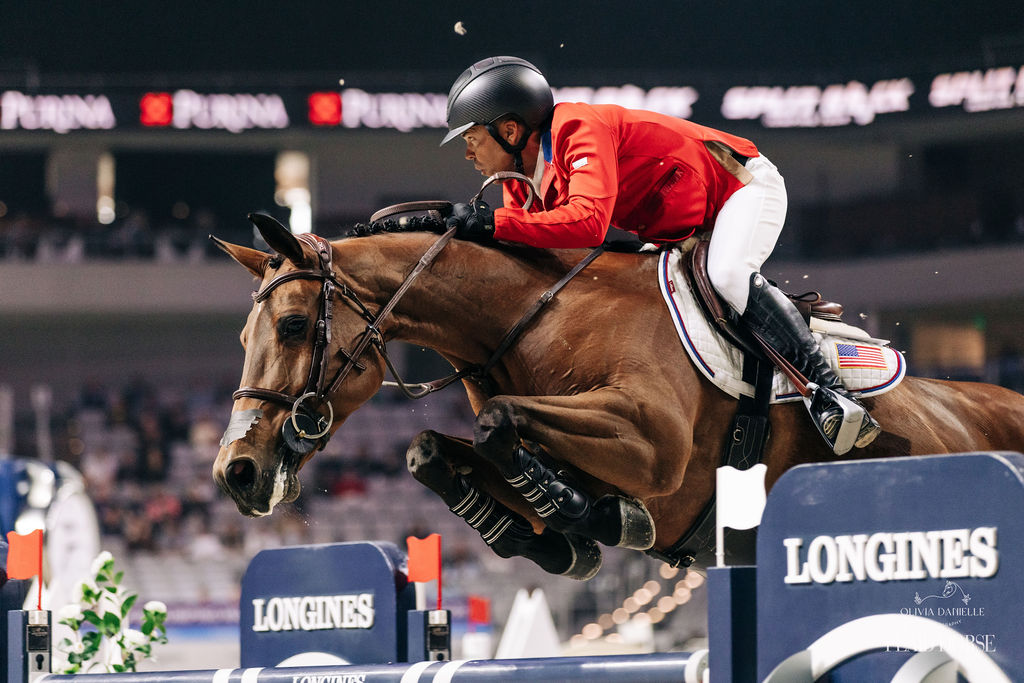
The same idea can apply to riding. Johnston encourages riders to intentionally watch excellent riding before an important show, lesson, or outing instead of treating all horse-related screen time as equal.
That means being selective. Rather than scrolling through random snippets of wins, dramatic jumps, mistakes, and highlight moments, riders can seek out full rounds or longer videos from athletes whose riding they admire. The goal is to watch with a purpose.
Pay attention to the way the rider approaches a line, how they organize the horse after landing, the pace they establish, the track they choose, and the rhythm they maintain throughout the course. Instead of simply deciding whether a round was good, notice the specific elements that made it effective. Observation can become another form of preparation between opportunities to physically practice.
Choose Riders Who Are Useful to You
Johnston also recommends thinking carefully about who you watch. A rider may be exceptionally successful without necessarily being the most useful model for your own riding. She suggests identifying riders who have a similar body type, riding style, or approach. That can make the visual information feel more relevant to what you are trying to accomplish yourself.
If you are a particularly visual learner, it may help to maintain a list of riders or videos you want to revisit. Johnston even suggests creating collections of links so that good examples are easy to find before a show or lesson.
The important part is making observation intentional rather than accidental. Instead of letting an algorithm decide what you see next, decide what you want your brain to spend time studying.
Social media already gives riders enormous exposure to other people riding, but Johnston draws an important distinction between random consumption and deliberate observation.
A feed filled with quick clips does not necessarily give you enough context to understand what the rider is doing. A short video may show the impressive jump, but not the preparation that created it. Watching a full round gives you the chance to see how pace, track, turns, and adjustments work together.
Johnston encourages riders to substitute some social media time with carefully chosen footage. Maybe you want to study pace in an equitation round. Maybe you want to see how someone uses the corners or how several different riders solve the same technical question.
The more specific the purpose, the more useful the watching becomes.
Observation Can Help Confidence Too
Johnston believes the benefit is not only technical. Watching excellent execution can also help riders feel more prepared and confident. Before her volleyball championship, the video work gave her a sense that she had prepared to the best of her ability under the circumstances. “I felt like I’d prepared to do my best to the best of my ability,” she said.
For riders, the same strategy can be useful when physical preparation is limited. You may not be able to ride another course before the show. You may not have access to another lesson. You may be traveling, resting your horse, or simply working within a busy schedule.
You can still spend time watching quality examples of the skills you want to perform. In that way, purposeful observation can help riders arrive feeling not only more familiar with what they want to execute, but also more confident that they have used the preparation tools available to them.
Observation is not a substitute for practice, coaching, or time in the saddle. Johnston presents it as another mental skill riders can add to their toolbox.
Rather than treating horse videos as background entertainment, use some of that time to study riding you admire. Pick riders whose style makes sense for you. Watch enough of the round to understand how the pieces fit together. Look for specific skills rather than simply watching the ribbon-winning result.
Your brain is taking in information from what you watch anyway. You might as well give it something useful to learn from.
To hear the full conversation with Ava Stearns and Tonya Johnston, listen to episode 483 of The Plaidcast. Subscribe and follow The Plaidcast on your favorite podcast platform for more conversations about riding, mindset, and performance.














