Brought to you by The Plaidcast
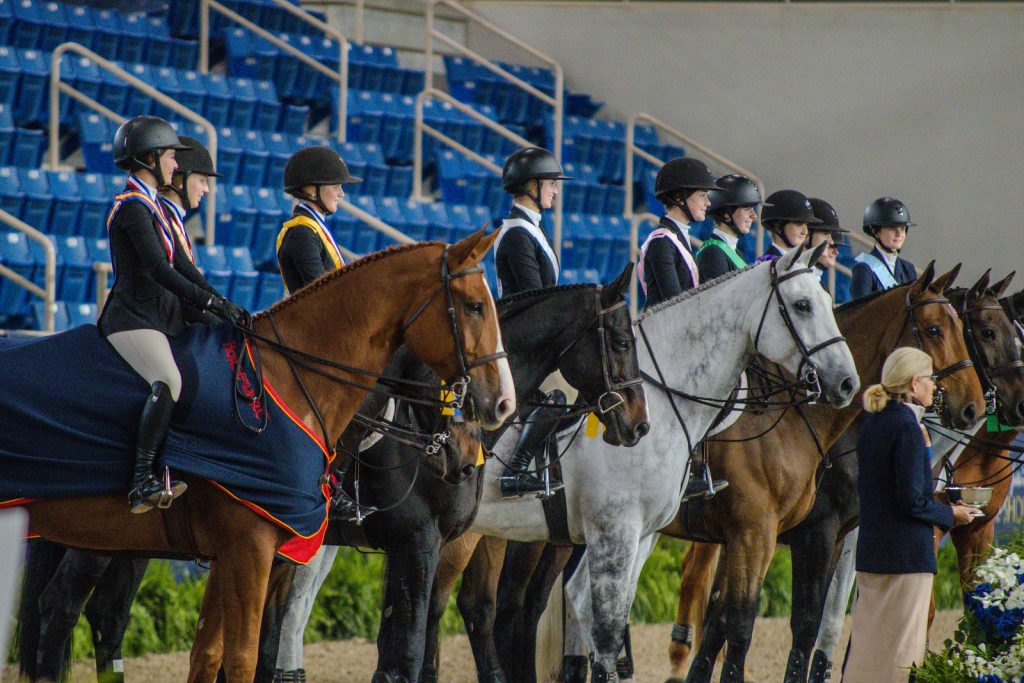
At 157 riders, the 2025 Dover Saddlery/USEF Hunter Seat Medal Final had the smallest field in more than a decade and a noticeable drop from 231 entries just three years earlier. But according to judge Michael Tokaruk, the shrinking numbers at Harrisburg don’t signal a problem, but a transformation.
A New Pathway for Developing Riders
“The three-three medals are doing exactly what they were created to do,” Tokaruk explained. “They give a stepping stone to riders from the children’s and the Taylor Harris before they’re necessarily ready to do the demanding three-foot-six equitation.”
In other words, the new generation of equitation riders isn’t disappearing, but rather developing differently. The addition of national 3’3” finals like the Hamel Foundation NHS 3’3” Equitation Championship and US Equestrian’s Jumping Seat Medal Finals has given younger, greener, and less experienced riders their own pinnacle events.
Those classes help make the sport more accessible and create a progression. Riders now have the freedom to move up gradually, build confidence, and find horses appropriate to their skill level without jumping straight from local medals to Harrisburg.
“It’s the right progression,” Tokaruk said. “Not every horse or rider is ready for the kind of questions we ask at the 3’6” level. These 3’3” divisions let them gain experience in a national final environment before taking that step.”
Quality Over Quantity at Harrisburg
The change is already reshaping the top of the sport. When the Medal Final field was smaller this year, it made for a cleaner, more focused day and a stronger average level of competition.
Tokaruk contrasted that with past years when the class ballooned past 300 entries. “When regionals are optional and everybody can qualify, you end up with a lot who honestly are over their head,” he said. “The 3’3” is a much better place for people who are greener or don’t quite have the horse yet.”
That shift toward smaller, stronger fields has changed the feel of the Medal Final itself. Fewer riders mean more meaningful competition and a better experience for everyone involved.
Evolving Expectations
For many young riders, the rise of the 3’3” equitation divisions has also redefined what “making it” looks like. Success is no longer measured solely by a trip to Harrisburg or Syracuse. Instead, a Hamel or Jumping Seat Finals appearance can serve as a capstone for a certain phase of development.
The change also aligns with the realities of the modern sport. Not every rider has access to a horse that can easily answer the scope questions at 3’6”. The 3’3” divisions allow those riders to compete nationally, learn, and still have a legitimate goal.
By creating that space, the sport is retaining more participants and encouraging sustainable growth. As Tokaruk suggested, the 3’3” classes offer a healthy on-ramp that helps riders gain experience without overfacing themselves or their horses.
A Pipeline for the Future
The 3’3” finals are growing, but they aren’t siphoning talent. Riders who begin in the 3’3” divisions are arriving at 3’6” better prepared and more confident. They’ve logged indoor miles, handled pressure, and learned to think on course.
Tokaruk believes that foundation will elevate the sport as a whole. “The three-three division is doing what it was created to do,” he said. “It’s helping these kids get ready. And when they do come to the three-six finals, they’re coming in with the skill and experience to show what they can really do.”
Looking ahead, Tokaruk sees continued refinement, rather than rivalry, between the 3’3” and 3’6” championships. Each division fills a vital role in the equitation ecosystem.
“The three-three medals aren’t replacing the Medal Finals,” he said. “They’re feeding them.”
Want more insight from Michael Tokaruk? Listen to episode 455 of The Plaidcast and subscribe on your favorite podcast platform for conversations with the most influential voices in the equestrian world.