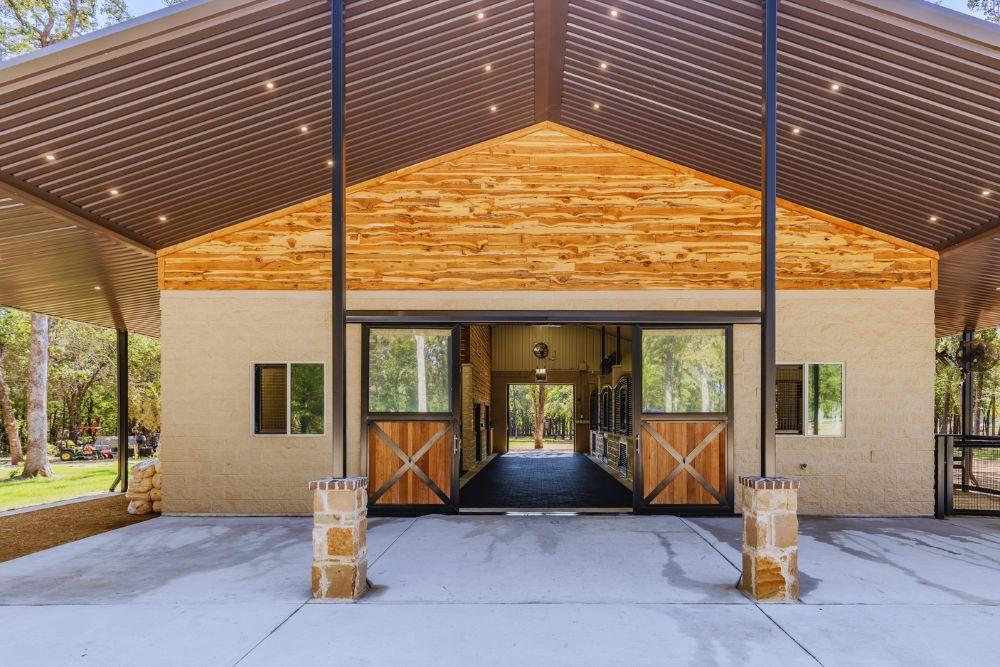
Ask anyone who has priced a new barn lately and you will hear the same story. The number came back far higher than the one a friend paid in 2019, and nobody could explain exactly why.
I estimate construction for a living. My company provides Florida construction estimating services out of Miami, and a surprising amount of that work comes from horse country, from Ocala farms to show barns around Wellington. So I see these numbers every week, and the rise is real. Construction input prices have climbed roughly 40 percent since early 2020, and they have not come back down.
Where the money actually went
It is tempting to blame one thing, usually lumber. Lumber did spike, then settled. The rest of the bill kept climbing.
Steel framing and metal roofing jumped and stayed high. Concrete went up nearly every year, and a barn floor, wash rack, and aisle add up to a lot of concrete. Electrical wire and panels followed copper. Then labor, which is the part people underestimate most. Skilled framers, electricians, and concrete finishers are in short supply across the Southeast, and the good ones are booked months ahead. When a contractor has more work than crew, the price reflects it.
Insurance, permits, and impact fees have also crept up. None of these show up in the picture of the barn you have in your head, and all of them show up on the invoice.
Why a horse barn is harder to price than a house
A barn looks simple. Four walls, a roof, some stalls. That is exactly why the budgets go wrong.
Horse facilities have requirements a garage or a home never has. Stall walls need to take a kick from a 1,200 pound animal, so they are built heavier than a typical partition. Ventilation has to move a lot of air without drafts, which changes the roof design and the cost of the ridge. Drainage under stalls and around the wash rack is its own small project. Fire safety matters more when there is hay overhead and animals that cannot let themselves out.
Then there is the site. A long drive from the road means a longer trench for power and water. Soft ground means more fill and compaction before any slab gets poured. A riding arena nearby changes the grading plan for the whole property.
Each of these is manageable. The problem is when nobody counts them before the contract is signed.
What an estimating firm does that a single bid does not
Most owners get one or two bids from builders and pick the lower one. That feels careful. It is not quite enough.
A builder’s bid tells you what that builder wants to charge. An independent estimate tells you what the work should cost, line by line, based on actual quantities: how many cubic yards of concrete, how many linear feet of stall front, how many squares of roofing, how many hours of each trade. With that in hand, you can see which bid left something out and which one padded it.
That matters more when prices are moving. A quote from six months ago may already be stale. A good estimate uses current material and labor costs for your region, not a national average and not last year’s numbers.
I have watched owners save more than the cost of the estimate on a single line item, often the concrete or the site work, simply because they could point to the quantity and ask the builder to explain the difference.
A few habits that protect your budget
Get the site work priced first. Grading, drainage, and utilities can swing a barn budget by tens of thousands of dollars, and they are the easiest things to leave vague.
Ask for a contingency in writing. Ten percent is a sensible floor right now, and fifteen is safer on a rural site.
Lock material prices where you can. Some suppliers will hold steel or roofing pricing for a short window if you commit early.
And do not let the design run ahead of the numbers. It is much cheaper to drop a feature on paper than to change it after the trusses arrive.
The barn is still worth building
Rising costs do not mean the project is out of reach. They mean the old rules of thumb no longer work. The owners who end up happy are the ones who knew the real number before the first shovel went in, planned for it, and held their builder to it.
A barn should last forty years. Spending a little time up front getting the budget right is the cheapest part of the whole project.