BY KAREN BORNE AND ANDY SANKEY
The word “bespoke” gets used a lot in saddle making today, but it does not always mean what riders think it means.
Longtime saddle industry professional Karen Borne thinks of the term much the way someone might think of a tailored suit: something created specifically for the individual rather than simply taken off the rack. Saddler Andy Sankey applies that same distinction to saddle making.
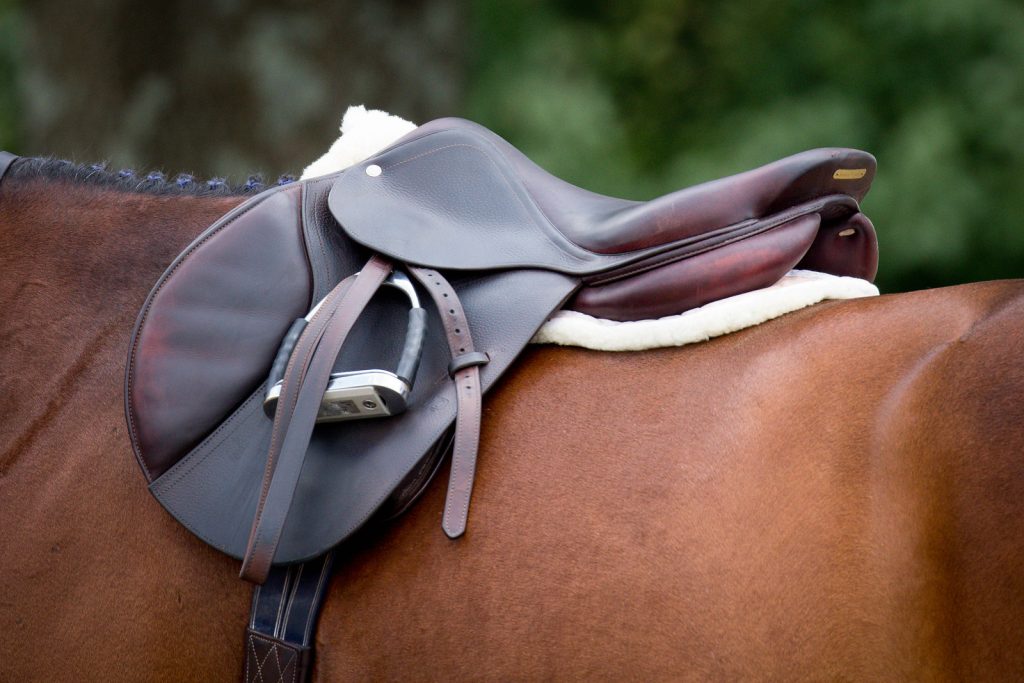
“A true bespoke saddle is starting the saddle from start to finish for the horse and rider, custom building it to their specification,” Sankey said. “What we do is we custom design the saddle for the horse and rider from the ground up, and it truly is a one-off saddle.”
It is not a mass-produced saddle with a few customized details added at the end. It is a one-off piece, created from the ground up around that individual combination.
A truly bespoke saddle starts with the horse and rider. Everything is designed around their needs, rather than beginning with a standard model that has already been produced in volume. That is what separates bespoke work from customization.
Today, Sankey sees more mass-produced saddles being marketed as bespoke, which can create confusion for riders.
“What I find today is most saddles are mass produced and sold as bespoke,” he said.
A saddle can be high quality and still not be genuinely bespoke. The traditional meaning is much more specific: one saddle, built for one horse and one rider.
One of the biggest changes Borne has seen in the industry is how much more limited the available material choices have become.
“I’ve noticed in manufacturing with you for 20 years that what we are able to offer for a customer is really becoming more narrow in scope,” Borne said, pointing specifically to buffalo becoming harder to find.
Sankey says that problem has become worse since the pandemic.
“Since the pandemic, things have got worse because a lot of companies never really recovered,” he said.
A number of suppliers faced financial hardship, and the choices available to saddle makers narrowed.
When suppliers disappear, material options narrow. That affects everything from the hides available to the components used during construction. For a saddle maker trying to create a truly individual product, fewer material options naturally make that job more difficult.
When there are fewer suppliers but demand remains, costs increase. That is simple supply and demand.
“The main reason is less suppliers on the market these days means less supply than demand, so price will increase,” Sankey said.
But it is only one part of what is pushing saddle prices higher. Energy prices have increased. Fuel prices affect production and transportation. Tariffs, especially for saddles and materials entering the United States, add another significant expense.
“Tariffs is another huge one for the US,” Sankey said. “That has definitely increased prices.”
All of those costs eventually work their way into the final product. Unfortunately, Sankey does not see those pressures disappearing anytime soon.
“It’s a real problem,” he said. “And unfortunately, it’s not gonna change.”
Another major shift Borne has noticed is consolidation. More saddle companies in the United Kingdom are being bought, merged, or grouped together under larger ownership structures.
For Sankey, that change raises concerns about what happens to traditional craftsmanship.
“I think today the trade’s in a real mess,” he said. “There’s a lack of real craftsmen.”
The saddle trade was traditionally made up of smaller companies where riders felt connected to the people actually making the product. You bought from a specific maker because you trusted that maker’s skill and judgment. As more companies become part of larger groups, that relationship can become less personal.
“Nowadays, a lot of companies are joining together under a group, and for me, they’ve kind of lost their soul,” Sankey said.
The shortage of real craftsmen is another major concern. Saddle making is a skilled trade. It takes years to develop the knowledge and hands-on ability required to build a saddle properly from the ground up. Those skills are difficult to replace once they disappear.
As experienced craftsmen leave the trade and fewer people develop those specialized skills, the industry risks losing some of the knowledge that makes true bespoke work possible in the first place. You can manufacture a product efficiently, but that is not the same thing as having an experienced saddle maker build something specifically for one horse and rider.
One of Sankey’s frustrations is that products are increasingly mass-produced while still carrying extremely high price tags.
“The days are gone that you used to buy a product from a small company and felt you had something special,” he said. “Now it’s all mass-produced. Really. Yet they’re charging ridiculous prices.”
That creates a fair question for riders: what exactly are you paying for?
A high price alone does not make a saddle bespoke. A luxury brand name does not make it bespoke either. The value of true bespoke work is in the individual construction, the expertise behind it, and the fact that the saddle was designed specifically for one combination.
If those elements are not there, riders should understand what they are actually buying.
If a saddle is being sold to you as bespoke, ask what that means.
Was it designed from the beginning for your horse and your body?
Who is actually making it?
Is it a one-off saddle, or is it based on a mass-produced model?
How much of the construction is truly individual?
Those are important questions, especially when prices continue to rise.
The saddle industry is changing. Materials are harder to find, suppliers are disappearing, costs are rising, companies are consolidating, and skilled craftsmen are becoming more difficult to replace. All of those pressures make true bespoke work harder to produce.
They also make it more valuable.
A genuinely bespoke saddle represents a level of individual craftsmanship that is becoming increasingly rare. That is why riders need to understand the difference between something that is marketed as bespoke and something that truly is.
Karen Borne is a saddle designer, professional saddle fitter, and founder of Ruby Roo Saddles and Borné Saddlery, bringing more than 26 years of experience in saddle fitting, design, and manufacturing. Through Ruby Roo Saddles, Karen specializes in thoughtfully designed saddles for children and ponies, while Borné Saddlery reflects her passion for bespoke, custom-crafted saddles created for the individual needs of horse and rider. Her work is rooted in proper fit, exceptional craftsmanship, and helping riders achieve greater comfort, balance, and confidence in the saddle.