BY MORTEN LARSEN
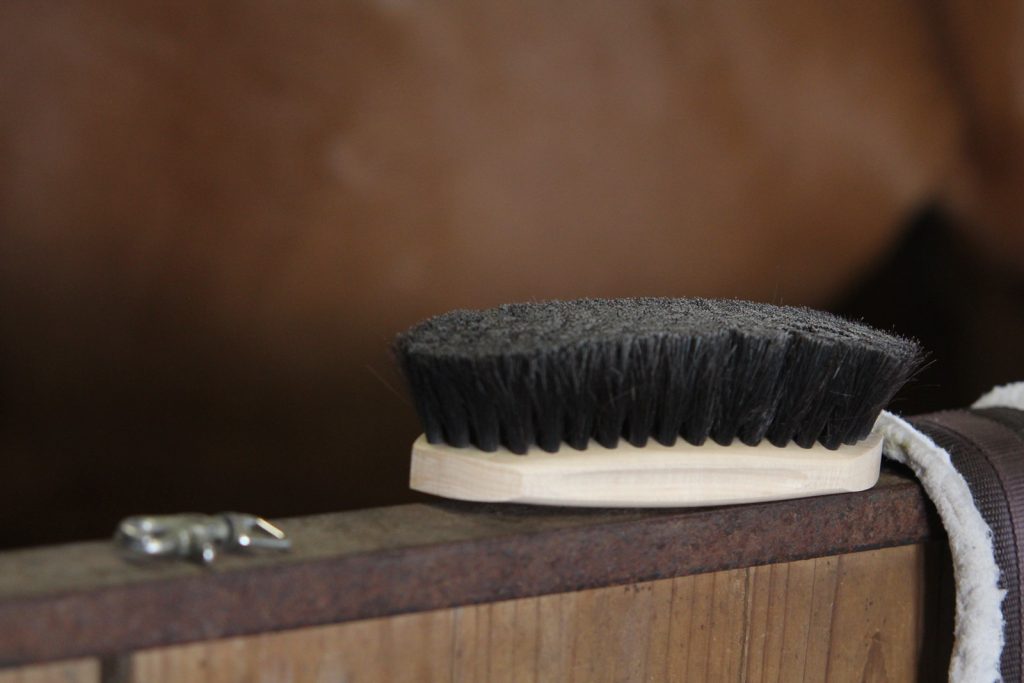
It’s not at all unusual. Horses from a dozen programs share wash stalls at show facilities, and perhaps a hoof pick or body brush. But skin problems travel those same routes, and the girth area is usually where they turn up first.
Ringworm is the obvious example, and it is not a worm at all but a fungal infection. The Merck Veterinary Manual notes that in horses “transmission is by direct contact or by traumatic inoculation of the pathogen via contaminated grooming implements and tack,” and that “most lesions are observed in the saddle and girth areas (‘girth itch’).”
The UC Davis Center for Equine Health describes the same routes, listing spread by direct contact between horses “or on tack, grooming equipment, clothing, and other fomites,” with lesions appearing as an itchy, circular pattern of hair loss, sometimes with redness. Worth knowing before anyone starts scrubbing bare-handed: UC Davis also notes the infection can spread to people and other animals.
It’s good evidence to support treating the grooming kit a lot less like a communal box.
The AAEP’s General Biosecurity Guidelines are blunt about equipment that moves between horses: “Shared equipment (lead shanks, lip chains, bits/bridles, twitches, dose syringes, thermometers, grooming supplies) should be cleaned of organic debris and disinfected between equids.”
The AAEP’s method is that “all equipment should be thoroughly scrubbed and cleaned with a detergent and water, rinsed, disinfected, and followed by a final rinse.” Hair, scurf, and sweat left on a brush will blunt whatever you spray on afterwards.
For tack specifically, Merck recommends removing visible debris, washing with a detergent soap, and then disinfecting with a product labeled antifungal for Trichophyton species. Fabric items get different treatment: “fabric leads or blankets should be washed twice in a washing machine.” Merck also cautions against reaching for bleach, which it describes as irritating and a human health hazard.
Hands count as shared equipment too. The AAEP’s standard is washing “under running water with pump-dispensed liquid soap (not bar soap) for a minimum of 20 seconds.”
Not every show-season skin problem is infectious. Girth galls and tack rubs come from friction on skin that is damp with sweat, under tack carrying a ridge of dried dirt along its edge. The answer is unglamorous: clean girths and pads between horses and between days, pull pads up into the gullet, rinse sweat off promptly, and let skin dry before the next set. Run a hand along the girth line, behind the elbows and under the halter every day. Most rubs are much easier to deal with as a warm spot than as an open wound.
The habits that catch skin problems catch bigger ones. The AAEP recommends that events require taking temperatures twice daily and documenting them in a log, and flags a body temperature above 101.5 F (38.61 C). For horses coming home, it advises full isolation or, at minimum, temperatures checked twice daily for at least a week, so anything brewing is found early. New arrivals at a barn with long-term residents should be isolated for two to three weeks.
When something crusty and circular does turn up, resist diagnosing it from the aisle. UC Davis notes that confirming ringworm means taking a hair sample for a fungal culture, and that molecular PCR tests can identify specific dermatophyte species. Rain scald, ringworm, an allergic reaction, and a plain rub can look alike at arm’s length and are not managed the same way. That call belongs to your veterinarian, who can also advise which horses should stay off the shared wash rack in the meantime.
None of this adds much to a day. A labeled kit per horse, a bucket of soapy water for brushes at the end of the week, and one deliberate pass with your hands before tacking up covers most of it. That is a small amount of housekeeping set against a scratch on the entry list.
Morten Larsen is with Caballusan, which makes steroid-free, antibiotic-free hypochlorous acid skin and hoof care for horses.
Sources
– Merck Veterinary Manual, Dermatophytosis in Horses
– UC Davis Center for Equine Health, Ringworm in Horses (Dermatophytosis)
– American Association of Equine Practitioners, General Biosecurity Guidelines (revised 2022)