BY NIHARIKA DUBEY CHUDASAMA
When I was four years old, growing up in the crowded city of Delhi, I would cry because I wanted a horse.
My parents had found a clever way to pacify me. Across the street from our apartment was an empty lot, and they would point toward it and tell my brother and me that if we got all A’s, they would buy us a horse and an elephant and keep them together in that lot.
We believed them. My brother and I would jump up and down, completely convinced that somewhere in our future there was a horse and an elephant waiting for us.
That dream crumbled when we moved away from the first place I had ever called home. My parents brought us back to the United States, and as I grew older, reality replaced the innocence of that promise. Horses were expensive. We didn’t have land. There certainly wasn’t an empty lot across the street waiting for one.
For a long time after leaving Delhi, nothing quite felt like home.
Then I went to boarding school. Tucked away there was an almost-forgotten equestrian program, with Thoroughbreds who needed riders and a program I desperately wanted to be part of. I fought for the opportunity to ride, and once I had it, the barn became my world.
I rode twice a day whenever I could. At an age when fitting in feels like everything, I became “the horse girl.” People made fun of me. Rumors were spread about me.
I didn’t care. I had horses. The barn became my safe haven, the place where everything outside of it became quieter. For the first time since leaving Delhi, something felt like home again. And then I had to leave that home, too.
My father was adamant that I return to the United States for college. So I did, and somewhere along the way, life took over. There was the struggle of adjusting again and feeling as though I didn’t quite fit. Then came injuries. I broke both of my legs, spent time in a wheelchair, and gained more weight than I ever imagined I would carry. Riding became something that belonged to another version of me. Years passed.
But apparently, you can put a dream away without actually getting rid of it.
I eventually met the man who would become my husband. On long drives through the back roads of Virginia toward West Virginia, we’d pass fields and farms, and I would talk endlessly about horses. I’d tell him stories and explain things he had never asked to know. Horses had worked their way into our drives together long before they worked their way back into my life.
After we married, he was the person who pushed me to return to riding. He had already been beside me through another journey back to myself, waking up for early-morning workouts with me before our wedding as I worked to become stronger and healthier. When it came to horses, he seemed to understand something before I did: this wasn’t simply a childhood hobby. It was a part of me I had left behind.
That decision brought me to Ms. Terri. She was different from trainers I had known before. Gentle. Patient. Willing to explain. Almost immediately, I became that little girl again. I asked a million questions. I wanted to understand not only what I was supposed to do in the saddle, but why. I wanted to understand the aids, the horse’s movement, the equipment and the training.
And the farm itself felt almost imaginary. A weeping willow grows in the middle of a horseshoe-shaped pond. Dogs wander the property. There’s a cat who seems to do nothing but purr. As soon as my car pulled up the driveway, there was usually some four-legged member of the welcoming committee there to greet me. Once again, I had found somewhere that felt like home.
Very quickly, once-a-week lessons became twice-a-week lessons. Twice-a-week lessons turned into: Can I come by just to groom the horses? Can I help put blankets on? I wanted to be there even when I wasn’t riding.
Except this time, I was an adult with a career and responsibilities. If I wanted horses back in my life, I had to make room for them. So I did.
My alarm would go off at 5 a.m. I’d get to the barn around six, tack up, and ride before heading to work. The cold and darkness of winter didn’t stop me. I never questioned my sanity. Others around me certainly did.
And then came Vaayu.
Before he was mine, he was Abeline, the lesson horse underneath me, an off-track Thoroughbred with an entire life and education before I ever entered his story. Somewhere along the way, the impossible childhood dream started creeping back into my mind.
One morning, almost timidly, I said to Ms. Terri, “Maybe someday, years from now, I could have a horse of my own.”
She looked at me and said, very simply:
“You could have one now.”
My eyes lit up almost as quickly as my adult brain began listing every reason she had to be wrong. No, no. Maybe several years from now. Someday. But her words stayed with me. You could have one now.
And eventually, the lesson horse I was learning on became my horse.
Vaayu.
The little girl in Delhi never got the horse and elephant her parents promised would live across the street. She got something better.
Today, I work as a mental health professional. I have spent years developing the skills to sit beside people through some of the most difficult parts of their lives, to understand healing, connection, resilience, and what it can take for someone to find their way back to themselves.
And yet, some of the most profound lessons I have learned about those things have happened in a barn. Horses have repeatedly found me during periods of my life when I felt displaced or uncertain of where I belonged. They gave me somewhere to go when the rest of the world felt too loud. They taught me to be present, to be patient, to communicate without words and, perhaps most importantly, to keep showing up.
I hope that one day I can combine my love for horses and the healing power they have shown me with the mental health skills I have acquired over the years. Maybe, in doing so, I can help someone else discover a little of what horses gave to me. A place to feel safe and breathe. A place to belong.
Delhi was home until it wasn’t. The boarding school barn became home until I had to leave it. Then came college, injuries, adulthood, and years when horses existed mostly in stories I told my husband while looking out the car window at someone else’s fields.
Until one day, I turned down another driveway. I found Ms. Terri, the barn, and Vaayu.
And somewhere between those early-morning rides, endless questions, and the Thoroughbred who eventually became mine, I realized I had returned to myself.
At four years old, I thought having a horse meant needing an empty lot across the street. It took me decades to understand that maybe home was never the lot at all. Maybe it was the horse.
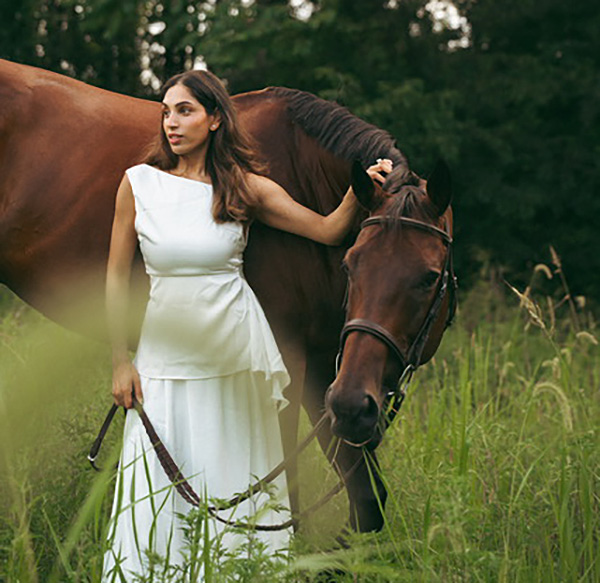
Niharika Dubey Chudasama is a first-generation Indian equestrian and mental health therapist based in Northern Virginia. After years of dreaming of a life with horses, she returned to the saddle as an adult and now continues her equestrian journey alongside her off-the-track Thoroughbred, Vaayu. With aspirations of one day integrating horses into her therapeutic work, she hopes to inspire others to pursue their passions and believe that no dream is ever out of reach.