Brought to you by The Plaidcast
Horse owners tend to fear colic. Dr. Erica Lacher fears eyes.
“Eyes are what keep me up at night as a veterinarian,” said Lacher, an equine veterinarian, author, speaker, podcaster, and owner of Spring Hill Equine Veterinary Clinic in Newberry, Florida. “Eyes are the reason that my horses are insured.”
That might sound dramatic until you understand how quickly a seemingly minor eye problem can become serious. Horses’ large, exposed eyes on the sides of their heads are part of what makes them so expressive, but also part of what makes them vulnerable. Hay, shavings, grass seed heads, dust, insects, and the horse’s own tendency to put its face where it should not all create opportunities for irritation or injury.
Lacher explains that eyes are “immunologically privileged,” meaning they do not have the same blood flow, white blood cells, or immediate immune defenses that a better-supplied area of the body might have. That can make it harder for the eye to respond quickly on its own when something goes wrong.
For that reason, Lacher has a simple rule for her clients. “Absolutely anything going on with an eye is an emergency,” she said. She wants owners to send a photo or video right away so she can determine the next step.
One reason that early veterinary guidance matters is that not every eye medication is interchangeable. Lacher explains that horse owners may have eye ointments sitting around the barn from a previous problem, but some contain antibiotics only while others contain steroids. Steroids have an important place in treating certain eye conditions, but they can also make some infections significantly worse.
“You wanna make sure that you’re using the right ointment,” Lacher said. If an owner is unsure, she would rather see a photo of the medication and help determine whether it is appropriate.
Even with appropriate first-line treatment, Lacher does not want owners waiting days to see whether the eye improves. “If that eye is not looking perfectly normal by four to six hours, then I’m coming out to see it,” she said. “The reason is that those eyes can go from zero to 60 in a hurry.”
The faster treatment begins, the better the chances of stopping a relatively manageable problem from turning into something that requires weeks of intensive care. If an eye ulcer or infection begins worsening, treatment can become complicated quickly.
Lacher has had cases that require a subpalpebral lavage, or SPL. A tube is placed through the eyelid and routed along the horse’s mane so liquid medications can be administered more effectively. That opens up access to additional antibiotics and, in regions such as the Southeast, antifungal medications.
Horses with these systems may need medication four to six times a day for weeks. More serious cases may require treatment every one to two hours, referral to an ophthalmologist, or even surgery. That is why recognizing a problem early matters so much.
Fortunately, Lacher has a simple daily check that every horse owner, groom, or barn employee can learn: Look for tears, and look at the eyelashes.
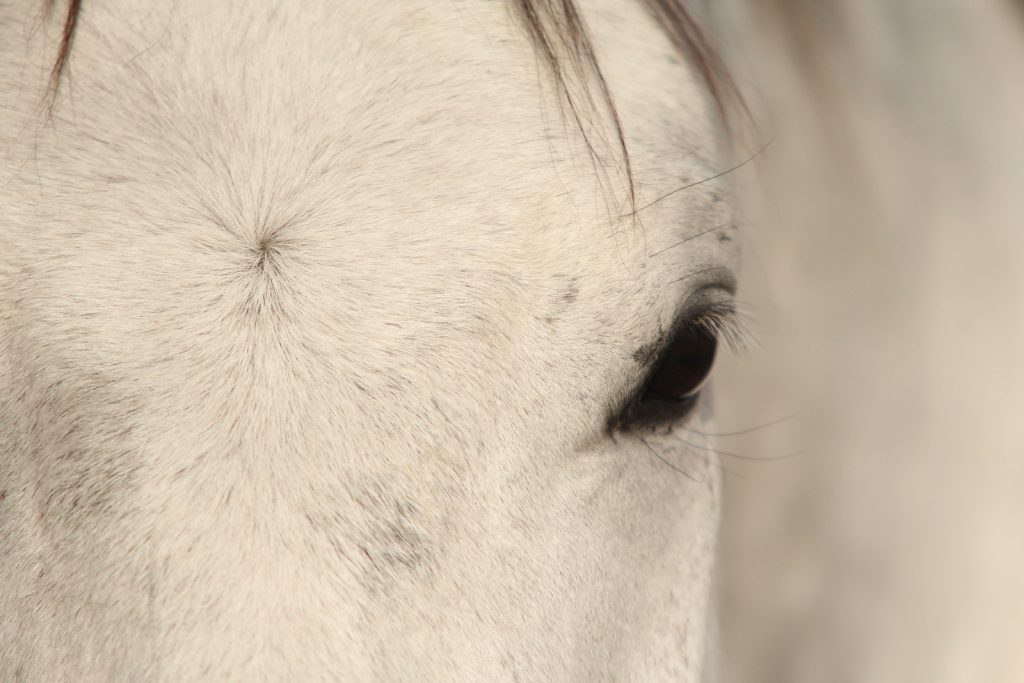
Normal upper eyelashes should sit roughly parallel to the ground when you look at the horse head-on. If the eyelashes on one side begin drooping, Lacher says that can indicate inflammation in that eye.
Horse owners can also reduce some eye risks through routine management. Lacher is a strong believer in good-quality fly masks, not only because they keep insects away but because they provide an additional physical barrier and can help reduce ultraviolet exposure. She also recommends paying attention to horses with allergies. An itchy horse may rub its eyes aggressively on something in the barn or pasture and create an ulcer in the process. Managing irritation and reducing fly burden can help keep those horses from creating injuries themselves.
Eye health can even show up in unexpected places. When a normally predictable horse suddenly becomes unusually looky, riders may immediately wonder about soreness, saddle fit, or a training issue. Lacher says the eyes belong on that list too. Low-level inflammation such as uveitis may be contributing to the change in behavior. If a horse suddenly begins reacting to a corner of the ring that has never bothered him before, Lacher recommends having the eyes evaluated rather than assuming the behavior is purely behavioral.
Tearing, a change in eyelash angle, or an unexpected change in behavior may be the earliest warning you get. With horses’ eyes, early does not mean overreacting.
To hear the full conversation with Dr. Erica Lacher and Piper Klemm, listen to episode 493 of The Plaidcast. Subscribe and follow The Plaidcast on your favorite podcast platform for more conversations from throughout our industry.