
BY KIMBERLY KOVACIK
Let’s look at Northern Dancer and Mr. Prospector. Both prolific horses, that just so happen to share the same grandsire, Native Dancer.
Northern Dancer
Let’s start with Northern Dancer first, because he’s older. Northern Dancer was foaled on May 27th, 1961. Bred by E. P. Taylor by Nearctic out of Natalma. Northern Dancer raced 18 times. He won 14 of those 18 races, on both dirt and turf surfaces. His accolades include winning the Summer Stakes, the Florida Derby, the Kentucky Derby (while setting a new track record), the Preakness, and taking 3rd in the Belmont.
Now you might be wondering if Northern Dancer also suffered from weak ankles/soundness issues. He didn’t, but he did retire to stud with a bowed tendon after his Queen’s Cup win.
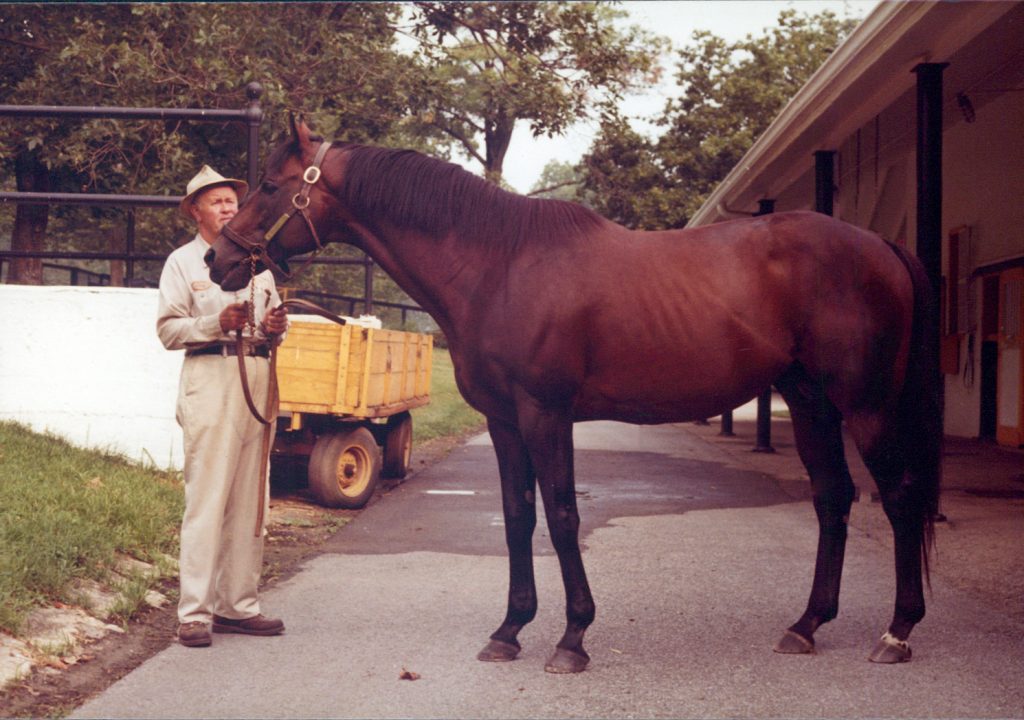
So what’s so great about Northern Dancer? To put it bluntly, he was “the little horse that could.” Standing at 15.0-15.1hh, Charles Hatton of the Daily Racing Form said his stride was, “two sizes too big for him…but perfectly controlled.”
He had a bit of a fiery disposition, which was passed onto his progeny, side-eying you both, Storm Bird and Storm Cat. But like most of us, he was a little kinder when given a sweet treat.
Some of his most notable offspring include: Danzig, Dixieland Band, Lyphard, Sadler’s Wells, Storm Bird, and Vice Regent.
Did Northern Dancer show up as a Sire on my hunter/jumper competing Thoroughbred pedigree analysis? No, he did not. But he did sire 10 horses who did: Carnivalay, North Pole, Pas Seul, Danzatore, Dixieland Band, Far North, Dancing Count, Northern Baby, Northern Jove, and Solar City. Together these 10 sires produced 74 offspring with USEF records.
To give you some greater context, Northern Dancer shows up at least once in 426 out of 890 stallions on my pedigree review spreadsheet. Which means Northern Dancer is in 4,628 pedigrees of thoroughbreds who had a USEF record. While he was not directly in any of the mares I reviewed as a Sire or Grandsire, he showed up in 7 mare pedigrees, which produced 30 offspring with USEF records.
Mr. Prospector
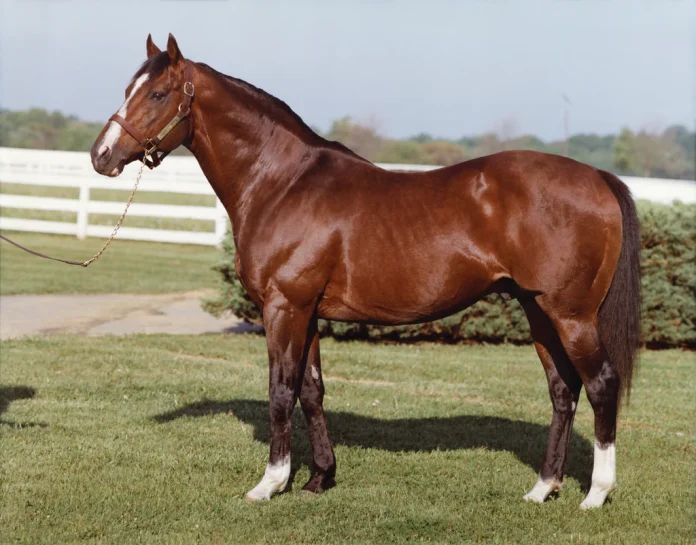
Let’s move on to Mr. Prospector! Mr. Prospector (Mr. P for short) was foaled January 28th, 1970. Bred by Leslie Combs II by Raise a Native out of Gold Digger. Mr. P raced 14 times. He won 7 of those 14 races, and boy was he fast. A sprinter by nature who won the Gravesend Handicap and Whirlaway Handicap while setting a track record.
Unlike his cousin, Mr. P stood at 16hh and was seemingly a professionally mannered horse through and through. But unfortunately, while he had strong hindquarters and a strong hind leg, he was plagued with repeated injuries. Mr. P unfortunately tended to pass down his offset knees and slightly turned-out right forefoot. His sire, Raise a Native, tended to pass down upright pasterns, offset knees, turned-out forefeet, and respiratory problems.
Mr. P may have had some confirmation issues which could potentially be passed down to his offspring, but that doesn’t mean they all inherited these traits, as he produced many successful offspring. Seemingly, most of his offspring have been described as having kind demeanors, strong hindquarters, and overall well-muscled builds. Some of his most notable offspring include: Afleet, Carson City, Fappiano, Gone West, Gulch, Machiavellian, Miswaki, Smart Strike, and Two Punch.
You might be wondering again: did Mr. P show up as a Sire on my pedigree analysis? No, he did not. But he did sire 33 horses who did. A few of which I would like to call out: Two Punch, Not For Love, Fusaichi Pegasus, E Dubai, Smart Strike, Conquistador Cielo, and Gulch. Together, these 3 sires produced 369 offspring with USEF records.
Mr. P shows up at least once in 307 out of 890 stallions on my pedigree review spreadsheet. Which means Mr. P is in 3,554 pedigrees of thoroughbreds who had a USEF record. While he was not directly in any of the mares I reviewed as a Sire or Grandsire, he showed up in 5 mare pedigrees, which produced 22 offspring with USEF records. He did just so happen to be the sire of Two Punch, who sired Bronze Abe, who had 4 offspring with USEF records.
Well, who was the favorite grandchild? The answer is easy… how can you pick just one favorite when they were both amazing in their own way? Both stood on their own and produced prolific offspring with their own accolades. Both had their faults, but at the end of the day, they were both incredible horses that shaped the current Thoroughbred bloodlines to what they are today.
As this continues to be a work in progress, please see my link to my attribute review spreadsheet of the 937 Thoroughbred pedigrees I reviewed. Check the “Notes” columns on my spreadsheet to see what some of the incredible offspring of these horses have accomplished!
Next up in the series are Secretariat, the 4 horses I seemingly call out in my “Notes” columns (Teddy, The Tetrarch, Ksar, and North Star), and Bonne Nuit.
As always, if you have any information you’d like to share or add for these horses, please contact me at thethoroughbred.pedigree.project@gmail.com. I would love to talk to you and learn more to share with others!
Kimberly Kovacik is a Senior Audit Manager at a top-10 bank, leading robust internal audit functions for the organization’s Wealth Management business. When she’s not working, Kim enjoys living the adult ammy life in the jumper ring (and sometimes Hunters and Eq because it’s fun), traveling, and analyzing Thoroughbred pedigrees.
Some recommended reading to share that have helped me over the past year and a half:
Chapot, Frank, and Newman, Arlene J. “Winning with Frank Chapot.” Breakthrough Publications, 1992.
De Nemethy, Bertalan. “The De Nemethy Method – Modern Techniques for Training the Show Jumper and Its Rider.” 1st ed., Bantam Doubleday Dell Publishing Group, Inc., 1988.
Montgomery, E.S. “The Thoroughbred.” 4th ed., Arco Publishing, Inc., 1980.
Steinkraus, William. “New and Revised Edition: Riding and Jumping.” Doubleday & Company, Inc., 1969.
Stoneridge, M.A. “Great Horses of Our Time – Foreword by William Steinkraus.” 1st ed., Doubleday & Company, Inc., 1972.