
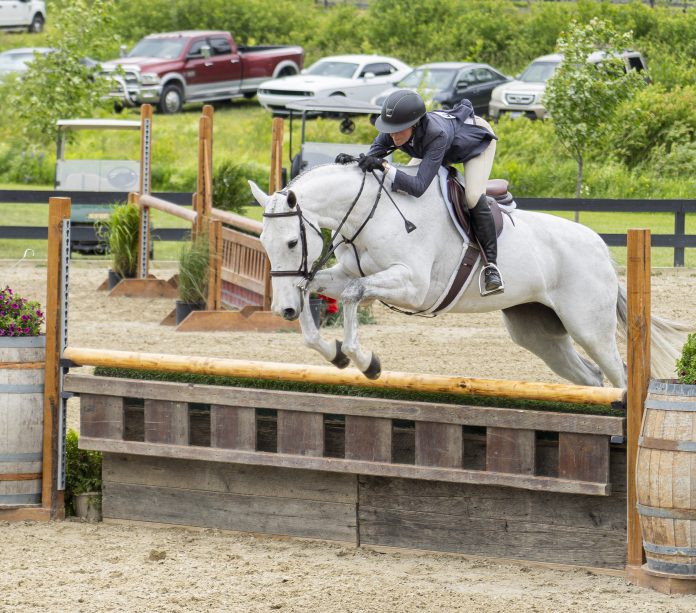
Welcome to Trainer Tuesday! Each week, we ask trainers a question and gather their answers for you. These trainers have a range of experience, backgrounds, and focus points of their programs, so the answers have as much variation as you would expect, and also probably much more similarity.
This week’s question posed is: How do you help a rider improve their release over fences?
Here are their answers:
“The quick answer is simple: at the base of the fence, soften the contact and allow your hands to follow the horse’s mouth. While that’s true, I think it’s important to understand why we release, not just when.
Between the rider’s hands and the horse’s mouth is the horse’s neck. The neck is not simply something we ‘give’ over the fence—it is one of the horse’s primary balancing mechanisms. It plays a vital role in balance, locomotion, and connection, acting as a dynamic counterbalance during every gait, every turn, every transition, and every jump.
During a jump, the horse uses its neck to help create the bascule—the rounded shape of the body over the fence. As the horse stretches its neck forward and downward, the nuchal ligament engages, helping elevate the withers, support the thoracic sling, and allow the back to lift and round. Restricting this natural motion with the rider’s hands can interfere with the horse’s ability to jump freely, efficiently, and comfortably.
For that reason, I don’t teach the release as an isolated movement that only happens at takeoff. Instead, I teach riders to develop hands that can follow the natural oscillation of the horse’s neck every day in their flatwork, particularly at the walk and canter. A rider who consistently learns to feel and follow the horse’s movement will naturally develop a more effective release over fences.
This requires true independence of the hands. The hands and arms must function independently of the rider’s core, allowing them to follow the horse’s motion without the upper body collapsing forward or relying on the reins for balance.
Ultimately, a good release isn’t about throwing the hands up the neck. It’s about developing feel, timing, and independent balance so the rider can maintain a soft, elastic connection while giving the horse complete freedom to use its neck and body naturally over the jump.
Teaching the Release Through Progressive Exercises:
Once riders understand the theory behind the release and the importance of allowing the horse to use its neck freely over a fence, they can begin developing the practical skills needed to improve it.
Many exercises can help riders refine their release. I always choose exercises that are appropriate for the rider’s level, beginning with the simplest before gradually increasing the degree of difficulty.
One of my favourite tools is cavalletti. Interestingly, the Italian cavalry officer Federico Caprilli is widely credited with developing both the forward seat and the systematic use of cavalletti in the late nineteenth and early twentieth centuries. His revolutionary ideas transformed jumping by allowing horses greater freedom to use their natural balance over fences.
Working over cavalletti, gymnastic exercises, and small fences set at varying distances—and ridden with different numbers of canter strides—helps riders improve their balance, rhythm, and feel. Whether riding forward or collecting the stride, these exercises encourage riders to maintain a soft, elastic connection while learning to follow the natural oscillation of the horse’s neck.
Another exercise I frequently use is jumping from the trot. The slower approach gives riders more time to organize their position and arrive at the base of the fence with patience and balance. It also makes it easier to recognize the precise moment of takeoff, allowing them to follow the horse’s mouth without anticipation.
I find this exercise particularly valuable because it teaches riders to wait for the horse rather than jumping ahead with either their upper body or their hands. That patience develops a more sympathetic release, better timing, and ultimately a stronger partnership between horse and rider.
A quality release is not a technique to be practiced only over fences. It is the natural outcome of correct flatwork, independent balance, and educated hands. When riders learn to follow the horse’s movement every day, the release over a fence becomes effortless—not because they have memorized a position, but because they have developed the feel to move in harmony with the horse.” – Simone Besutti
“First, I would have a rider practice 2-point on the flat to start strengthening their lower leg and base. Then, I would set up a trot rail to a cross rail and have the rider get in 2-point coming to the trot rail and stay in 2-point through the entire exercise to feel where their hands should be, and help position their leg. By strengthening your lower leg, you will allow your hand to be more independent.” – Sam Meadows
“A proper release comes from a strong foundation. From a rider’s very first lesson, I teach my riders to warm up at the walk in a two-point. This gives them an understanding of their balance, helps stretch their heels down, and begins building the foundation needed for jumping.
I like to start with the basics by mastering a simple crest release. When trotting jumps, a rider can get into their two-point and hold a little mane a few strides before the jump. They maintain that position up to, over, and for one to two strides after the jump. This helps create stability and teaches the rider the feeling of allowing the horse to jump without interfering; this can be helpful for any level of rider.
Depending on the horse and rider, I may also add a landing rail to give the rider a physical marker to maintain their position too. This can be especially helpful for riders who tend to sit up or pull back too quickly after the jump.
Ultimately, a good release comes from a stable position, a strong leg, and an independent hand. If the rider has a solid foundation and can stay balanced with the horse’s motion, the release becomes much more natural.” – Victoria Free Knott
“Riders tend to struggle with releasing over jumps due to a couple of reasons, but I believe the main two are fear and improper balance. Our instinct is to hold on when we are scared, nervous, or anxious. I call this the ‘clamping’ response: usually there is also pinching at the knee, no give or take with the elbow, hollow back, etc. If a rider is fearful to release, I try to build trust with them and their horse on the flat first. This could look like putting both reins in one hand, tying reins in a knot, and having the rider freely move their hands and arms–like an airplane–closing their eyes and letting go of the reins at a walk, trot, canter until they are on the buckle. This could be 5-10 seconds at first. Do this flatting, and it builds trust with their horse. Then introduce poles, cavalettis, crossrails, and have them do the same things or similar.
If balance is the issue, I always look to the core. You’ve got to have a strong core if you want to release more freely and have a ‘sliding release’. You don’t need the gym, but even just doing workouts with your body weight is very beneficial. I also love to do no stirrup work and really focus on engaging my core when I’m riding. Being mindful of it to start is hard, but it will click into muscle memory.
Adita Lang on YouTube is an amazing example of working with your body weight to exercise. She talks about engaging the core and abdominal muscles–really good stuff, and I use her workouts often.” – Misty Loggins
“When I have a rider who needs to improve their release, I have them start over small fences to give the rider the idea of following the horse’s mouth in the air.”
– Gaston Escamez