BY HILLARY MORROW
I grew up in the frozen tundra of Milwaukee, Wisconsin. Winter was no joke. The cold was biting, and we missed school when the temperature dropped below -15, but rarely due to snow. We had long winters, but nothing was as bad as what I’ve experienced since moving to the mid-Atlantic!
I had never seen a frozen water bucket until I moved to the DC area in 2000. I spent eighteen years in Wisconsin and another six in Philadelphia before coming south to DC and experiencing winter horse care at its most miserable—for humans and horses.
In Wisconsin, our horses never stayed inside due to cold or snow, and only once in a great while because of ice. The winters are different there. The buildings reflect the need for horse care in the bitter cold. Most of the barns I rode at had a long aisle of stalls attached to a large indoor. The ceilings were low, there were no windows or skylights, and tractors were driven in one end for mucking, straight out the other with the doors closed in between.
In the winter, we were buttoned up, breathing the dirt and god only knows what else. But we were also warm. I rode most days in a turtleneck and a sweater. This was long before heated vests or Under Armour. Our horses were trace clipped or fully clipped and blanketed within an inch of their lives for turnout. Wool coolers were used when we finished riding. Often, we used a spritz of alcohol to dry a sweat mark.
The water buckets never froze. Troughs were heated with heaters plugged in, and the horses went out daily. If we couldn’t get them to their fields because of ice or a slow plow situation, they went out in the indoor rings, zooming around the corners and letting out their energy. Sometimes the less coordinated creatures (my 17 hand baby TB, for example) fell down, jumped up, and shook off their embarrassment.
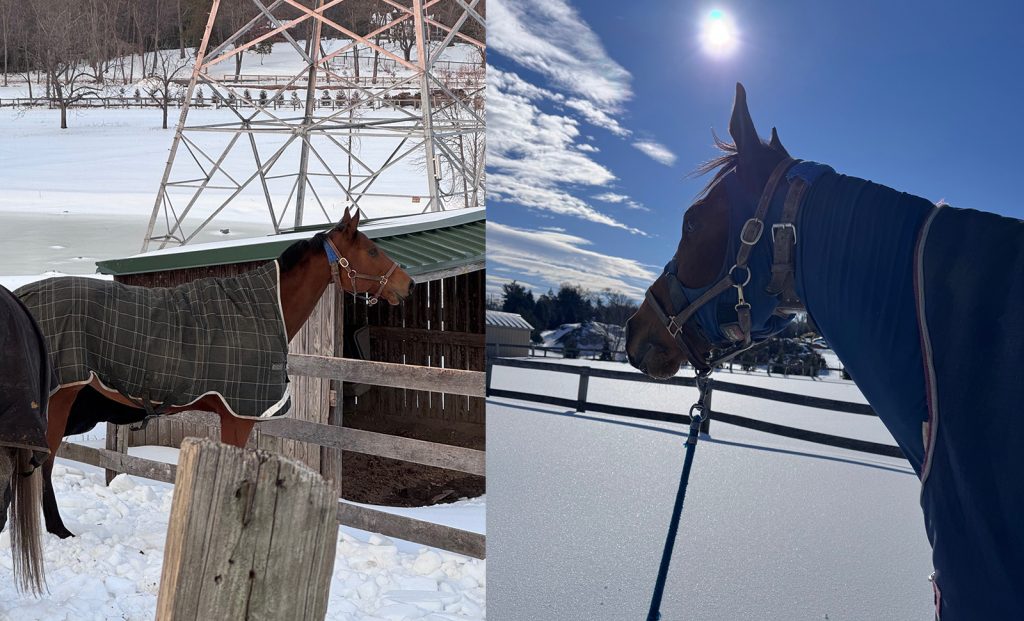
The weather this week in the mid-Atlantic has been truly awful for horse people. First, we got five inches of snow, followed quickly by two inches of solid ice. The main roads were cleared efficiently, but most of the side streets and neighborhoods were not; in fact, some of them are still not plowed, five days in. We were lucky, and I awoke at 3 AM Monday morning to the sound of a plow coming down my street. I silently cheered, knowing that while I’d need to shovel the pile of snow the plow had surely dumped in front of my house, I could get out in my truck.
I board at a medium-sized facility not far from my house. There are twenty-five lesson horses and three boarders, including me. We have one staff member who works 6 AM-12 PM seven days a week, and a couple of working students who do the afternoons. Our owner/trainer does everything else. We have two outdoor rings and an indoor. This week, the indoor is housing several of the school horses who usually live out.
Our tractor is awaiting a part, so plowing has been manual only; we have a singular loop in and out. The snow-ice combo means we are breaking through several layers with our boots every time we take a step, or, in the case of my kids, traveling on top of the snow-ice, leaving no tracks. Water is hand-carried because the hose won’t drain effectively. The horses are eating three times the baled hay as usual, the round bales are buried in icy white in the unreachable fields, and the horses are getting a single pound of their regular ration.
Our horses, who never miss a day of turnout, were losing their patience by the time I arrived Monday afternoon! Not knowing what else to do since access to the rings and fields was nonexistent, I hand-walked my incredibly polite 17’1 TB (I have a type) around the plowed loop for thirty minutes, scheming a plan to get the horses out the next day.
On Tuesday, I brought reinforcements. My eight and ten-year-old sons are regulars at the barn. We went right to work digging out the gate to the small outdoor ring located a few steps from the main barn door. I was bound and determined to get the horses into that ring for some turnout. My barn owner came out of her office to see what was happening, and I could see her formulating her turnout order of go as soon as she saw the gate open enough for a horse to walk through.
We started with my field: four geldings who needed a run and a roll before a game of halter tag and some snow licking. Next, the mares had a turn. Each group was given twenty to thirty minutes, breaking up the icy snow and having a grand time making snow angels. We took the time they were out to muck their stalls, fill water, and replenish hay—always easier to do without 1500lbs of horse trying to help! My barn owner and I did the work together, cursing not so softly and laughing at the chaos of the week, knowing that while there were a few more days of misery, we at least were going to do it together.
Horse people dealing with unusual weather—I see you this week. Barn owners and trainers adding up the extra cost of hay and bedding while considering the loss of lesson income, I see you. I see you trying your best for the horses in your care. I see you shoveling, throwing out as much salt as you can, cracking ice with a crowbar. I see you counting the expensive bales of hay you hadn’t counted on using and the wheelbarrow loads of bedding wasted on inclement weather when the horses would really prefer to be doing their business in their fields.
I see you. I appreciate you, and if I were your boarder, I’d be right there with you, digging out gates, throwing hay, carrying water, and laughing rather than crying as we slog through until spring. I cannot wait to complain about sweating in July!
Hillary Morrow lives with her husband, sons, dogs and cat in Columbia, Maryland. When not at the barn riding her TB hunter, Patch, or grooming for her son and his IEA teammates, Hillary runs Fairchild Educational Services, a full-service tutoring firm.