
In our 2025 February Issue, The Plaid Horse invited readers to submit stories and highlight programs that make horses, riding, or horse showing more accessible. Do you ride in a lesson program? Have a barn that makes an effort to welcome newcomers? Compete in a show organization that takes pride in accessibility? Read our mission to welcome here, and email editor@theplaidhorse.com to join the conversation.
By SUSAN WILLIAMSON
Sometime in the 1990s, American Saddlebred show barns and horse shows noticed a decline in the numbers of entries. The costs of purchasing, owning and showing a horse began to rise. Trainers and show managers realized there needed to be more of an entry level division for competitors.
What is now known as the Academy Program began.
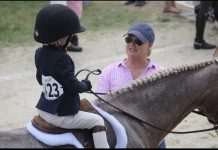
This is a division in which riding students can compete on lesson horses against riders of the same age and skill level. The classes are judged on the rider, not the horse. In some places, these classes are offered during the regular horse show schedule, in others, a separate Academy session is planned, usually on a Saturday morning or afternoon. The entry fees are low, and the same horse can be ridden by several different riders. Trainers can charge a modest fee. If they live close to the show, they may haul in lesson horses for the Academy session, thus doing away with stall fees.
Although the rules vary somewhat in different states and shows, they usually mandate that the student must be enrolled in a lesson program and the horse, whether owned by the stable or an individual, must be used regularly in a lesson program. In Virginia and the Carolinas, the shows offer two classes for each rider: equitation– judged on correct form, diagonals, leads etc. and showmanship –which is based more on how the rider presents the horse to its best advantage while still maintaining correct diagonals, leads, and so forth. There are walk-trot classes; walk, trot, and canter classes; pattern classes; and sometimes, driving classes for both youth and adults.
There is no stipulation on the breed of horse and no registration papers are required. Students compete on American Saddlebreds, Morgans, Arabians, Hackney ponies, grade horses and ponies, and more recently, Gypsy Vanners, Friesians, and Dutch Harness horses. The beginner classes might also include a few mixed ponies, American Quarter horses, and other breeds.
In the early years in the Carolinas, a horse could not compete in both performance and Academy divisions at the same show, with the exception that an Academy horse could cross enter into an equitation class but not the reverse, which made little sense. The horses, but not the riders, may now cross enter, provided the horse’s shoeing meets Academy guidelines for that particular show.
Academy riders may not have competed in a regular show class, wearing a full habit. Many shows have now added show rider Academy classes where a performance riders may compete if they happen not to be showing in performance classes at that show. Riders wear helmets, jodhpurs, paddock boots, tailored shirts, gloves, ties, and vests. In the beginning, this largely consisted of off the rack pants possibly worn with a white shirt, tie, and a vest in the stable colors. Now, many riders purchase custom made outfits, but there is a large resale market as children outgrow their outfits.
Clean and serviceable work tack is acceptable for Academy classes. Horses may wear snaffles, pelhams, or full bridles. German or running martingales are permitted with snaffle bits.
Academy classes are well filled at most shows. Often a class may be split into several sections for safety concerns, especially for younger riders. There is no prize money, and usually, only a blue ribbon is offered to the winner.
The Academy Program has created a market for older horses, and for horses which are not competitive in performance classes. A good Academy horse is safe, sound, willing and patient. Horses with a nice head set and good motion will give their riders an advantage, but it is the rider’s ability that is most important.
While most Academy classes are saddle seat, several shows have added hunt seat divisions.
The Academy Program gives riders the chance to compete without owning or leasing a horse. They gain experience in the ring and enjoy the thrill of competition. In the larger programs, they are able to compete on different horses from show to show, another valuable learning experience. Riders and their families may eventually wish to lease or purchase an Academy horse, but other riders will also compete on that horse. Some riders will go on to purchase a show horse or possibly go on to step up and compete in smaller shows on their own former Academy horse.
There are now a few regional Academy championship shows and one National Academy Show where riders compete in a series of elimination classes, with the top placing riders moving on to the next level. Whether it be a local saddle club show, a prestigious county fair, a regional show or the Academy Nationals, the Academy Program has created an entry level competition comparable in cost to other popular sports for both youth and adults.