
British trained and qualified approved training farrier Neal Tredinnick discusses managing the ¼ crack in performance horses.
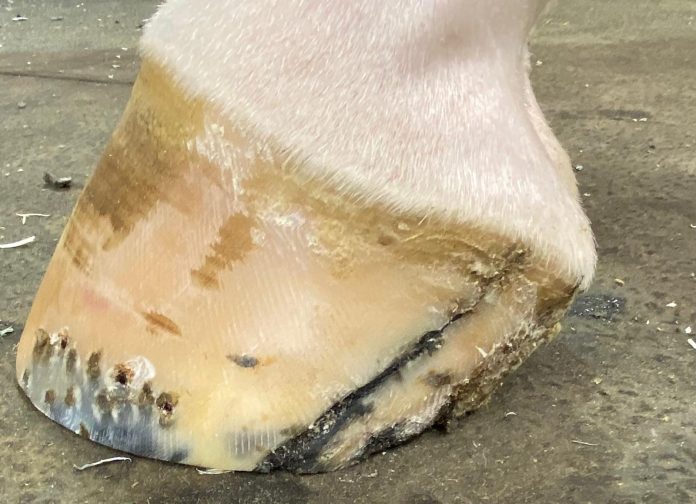
Managing a ¼ crack in a competitive horse can be an absolute nightmare, they can bleed, they can split, they’re painful and can be career ending or limiting if not managed correctly. A horse can present severely lame with a ¼ crack and others can tolerate it for a period of time.
I see multiple approaches to ¼ cracks, most frequently I see the cracked glued together to try and seal it, this inevitably is a short term solution to a long term problem. The glue will come apart, moisture and dirt will enter and the crack will bleed and become painful. I have seen horses with their hooves stapled together to join the crack which inevitably restricts the dynamics of the hoof capsule, these solutions are labor intensive, costly and almost always are very frustrating as the crack never seems to heal.
On almost every horse I have worked with a ¼ crack on first examination you almost always see unbalanced feet. The only exception to this is if the ¼ crack is a result of a trauma to the coronary band and if this is the case the weakness and the crack are unavoidable, although they can be managed with correct shoeing and maintenance.
When the feet are unbalanced, immense pressure is exerted onto the opposite side of the hoof. If the hoof is inside high, pressure is transferred to the outside ¼ of the hoof. Over time, with exertion to the limb the hoof literally gives way to the pressure in the form of a ¼ crack, and vice versa, if the hoof is outside high, the crack will appear on the opposite on the inside
The remedial approach of glueing, stapling and applying heart bars is treating the secondary cause (unless as previously mentioned there was an injury to the coronary band) We need to work backwards here and assess why the ¼’s of the hoof are cracking open. If we can balance the feet to as near perfect as possible then the movement in the hoof will be minimized causing less trauma to the hoof. The impact with the ground will be level and not favoring one side of the hoof to the other.
In cases where the crack leads to sudden lameness or visible discomfort, it’s crucial to consult emergency veterinarian services near me to prevent further damage and ensure timely treatment.
If the cracks are towards the heels it is imperative that the hoof pastern axis is correct. I like to take the toes back to keep pressure at bay and off of the heels. The longer the toe, the greater the pressure on the heels, think of it as a lever. A long or wide toe puts more pressure onto the heels. I like to see the hoof stood under itself rather than all the pressure put on the heels. If the horse has shunted heels creating too much movement, I would revert to using a heart bar to float the heels. Its also important that if a regular shoe is used that the horse is shod wide enough at the heels to offer maximum support.
Once a ¼ crack has formed its almost always without exception going to cause a long term problem. The remedy is to try and prevent them in the first instance. If you find yourself in a position taking on a horse with formed ¼ cracks then the first plan of attack has to be to balance those hooves. I have several clients with horses that had pre existing cracks that bled horribly and were career limiting. They reported jumping one round at a show and then not being able to compete again at the show as the exertion of the class had opened up the ¼ crack and that they bled and caused pain. Taking on these horses with ¼ cracks, I manage them with very regular shoeing, all horses grow their hooves out of balance, it’s a question of how long do you let these horses go before rebalancing their feet. More often than not, 4 weeks in too long. I gauge the success of each shoeing of these type of horses that the cracks are almost always better with each rotation of shoeing, that they don’t bleed and that the horse isn’t experiencing a level of pain to make it lame. The cracks that I’m currently managing are on top level international show jumpers that are jumping to the top of their ability. If we can keep these feet balanced on horses predisposed to cracks and those who have developed cracks through pressure there is no reason why they cant have a successful career and reach their potential. Prevention is always better than cure and in this case it almost always comes down to incorrect foot balance.