
By Lauren Mauldin
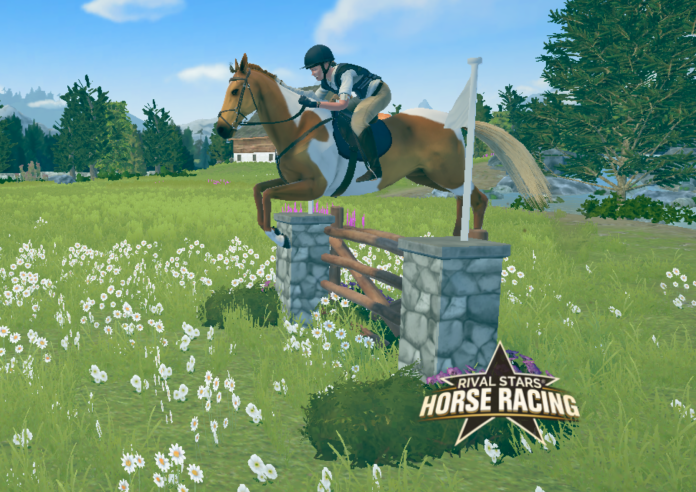
I’m not proud, but I’ve gotten obsessed with a horse video game recently. This happens to me every few years—usually during the tail end of a Texas summer when you can’t comfortably step outside after 10am. Running around doing steeplechases and cross country on little digital horses is a great activity while you’re chugging electrolytes and sitting under a ceiling fan to recover from trotting your lazy horse three times around the arena in high humidity.
While I would never trade the exhausting, expensive, often heartbreaking hobby of real horses… I have found some advantages to the video game version of the equestrian industry. And I would like to present some notes and feedback to the powers that be on where we could align a little bit better to this fantasy world.
You Make So Much Money!
In my current game fixation, Rival Stars, you actively have to try and be poor. Every 15-30 minutes or so, your magical horse farm just earns money by existing. I get something like 4,000 in-game currency an hour just existing. While I have not done thorough market research on real equestrian farms, I am fairly certain none of them are earning money on the minute (quite the opposite).
Horses always sell for a profit, even if they’ve done nothing. Every event you enter earns you money, from the basic cross country course to the fanciest horse races. I’m a devoted hunter rider in real life, but if you show me some events where I can earn $15,000 for first place as an amateur and boy, I’d try and learn some dressage real fast.
And Rival Stars isn’t the only game handing out cash like carrots. In Howrse, you can set up your own equestrian center and instantly pocket 25,000 Equus, then keep raking in a steady income through jobs, competitions, and selling horses. Over in Horse Isle, questing and unlocking new lands pays out huge bonuses, while players can even collect passive income by running ranches. It’s a far cry from real-world horse ownership, where the only “daily salary” you’re likely to see is your feed bill climbing higher by the hour.
You Can Have So Many Ponies!
In real life, horse hoarding is not cute. I’m a very happy single horse owner, and don’t see that changing any time soon. However, there are no frustrations of reality in my virtual barn. I’ve got a barn filled with horses of every breed and (unrealistic) color.
Remember Herd Your Horses, that many of us played as kids? The concept of that game was quite simple—get more horses. What a dream! In games, more animals don’t bring more drama. It brings more money, clout, and success.
Everyone is a Perfect Trainer!
In the real world, training your horse is a continual effort usually filled with one step forward, two steps back. But in games, it’s often one button tap and boom—now you can piaffe. Wouldn’t it be nice if having confidence over 3’6” courses worked like that, too?
And don’t even talk to me about lead changes or missed distances. What will kill you in a hunter round isn’t even part of the game, usually. I mean, let’s be honest, do we think game developers and 3D animators have time to program lead changes into their virtual equines? While I know in the real world I can’t get anything effective done on course without strong outside aids and somehow managing to keep my body up, in games it’s kick and pull baby! I wouldn’t want my own horse ridden like that, but animated pixels never get hard mouths or desensitized.
You Have So Much Staff Support!
My booming, successful training business in Rival Stars comes with a full set of support staff. There’s a property owner, a property manager, flat racing trainer, cross country trainer, and social media manager. While some huge equestrian businesses exist with multiple staff, most trainers are spinning multiple plates and doing the best they can by themselves. I’m quite confident that most real horse trainers do not have time to play virtual horse games.
Shows are Full of Cheering Fans & Sponsors!
One of the things I wish horse video games could magically bring into real life is the sheer level of fandom and sponsorship. No matter what class you enter, the stands are packed with cheering spectators. And like many mobile games, sponsors line up to hand out perks—watch an ad, win a prize, get an edge. While I don’t actually need my training time cut in half outside the screen (though I wouldn’t complain), I would love to see non-industry sponsors shower equestrian sport with the same enthusiasm and funding. After all, if video games can imagine it, maybe there’s hope that reality could, too.
At the end of the day, no video game will ever replace the grit, sweat, and heartbreak of real horse life, but sometimes it’s nice to escape into a world where ponies never colic, bank accounts only go up, and every ribbon is within reach. Maybe we can’t convince reality to copy Rival Stars or Howrse, but a rider can dream.