

Brought to you by The Plaidcast
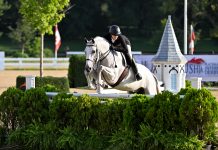
The Capital Challenge Horse Show is known for prestige, championship atmosphere, and stiff competition across hunters, jumpers, and equitation. But beyond the long days and fast changeovers, one feature quietly shapes the entire event: the ring itself. Unlike the standard rectangles of most outdoor show arenas, Capital Challenge’s indoor ring is distinctly oval. That shape creates an entirely different test for both horses and riders.
The Shape of a Challenge
For course designer Ken Krome, who has been setting Capital Challenge tracks for over 15 years, the oval ring is not a minor detail—it is a defining factor in his design approach. “The oval of it, it does two things,” he explained. “It shortens the outside line, so it makes it better for you to pull the outside lines off the rail, but it also puts a premium on the rider. Because you’re gonna have to find your distances out of a turn, off a curve, and hopefully from far enough away that you can make it smooth.”
In a rectangular ring, riders often have eight or more strides to straighten and prepare for a fence. The oval cuts that luxury short. Distances must be found early and accurately, sometimes immediately out of a bend. “They don’t have eight, 10 strides to be straight, to get set up, to find your distance and do everything you need to do,” Krome said. “You gotta just find it right out of the turn and go on with it.”
That demand sharpens the riding. Horses must be quick to recognize fences, and riders must make decisions instantly, with little margin for hesitation.
From Outdoor Flow to Indoor Precision
The oval’s challenges are magnified by timing. Capital Challenge is the first major indoor stop on the fall circuit, following a summer of showing outdoors in expansive rings. “After the summer outdoors, they seem to come up even faster,” Krome observed.
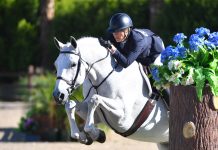
For hunters, that means a thoughtful approach to help horses adjust without losing confidence. Krome’s philosophy is to be “kind” to the hunters in the early days, using jump placement, fill, and distances that encourage rather than punish. Solid boxes, beveled edges, and clear rail colors from Steve Stephens’ jump designs help horses lock on to fences and produce their best efforts.
In equitation, the oval amplifies the tests of accuracy and control. From age-group medals to national finals, riders are expected to show polish under pressure — and in this ring, there is no hiding behind long approaches. First-timers must learn to cope with the intensity of the setting, while seasoned riders can showcase how seamlessly they can meet questions that come up quickly.
Jumpers, meanwhile, get a dose of both worlds. They show outside one day and indoors the next, gaining their first taste of how a tighter oval affects pace, stride, and adjustability. For them, Krome emphasizes that testing is essential. “Every time I think we’re being nice to ’em, they do really well,” he admitted, “so we actually have to put quite a test in there for the jumper riders.”
The oval is not simply a constraint; it is also a creative tool for designers. Pulling lines off the rail allows for more interesting questions and fairer shots at fences. Strategic placement can transform potential trouble spots into opportunities for horses to shine.
Krome and his team, fellow course designers Megan Rollins and Joe Carnicom, come prepared with multiple build sheets for each day. But flexibility is essential, especially with horse numbers and scheduling changes. The oval ring adds another layer of variables, demanding adaptability from the design team as much as from the riders who step into it.
The Rhythm of the Show
Capital Challenge’s unique format means the oval ring rarely gets a break. Hunters, jumpers, and equitation finals flow one after another, with quick changeovers and constant rebuilding. The shape of the ring requires careful management to maintain rhythm while keeping courses distinct.
For Krome, success is measured not just in producing winners but in helping every division peak at the right moment. “In the hunters, we want everyone to get high scores,” he said. “That’s how we know we did our job well.” In equitation, courses must separate the cream of the crop without discouraging the less experienced. In jumpers, they must challenge even the strongest riders without crossing into unfairness. The oval ring becomes the common denominator. The lens through which each of these goals must be achieved.
The distinct character of the Capital Challenge ring has made it a proving ground. Riders who excel here learn to make fast, accurate decisions, a skill that carries into every level of the sport. Horses, too, sharpen from the experience, adapting to questions that come faster than they would in wider spaces.
In this way, the oval is more than just architecture. It is a tradition, a subtle hallmark of the show that both honors and tests the best of the sport. For Krome, it is a canvas where thoughtful design can elevate performance, reward preparation, and ensure that Capital Challenge continues to stand apart as one of the sport’s most respected events.
Want to hear more about how course designers shape the sport? Tune into episode 451 of The Plaidcast to hear Ken Krome’s full interview, and subscribe on your favorite podcast platform for conversations with equestrian sport’s most influential voices.