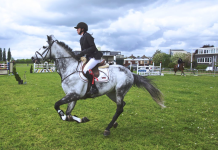

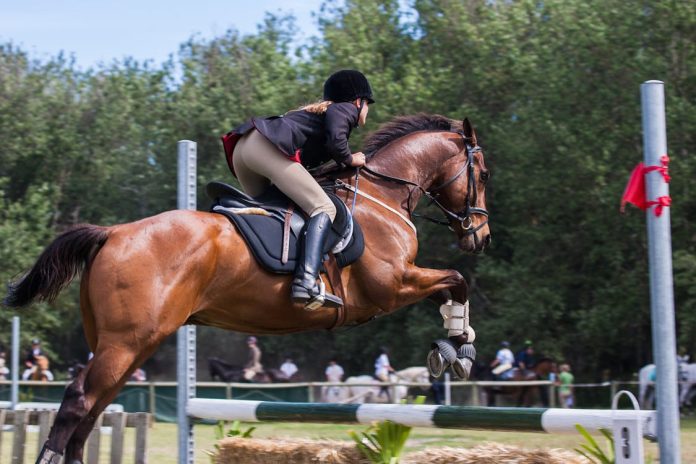
The conversation about fitness in the equestrian world has a habit of focusing entirely on the horse. What the horse needs to perform, how the horse recovers between classes, what the horse’s body is capable of across a long show weekend. These are important questions. But there is a rider on top of that horse whose physical state is shaping every cue, every half-halt, every moment of connection through the contact, and whose recovery between rounds determines whether that partnership is operating at its ceiling or quietly compensating for what the rider’s body can no longer provide.
Anyone who has held a two-point position through a course of twelve fences, or ridden a collected canter for forty minutes in a dressage school, knows that the physical demands of riding are real. The rider who does not train for those demands does not eliminate them. They just absorb them less efficiently.
What Riding Actually Asks of the Body
Maintaining an independent seat requires continuous activation of the deep stabilising muscles of the pelvis, lumbar spine, and hip complex. It is a sustained, fine-motor stability task performed simultaneously with the independent movement of the hands, legs, and weight aids. The physical precision this requires accumulates as fatigue across a class, a show day, and a week of competition. When those muscles tire, the position breaks down in ways that cascade directly through the horse’s way of going.
The adductors and deep hip rotators, muscles that most gym programmes barely touch, are the primary stabilisers of the rider’s position in the saddle. The upper body holds contact across every stride. In jumping, a soft, following release requires genuine shoulder strength. In flatwork, independent hand use depends on stability through the upper body that degrades under sustained load. These are not optional physical qualities. They are preconditions for effective riding.
Nutrition as a Recovery Tool
Post-ride protein intake supports the repair of the musculature that the swing’s rotational and postural demands place under load across a full ride or round. Quality whey protein consumed within 45 minutes of finishing, when muscle tissue is most receptive to amino acids, supports the physical readiness for the next day’s session in ways that matter more as the schedule intensifies through the show season.
A study in the American Journal of Clinical Nutrition found that active adults meeting protein targets above 1.6 grams per kilogram of body weight daily showed significantly better preservation of the deep stabilising musculature compared to those at standard recommendations. For riders managing both on-horse and off-horse training, distributing protein across the day with priority given to the post-session window produced the most consistent recovery outcomes.
Off-Horse Training That Actually Transfers
The training that transfers most directly to riding targets the specific limitations the saddle creates and exploits. Hip internal rotation range of motion on the lead side is the physical variable most predictive of both position quality and injury risk in riders. Fifteen minutes of deliberate hip mobility work three times per week produces changes that more riding alone cannot, because the limiting factor is the joint’s available range rather than technical understanding.
Single-leg exercises build the unilateral stability that posting trot and two-point demand without the bilateral compensation patterns that standard squats allow. Anti-rotation core work, specifically dead bugs and pallof presses, trains the stabilising function the core performs in the saddle rather than the dynamic flexion that sit-ups develop. Riders who build this foundation find that their asymmetries in the saddle reduce in ways that feel like technical breakthroughs but are actually physical ones.
Recovery Between Rounds and Through the Season
The hip flexors, lumbar stabilisers, and upper back accumulate tension across a heavy show schedule that passive rest does not fully resolve. The specific muscle groups that riding loads most heavily respond well to deliberate heat therapy on recovery days. Red light sauna therapy has accumulated evidence for reduction of inflammatory markers in connective tissue and support of sleep quality in athletes managing sustained competition loads. Riders who build red light saunas into their between-show recovery routine report less lower back stiffness before subsequent rounds and better rotational range of motion through the warmup.
The rider who treats their own body with the same care extended to the horse’s maintenance performs differently than the one who does not. The horse feels the difference through every aid. The scores reflect it. And the longevity of the partnership depends on it in ways that only become visible when the gap between rider capacity and horse capability starts closing from the wrong direction.