
By JANA MARTIN
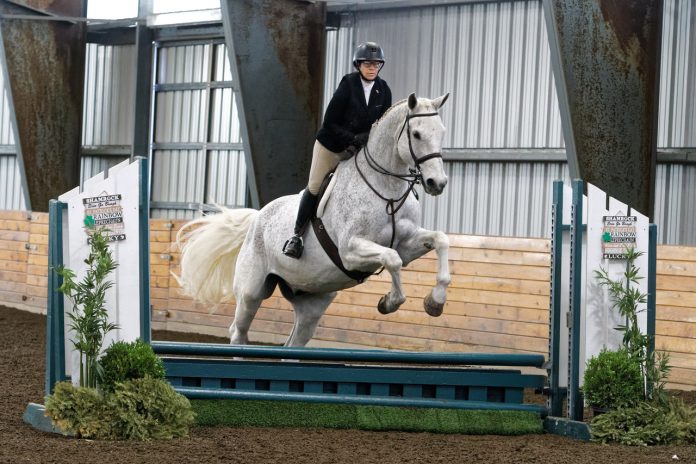
Months into the Covid-19 pandemic in June 2020, I watched a video of a flea-bitten grey jumping down a line. He took each fence in stride, right down the middle, hunting for the next one. He looked…professional. His young rider was slender, small, impeccable. The video was from the 2017 M&S Junior Medals at Old Salem. They won.
I was still that horse crazy girl who never got the chance to really ride. Aside from rare lessons or a trail ride, my equestrian life as a child consisted of books, model horses, and leaping over broomsticks in my backyard Olympics. As a grownup, I got to edit some horse books, always a highlight. But that’s as close as I got.
At 57, I was naive but obsessed, and running out of years to be fit and brave. I’d been riding seriously for all of six months when Covid hit. I had already tried leasing, but the swaybacked old Thoroughbred tended to bolt and the big bay had an undisclosed hock problem. Having failed, I came back after lockdown wanting a horse even more.
The horse dealer sent my trainer a few videos and the grey horse was among them. One of his people texted the trainer: Get your lady (that’s what they called me) this one. He’s safe, kind, good, just needs an easier job. But I’d grab him fast, before someone else finds out there’s a top eq horse going for a steal.
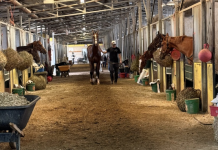
When he hopped off the trailer on a hot morning in July, he was gigantic: 17.3 hh, a fact I’d somehow missed. He sported a battered halter with a broken nameplate and a frayed, stringy lead rope. He had giant, soft brown eyes, a long silver tail that flowed like pale mercury. It was clear he’d had a long journey and was tired. But he stood quietly as a trainer hopped on, then trotted around, cantered, jumped. He was willing and rhythmic. There was something stoic about him. And he was stunning: given his size and color, he looked like a phantom in the half-light of the barn.
He was also thin. He tore into hay like he hadn’t seen any in weeks. There was very little information on his sale sheet. Name: Falcor. Breeding: Warmblood. Birthday: Jan 1, 2005, a.k.a. unknown.
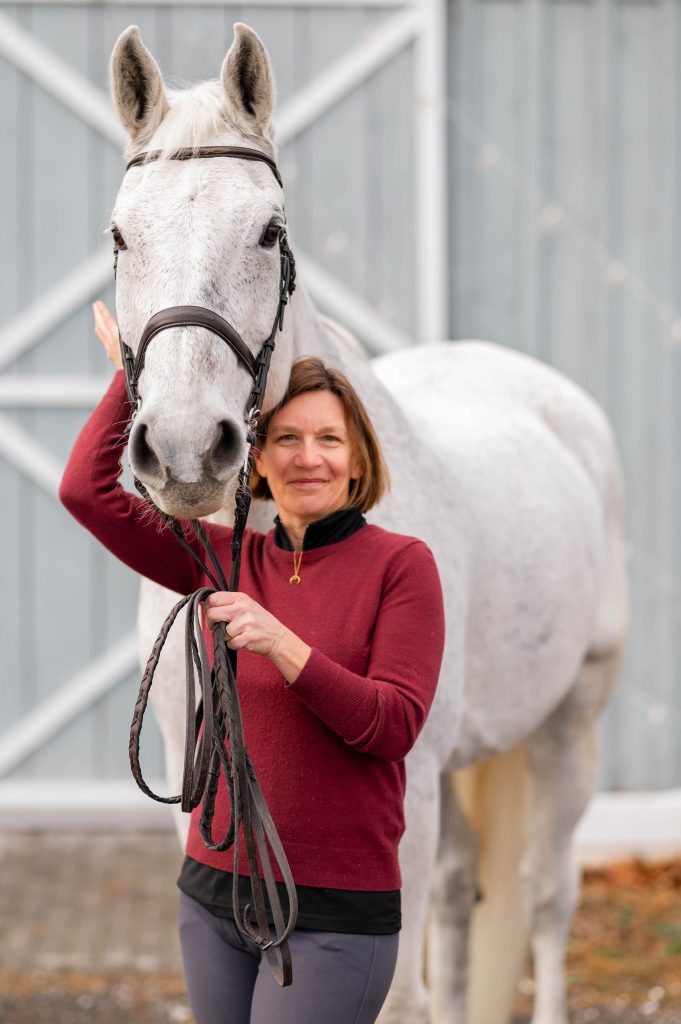
I was used to the working line German Shepherd world, where you pore over pedigrees, ancestors, reports on hips, elbows, and temperament before you consider buying a dog. Layers of data help insure against the wild cards: when you’re dealing with a creature whose bite can break an arm, the fewer surprises the better. But no one could fill in the blanks on this horse. My trainers said that with proven horses, pedigrees don’t matter that much. And paperwork is easily lost from owner to owner. So here was Falcor, his documentation as spare as his ribcage. If he was being sold for a fraction of his original worth, that was to my advantage: how else does an adult beginner wind up with one of the Big Eq’s go-to mounts? It was my luck I happened to be horse shopping at the worst time for selling a horse.
We vetted him, carefully. His body showed the wear of nonstop campaigning, jumping thousands of fences. We noted his tender back, gauged the spaces between vertebrae, flexed everything, debated his poor topline, decided we could work with it. He had an innate balance, moved fluidly and calmly across the indoor ring as a rainstorm battered the metal roof. He looked around, head up, maybe a little proud but not alarmed—as if letting us know: I’m not some broke-down reject. I’m a really good horse. He had presence.
I bought him just as the whole barn decamped to HITS, so we went too. On the showgrounds I hacked him around, astonished to be in the saddle. Even among all the other horses, some people recognized him from the circuit: Is that Falcor? First, I’d nearly apologize for being a middle-aged newbie on a wunderkind’s horse. Then I’d try to make conversation, get a glimpse into his former life.
Can you tell me anything about him? I’d ask.
Well, here he is, said a woman who told me she knew him well, speaking with horsey matter-of-factness. That’s all you need to know.
As Fall hit, we went into “rebuilding Falcor” phase. We got him on maintenance, good feed, plenty of hay. I learned about horsemanship as well as riding. I began to understand how hard it is to look impeccable on a 1400-pound moving animal. Falcor clearly loved to jump: aim at a rail and his ears pricked like radar. But he’d hold back for me, a considerate schoolmaster, waiting for me to catch up.
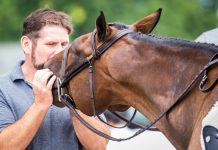
Who are you? I’d ask him after he did something flawless. He’d turn his head, cast a coffee-brown eye back at me.
The spring mud in this part of New York state is famously thick. One day Falcor rolled and came up with his flank coated. Highlighted by the stain was a brand: a shield around an H, faded numbers below. So, he was a Holsteiner. It was a start. I took 20 photos then reluctantly washed off the mud, the sole evidence I had so far of his life story. I found more videos and began piecing his history together—connecting names, shows, years, trainers, riders—and learning about the breed. To my trainers, this wasn’t a startling discovery. He wasn’t the first horse labeled “Warmblood” who turned out to have a brand. But I was fascinated.
His USEF record ran pages and pages: top placings in all three rings, class after class, rider after rider, season after season. I found his first owner in the US, who sent pictures: a huge dapple grey with those eager ears and big feet; jumping a massive oxer, standing in the winner’s circle at Capital Challenge. I found out he’d been at Beacon Hill, ridden by top juniors, loaned to one of Kevin Babington’s daughters.
But by early 2020, his showing stopped. Then came the pandemic, when the horse show world ran into a momentary wall. I heard that his last owner, a Wellington mom, wanted to buy her daughter a hunter instead. By dint of age, fitness, or circumstance, Falcor went from asset to liability, entering an uncertain trajectory that can lead to lesser barns, lesson programs, camps, auctions, possibly worse. Instead, it led to me.
We call our horses unicorns when they do well, when they tolerate our mistakes (I make many), shine in the ring, show up for us no matter what. But unicorns are the stuff of fairy tales. I still craved the true story. Do you remember where you got him? I messaged his first rider, but she didn’t. Do you have any information? I fruitlessly emailed equitation trainers. While researching, I found out about fake brands, intentionally “faded” to be unreadable. True ages can be hidden, passports disappeared. Scrupulousness and horse trading don’t always go hand in hand, which could mean he’d always be a mystery. If I were truly a horse person then, as I had longed to be all my life, it might not have mattered so much. As a trainer friend reminded me, most people just care the horse gets over the fence. They look for the horse they need at the time, then move on. And plenty of horses bred to the nines can’t nail their lead changes.
Months went by. I switched to a barn where Falcor could spend more hours outside, which did his mind and body good. He continued to be my unicorn, though the more we did, the more I wondered if he would soon be too old for his job. Occasionally an advanced rider would pilot him around a bigger course and they’d come back thrilled: rider beaming, Falcor’s high tail a victory flag. He still had it. He was far from done. He was just waiting for me.
Whoever you are, you’re something, I’d say, rubbing liniment into his magnificent shoulders.
As he gazed at the fields and the jumping ring beyond his stall I’d wonder if he was thinking of his show days, or the meadows of his early years. I know what they say: horses live in the moment, yet we also know horses remember a lot. Standing in his purple turnout blanket in the morning fog, he looked royal. Maybe he was.
I got a DNA kit from the Holsteiner Verband. One rainy afternoon in October, I put him in the crossties and pulled some mane hairs. I taped them onto the form, sent them off to Germany, and waited.
The Verband’s news wasn’t good: The lab couldn’t find a match. He may have been born before 2003, when we started DNA typing foals. We could look in our database, but we need his brand numbers.
Before 2003? My heart sank. He was 17 now, or was he 19, 20? I was still dreaming of the low hunters, my gateway, hopefully, to 2’6” and beyond. Could he be that old? I asked the vet. Could be, the vet said.
A new barn friend with access to fancy software offered to do some digital forensics. She took my iPhone photos of Falcor’s muddy flank, cleaned them up and threw them into high contrast. We saw a 9, then a fragment of something else — a 5? Impatiently, I ran possible combinations of the 15-digit life numbers assigned to registered warmbloods, but nothing hit. There was a Falcor, but he was a small bay. No tall grays born in 2005 had an F name, or any nearby year.
I kept riding. My possibly older-than-stated, possibly faux Holsteiner counter-cantered down a line of fences without batting an eyelash and executed another velvet lead change. I misjudged distances, buried him at the base, but he got us over every time. At a certain pace, the jumps rolled like waves beneath us. Another winter came, the season he would have shipped to Florida in the past. Crossing the ice to the indoor ring, I wondered if he missed the balmy weather and breezes, or if he took this easier routine to mean he might be discarded again.
But I’d go into his stall and unfurl the neck of his size 87 blanket and we’d do carrot stretches, his breath steaming in the cold. He’d furl his nose into a smile, nicker a mellow hello. He didn’t seem to yearn for anything. The vet said he looked like a different horse: topline restored, coat shining over muscle. One day while currying him, a shaft of sun hit his flank and I saw a second number, or thought I did. On a hunch, I sent another email to the Verband: Hi! The first number is definitely a 9, the second one could be an 8. Can you check the database?
A week later, on a cold January 25, the Verband’s response landed in my inbox. His life number wasn’t 98, they wrote. It was 99. Matched with the DNA from the hair sample, a horse came up:
Lifenumber: DE421000329905, Brand-Sign-No. 99, male born 09.07.2005 by Corrado I out of R-Condora.
So, he wasn’t ancient. In fact, he was 9 months younger. And the brand was real.
I dove onto HorseTelex and there he was: Conrad. Son of Corrado I and R-Condora. In his bloodline: Cor de la Bryere, Capitol I, Calypso II, Ramiro Z, Ladykiller xx, Foxlight; names I knew from the Holsteiner rabbit hole, illustrious sires with glorious biographies, and a famous mare line (Stamm 2067). There were grainy photos of his kin: rangy grays devouring fences in stadiums around the world, all with slightly dished faces, deep brown eyes, big feet, flowing tails.
Information builds its own momentum. I found out Falcor was bred in Germany, wound up in Sweden, did the 1.40 m jumpers and some 1.50 m, is also a registered Swedish Warmblood. A half-brother did Grand Prix with Alexander Zetterman. A half-sister was the highest-scoring 3-year-old in Sweden. It turned out a cousin of his and another half-brother were at our barn. He has thousands of relatives; at any given moment at a horse show, probably at least a few are saddled up.
His first owner in Sweden responded to my breathless Facebook message, remembering the horse as kind-hearted, a bit sensitive, prone to joking around. He sent photos: a strikingly dappled, leggy horse buzzing with health and potential, barely standing still. The dealer I sold him to imports a lot of horses to the US, he said. That was likely when the name changed from Conrad to Falcor.
So Falcor/Conrad hailed from a long line of jumping horses, bred in the hopes he might make his own mark. He was the rangy youngster in Sweden, the powerhouse soaring with his new American rider, the skilled equitation veteran campaigning in medal finals, then the wise professor with my name on his stall plate who diplomatically packs five strides into four, motors into a floaty trot at my slightest cue, and was as proud as I was when we won our first tricolor in a schooling show.
My father got sick and my own sense of time and life compressed. I had to move Falcor to a barn closer to my house. I worried it was too much upheaval, but as soon as he saw me there, he nickered and settled in. His new stall is huge, with a view of fields and mountains that might look like Sweden, I think. We did our first bigger show and he seemed honestly happy to be back in action. He’s chuffed! my new trainer glowed. We’re planning a summer return to HITS, this time without apologies. Yes, I’m still awestruck at the good fortune of getting the ride on this horse. But these days he doesn’t have to wait that much for me to catch up.
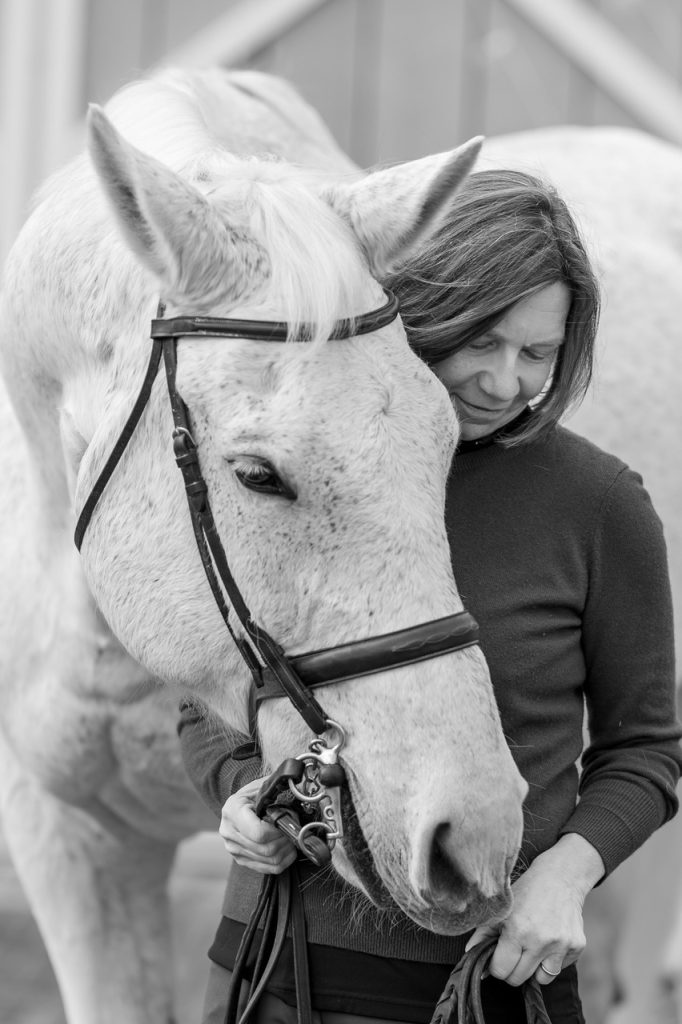
I know who you are, I say to Falcor. You’re a prince. Of course, regardless of where he came from, he’s still amazing. The better I ride the more I realize just how good, how smart, how sensible he is. Despite finding out his original name, it doesn’t fit him like Falcor does—the name of the luck dragon from the movie The Neverending Story, a benevolent, giant creature of air. Here’s what else I say to him, now that he’s 18, since we could just have a few years before he’ll need to take it easy: No matter what, you’ll always be my Falcor. I’ll always be your home.