
By MARLEY LIEN-GONZALEZ
Kris Cheyne’s proudest moment as a professional came not from his own success, but from a student’s—whom he’s known for most of her life.
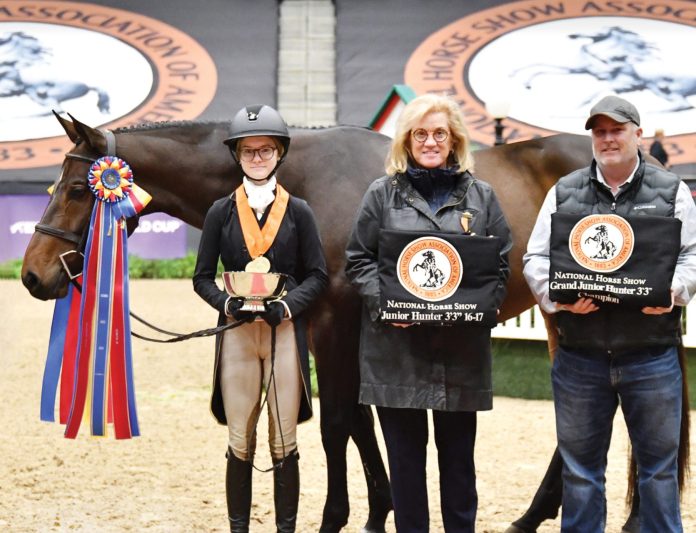
Last fall, Cheyne’s student Caroline Alexander and her horse Specialist were Grand Champion in the 3’3” Junior Hunters at the National Horse Show, in Alexander’s first time showing there.
“What made it more special is that Caroline has ridden with me literally since she started taking lessons over 10 years ago, and came up the ranks through just our program,” Cheyne tells The Plaid Horse. “That was just awesome, for that kid to win.”
A USEF “R” judge and the owner and trainer at Kirin Farm, a show barn based in Overland Park, KS, Cheyne says he’s proud every single time his students set goals and go after them.
“Whether it’s USHJA, Vegas, or Indoors, anytime they go and they’re happy, it’s always great to see hard work pay off on their end.”
Very few barns can say they’ve brought a walk-trot kid up to the highest levels of the sport, but Cheyne has done so with several riders, including one young amateur who started out in his riding school in 2003 and now has two Grand Prix horses.
“At this level, and maybe I’m doing it wrong, but I don’t do this to make zillions of dollars,” Cheyne says. “I do it because I love it.”
At Kirin Farm, Cheyne balances his highly competitive students who are heading to equitation finals and Indoors with a booming lesson programs with riders of all levels. He adds that as much as he enjoys standing ringside at a horse show, he also loves teaching his Monday and Tuesday night lessons with five ladies who jump 2’, might go to one horse show a year, but mostly take lessons for fun.
A key part of the success of his lesson program? Quality school horses. “When you learn on nice animals, you learn to ride better. When you learn to ride on hot horses that teach you to be a little nervous, you can’t focus on riding well if you’re dealing with all of that. Good horses to teach at home, and good, safe horses in general…we try to stay away from greener horses for our kids.”
A great team is also a vital part of the program: “I make it a priority to always have really good people around me so all these parts work. If that team wasn’t in place I couldn’t do it all, and I’ve been really fortunate to have them.”
He is also grateful for the students who come through his barn, saying most of his job isn’t encouraging riders to ride and show more, but rather slowing those people down, and telling them no. Cheyne might say: “You need to do “x” number lessons a week, you need to half lease, you need some mileage before you can just get a horse!”
When he’s not teaching at home or at the horse show, Cheyne, an “R” judge, is traveling the country and watching horses compete from the judge’s booth. Getting to do all of the above rounds out the professional experience for Cheyne and Kirin Farm, and he finds himself fulfilled by the balance.
“After judging for a few weeks in a row and I think, ‘Oh, I want to be horse showing,’ and then after a few weeks of horse showing, I’ll be like ‘I want to be judging!” Getting to do both, he adds, is his favorite place to be.
Notes for Students
Being a judge also lends its unique benefits to Cheyne’s teaching curriculum – here are some things he’s always telling his students:
- At a horse show, be as timely as possible when you get to the ring. Trainers sometimes have conflicts at other rings and life happens; but as a rider, you can be ready, know your course, warm up, and be able to walk in and get right to it. Be organized!
- To those that have nice movers, when you walk in the ring for the under saddle, if you have time to work at will, do it, because the judges are already looking. They’re kind of noting numbers, and they’re getting their card organized, so take advantage.
- When judges ask for the third time to have riders slide their numbers to the outside in the undersaddle, it is mind boggling the amount of people who outright ignore that. It’s because we physically can’t read your number. Once we know your number, it’s a lot easier to watch the class.
- Pet Peeve: When kids go in and pick up the wrong lead and immediately just kick their wonderful animals to do a flying change, instead of taking time to correct what they did poorly the first time. When you make a mistake, make the correction, fix it, and then you can move on.