
By KIMBERLY LOUSHIN
Ever sit on a horse whose greatest skill is telling the entire world exactly what you did wrong? I sure have. For many years, I was lucky enough to ride an upper-level event horse who had buttons beyond what I could imagine, and as such, he was good at tattling on my faults. In some of our earliest rides, he gave me flying changes every time I picked up the canter because it turns out my seat wasn’t as quiet as I thought, and he was so finely tuned that subtle shifts in weight meant flying change to him.
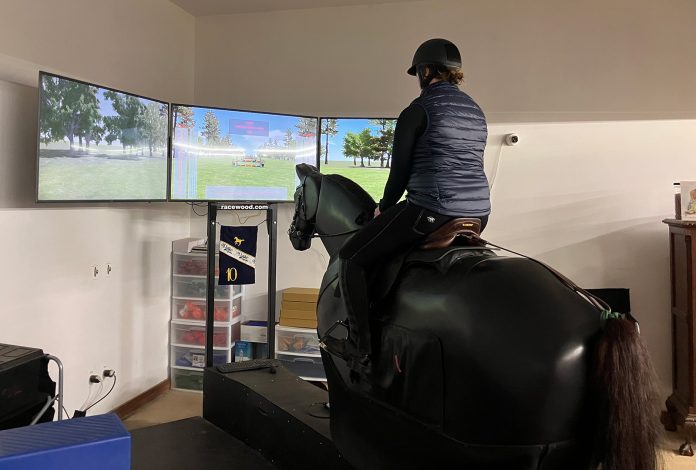
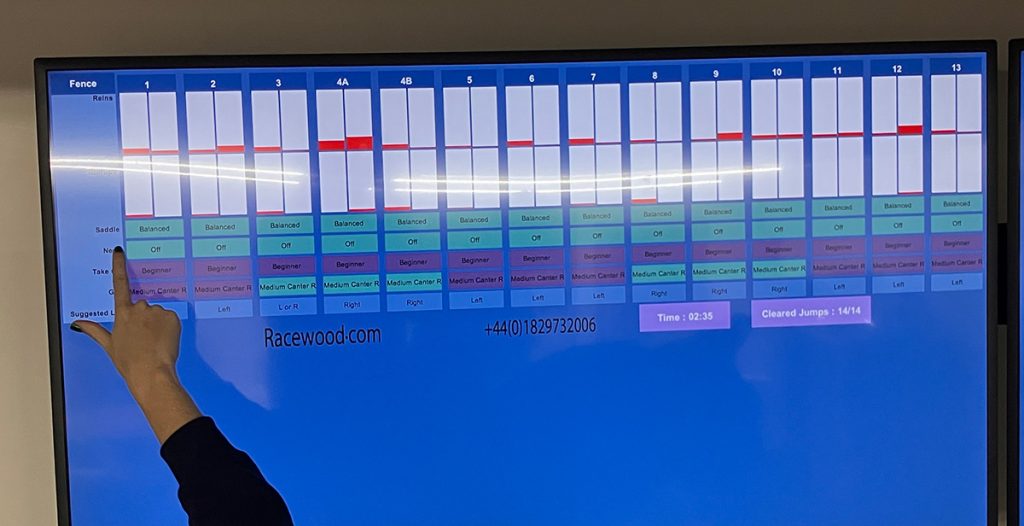
That’s exactly what it was like riding Blue, an equine simulator operated by Kendra Clarke of K. Clarke Equine in Kintnersville, Pennsylvania, except with Blue, her tattling comes with data.
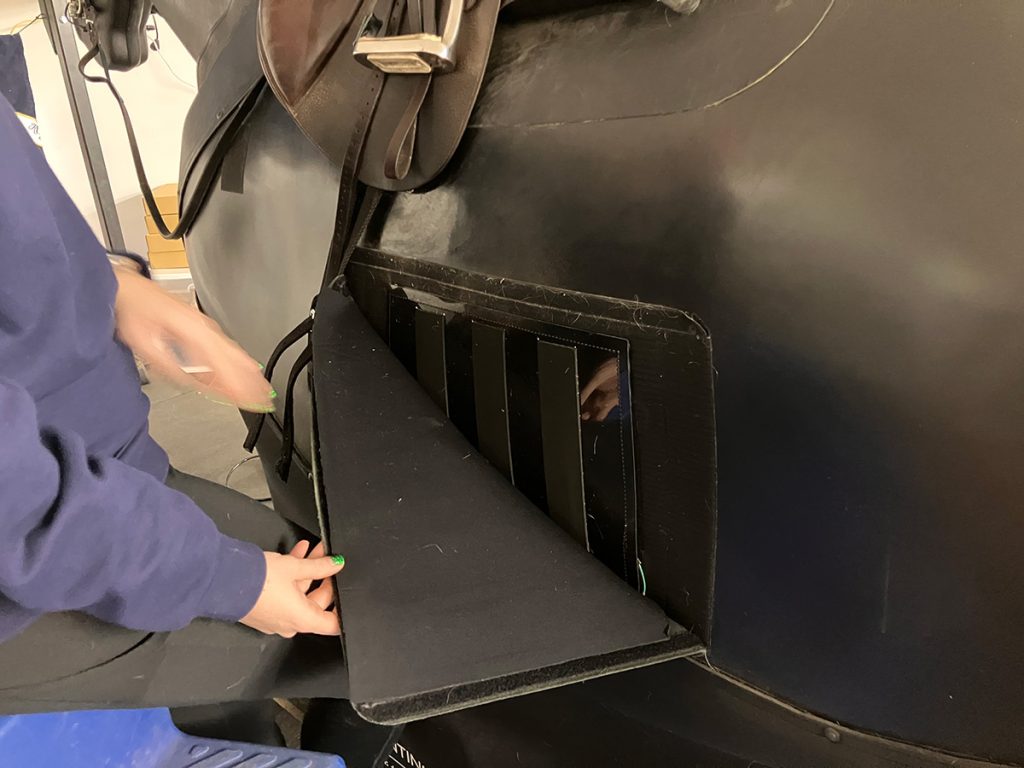
Riding an equine simulator is a unique experience that left me keenly aware of everything I need to work on. Blue is equipped with sensors in her sides, back, and attached to the reins, which are all translated to data on the screen. Have the tendency to tip forward? Blue’s going to tell you. Do you use your aids inconsistently? She’ll tell you that too. One of my riding sins: my right leg was more active than my left—whoops, guess I’ll have to work on evening that out in the gym.
When I first climbed upon Blue, Kendra ran her through a standard simulation that allowed me to get a feel for her, while also collecting some useful initial data points. Her trot was beautifully comfortable to sit as were her flying changes (why can’t it be that easy in a dressage test?), and when I started posting, Kendra immediately guessed that my real-life horse was a big mover, as I was rising too much for Blue’s rhythm. And when my elbows stopped moving, so did Blue.
Once I’d “graduated” from the simulation setting, we played in the dressage arena, where Blue didn’t care if my lack of steering meant she ran into the fence or if I didn’t back up my rein aids with leg. One fascinating setting was that Kendra could change the rein sensitivity settings to match how light my horse tends to be in the bridle.
In a jumping practice simulation—set like the world’s longest gymnastic—Blue found a perfect distance every time, which meant I could focus solely on what my body was doing. And boy was that telling, over smaller fences I tended to get ahead of her, but once Kendra upped the fence height, I was less likely to jump ahead. And guess what? That’s a fault I’ve fallen into on my own horse as well. In more advanced settings, the jumps just appear a few strides ahead of you.
There’s also the opportunity to jump courses, both in a ring and out on cross-country, which of course I had to try. Through spectacular mechanics, you can feel the terrain while out on cross-country, riding up and down hills, and jumping down banks. In more advanced modes, I would’ve been able to adjust her canter, collecting it to jump through a coffin combination and then extending it for gallop fences. And when my balance wasn’t quite right, and I leaned on her neck, a sensor there tattled on me too. Once I completed the course, Blue’s screens gave me data on how well I negotiated each obstacle—how hard I pulled on the reins, how my balance was, and more.
One of the benefits of riding with Kendra is that she specializes in horse and rider biomechanics and is a level 2 Centered Riding instructor and four-star Train Your Seat (formerly Franklin Method) educator. As such, she introduced things like OPTP balls or rubber bands into my riding, which is far less scary when on a steady Eddy like Blue than it would’ve been if I tried these position tools on my young horse. On Blue, I could shift my weight and watch in real time as the sensors measured whether I was putting more weight in my right or left seat bone, thus beginning a game to see how smoothly I could shift from one to the other—a skill that’ll serve me well when asking for lateral work.
One of the beauties of riding an equine simulator like Blue is that you can work on yourself without annoying your horse. Blue doesn’t care when you use too much rein and bring her to a halt in the middle of your course, and if you’re like me, you can accidentally passage—who knew I knew those aids? Spoiler alert, I did not—without accidentally untraining the horse in the process.
Riding with Kendra also gave me some insight into something I’ve never noticed on my own horse. On Blue, I tended to shift the saddle to the right even though the sensors showed I was keeping plenty of weight on my left side. So she gave me homework doing proprioception exercises while standing on one leg, and the next time I tried gymnastics at home, I felt more centered and balanced in the saddle.
While you could ride an equine simulator like Blue frequently—how cool would it be to have one in your basement to ride during poor weather?—Kendra says she tends to train people on Blue once a quarter, though frequency varies. She sees herself as the consultant you bring in every once in a while for more specialized feedback and data that you can use to influence your training until your next session.
The whole experience was part riding lesson, part physical therapy combined with data we rarely get in the equestrian realm. If you ever have a chance to try an equine simulator, I highly recommend it.
If you’d like to try riding Blue with Kendra, you can find out more on her website. Racewood Equestrian Simulator at K. Clarke Equine