
BY MARNYE LANGER
“They say variety is the spice of life.” In the hunter/jumper world, we repeat that idea often. We want options, flexibility, and a full calendar of competitions to choose from. But if we’re honest, our actions don’t always match that sentiment.
Because when it comes time to enter a show, too many of us make the same decision: we go where it’s biggest, most convenient, or most prestigious. That’s understandable, but we have to remember to support from the bottom up so we even have these choices in the first place.
If we want a future with options, we have to start acting like it.
Supporting Local Shows Helps The Sport Survive
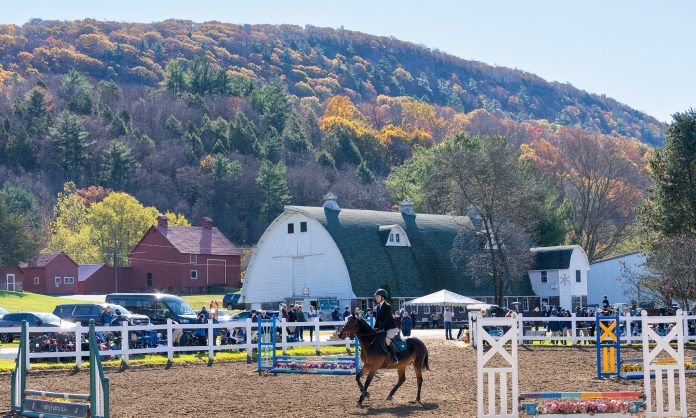
Local shows are not just “starter” venues, stepping stones, or landing pads for those tired of the financial and time demands of larger shows. They are the foundation of the sport.
They create true access for new riders. They give young horses the mileage they need. They allow amateurs, juniors, and professionals to compete without the constant financial and logistical strain of travel. Most importantly, they build the pipeline of horses, riders, trainers, and owners that sustains the sport at every level. And let’s be honest—not everyone is chasing the Big Eq or a national final. Some riders simply want a place to put their weekly work to the test.
When local shows struggle, the pipeline narrows. When it narrows enough, it eventually breaks. This isn’t theoretical. It’s already happening.
The Disappearing Horse Show Facility
At the same time, participation patterns are shifting, and the physical places where we can even hold horse shows are disappearing. Rapidly.
Urban sprawl, rising land values, and competing development pressures are pushing equestrian venues out of existence. What remains is a shrinking, fragile network of facilities, many of which are operating on thin margins, complex ownership structures or borrowed time. Look at California. One of the largest equestrian markets in the country, yet viable horse show venues are increasingly scarce.
Many of the remaining facilities exist only because of:
- Land owned by municipalities, the state or universities
- Nonprofit operators barely holding things together
- Private ownership with uncertain long-term plans
- Major investment groups backing mega-facilities
Historically, fairgrounds supported a broad base of competition. But as the sport specialized, those venues fell out of favor and faded away through the 1990s and early 2000s. What replaced them? A handful of purpose-built facilities. However, the only significant new facility that has emerged in the last decade is the Desert International Horse Park in Thermal, Calif. The rest of the facilities exist with infrastructure and design from several (or longer) decades ago. Some have been able to adapt to changing needs; the rest do their best.
Thinking about the horse shows themselves, Del Mar National, Santa Barbara Horse & Flower Show and Grand National (aka Cow Palace), all once were central to the sport. Now they’re shells of their former grandeur or outright memories.
And their disappearance didn’t spark widespread alarm. No collective pause. No meaningful intervention. That should concern all of us.
A Fragile Economic Ecosystem
Here’s the part that’s easy to overlook: most local show managers are not operating with large margins. Their businesses are highly sensitive to participation. A loss of even 15–20 entries can be the difference between breaking even and losing money.
Now layer that reality onto a broader ecosystem:
- Many facilities rely on show rentals to survive
- Show managers rely on entries to operate
- Trainers and riders rely on shows to justify keeping horses in work
- Third parties—vets, feed stores, farriers, tack stores, grooms – all rely on shows as an important part of their income
Remove one piece, and the rest begin to wobble. In many cases, a single show series supports a significant portion of a facility’s annual operating income. If that series disappears, the facility may not be far behind. When a facility goes, it doesn’t come back. And it’s even worse for those who also have horses boarded there.
Land doesn’t revert to horse use. It gets developed.
Permanently.
The Risk of Consolidation
As smaller operators struggle, larger, better-capitalized entities inevitably step in. On the surface, this can look like progress. There’s more investment, more polish, and more visibility.
But there’s a trade-off.
When competition among show organizers disappears, so does balance. Pricing power shifts. Opportunities consolidate. And the sport becomes less accessible, not more.
We have to ask ourselves a hard question: Do we want a system defined by broad participation and opportunity or one dictated by a small number of dominant players? Because if current trends continue, that choice may be made for us.
You Don’t Get to Complain About Losing Choices If You Didn’t Support Them
This is where the “paradox of choice” becomes real in our world. We say we want options. We say we value local shows. We say we worry about the future of the sport. But if we consistently choose not to support those shows by bypassing them for perceived convenience or prestige, then we are actively contributing to their disappearance.
And once they’re gone, they’re gone. There is no quick rebuild. No developer waiting to turn a housing project, golf course or soccer field back into a horse park. It’s just not going to happen.
A Call to Action
Supporting local shows recognizes that the health of the sport depends on a functional, layered ecosystem that includes entry-level opportunities, mid-tier competition, top-level events and the facilities that make all of it possible
If we want more people to enter the sport, and more importantly, stay in it, we need places for them to go. A variety of places and shows that meet riders where they are in terms of their ability, time and finances. If we want to preserve opportunity, we need to support it where it lives.
That means supporting local shows, even when it’s not the most glamorous option, valuing proximity and sustainability alongside prestige, and understanding that every entry is a vote for what survives. The future of horse showing won’t be decided by what we say we want. It will be decided by where we show up.