
BY BROOKE BELL
It’s my birthday. I’m sitting ringside at the Grand Prix arena at WEC Ocala with my two best friends, my partner, and two of my equestrian business associates who have become good friends. We talk for over two hours as the ring lights shine over perfectly dragged beige sand, hopping from topics of equine welfare to personal goals to fun family stories. We spent the day pushing through racks at local tack stores, exploring WEC’s grounds, and eating on saddle stools at the Yellow Pony. A wonderful 28th birthday spent at the seat of my passion.
I check my phone for the first time in a couple hours, and I see a DM on Instagram that reads: hey so you know, [name redacted] made a video about you. I’ve heard this name in passing, but I wasn’t online during their reign on socials about ten years ago. I decide I’m going to deal with it when I get home, the hour drive from Ocala to downtown Orlando a stretch of nervous anxiety about what could be. My friends and I scream songs from our favorite artists and laugh til we can’t breathe.
My partner watches the video for me and laughs at all the false assumptions the person makes about me from one video posted months ago, which I myself admitted was a bad ride.
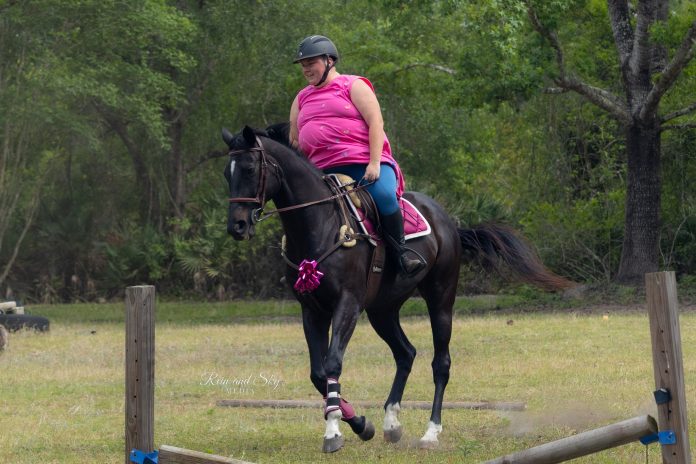
But when you’re big, you don’t get bad rides. And because I had the audacity to be honest, show my mistakes, I am now an internet hot topic because my stomach stretches, and I refuse to apologize for it. People comment in droves how they gained ten pounds and suddenly decided that was too much to ride their 17 hand horse. But their feelings of inadequacy are not my burden, and I refuse to be something that sad people project their own self-hate onto.
I am not your good fat. I won’t talk about all the methods I’m using to shrink myself, even as I shrink. You don’t need to know each bite I take or don’t take, every calorie I burn. You don’t get to police my body and then say it’s for my own good with your boot on my neck.
The online equestrian culture is made of vultures waiting to sink their teeth into a dead animal. Every step has to be perfect, and even then, it’s not enough. Your body shape and size have always been an enemy in an industry with a diet named after its talented junior equitation riders. Long, thin, sallow, stretched like putty down the sides of a six-figure import, all limbs and angles underneath thousands of dollars of sagging show clothes.
I have never been like that. Even as a kid and teen, I was the chubby rider who didn’t mind the hard horses and getting launched off a new green mare. While I’ve been bullied for my size as long as I could remember, I also bit back. As an adult, as someone with an online following, I started finding that the best response was to just be myself, happy, honest, continuing to spread my own form of influence.
An often-smacked comment or direct message I’ve received over my two years of being online is about the 20% rule, a rule made by the U.S. Cavalry in the 1800s about a horse only carrying 20% of its weight for optimum performance. Of course, some people, even plus-sized people who admitted to not being within this rule, start lowering the number: 18, 15, 10. Their science is outdated and based on a study with major flaws.
Modern studies have shown that most fit horses with well-balanced riders show no true difference in performance up to 25 or 30% of their weight, depending on their bone structure and fitness level. Of course, every study is flawed, and the science will continue to evolve as we care more about horse science and less about horse adages.
I have been scolded by people who don’t know how their own math works. I’ve been told I’m over 660 pounds, or 200, which would be under 18% of my horses’ body weight, but somehow that is also bad. I’ve lost dozens of pounds, and yet, I still am not enough.
But it’s not me. It’s the internal war these people are at with themselves, hating the fat accumulated on their hips and stomach from birthing kids, or injury, or their own insecurities at being told they could only be good riders if they shrank small, and I had the audacity to flash in front of their screen, riding well at a bigger size.
Now, a couple of days before my 29th birthday, sometimes the comments folks have said still flash like knives thrown across my brain as I trot my OTTB lease mare (sounder than ever almost two years into riding her) across the short side, her stretching across her back into my hand. But I try to remember that she walked herself into the crossties and waited for me to tack her up.
Despite this usual barrage of hate, the love is so overwhelming that it cures every knife cut. It’s wrong to say I don’t care, or that it doesn’t matter. To be plus-sized in this sport is to not be seen for anything but a size. But I’ve had hundreds and possibly thousands of messages from people who found my page and got back into horses because of me, who battled cancer or injury or pain to find their way back in the saddle. These people see me, my commitment to horse welfare, my love for the animals, my tenacity and toughness.
I’ve interacted with young riders who have told me that watching me helped them recover from their eating disorder, that to see a lesbian riding makes them feel less alone in their small town. I’ve talked to people from every continent except Antarctica, in a dozen languages, a global network of riders who are different, defying standards and norms, and enjoying and loving these animals we are so blessed to have in our lives.
For me, people can make any assumption about my size they want. Their false guesses and assumptions can’t change the fact that my online presence has helped people, and they can’t take that joy away from me.
I am so grateful to share my journey with folks who need it, and I hope to continue to spread a message of love and positivity in an online community that can be painful and toxic. We deserve to take up space. You deserve to be here. And I hope to continue to be a testament to a better reality.
Brooke Bell is an equestrian who got back to riding after 12 years of battling with chronic pain and illness. Now, she works as an assistant trainer at an eventing farm and freelances working with sensitive horses, OTTBs, and fellow disabled and queer riders, as well as working with equestrian brands for marketing. She recently was given her lease horse as her first horse, and they plan to compete in eventing and dressage.