
BY HOLLY HUGO-VIDAL
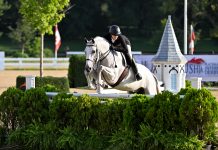
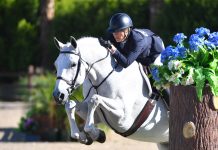
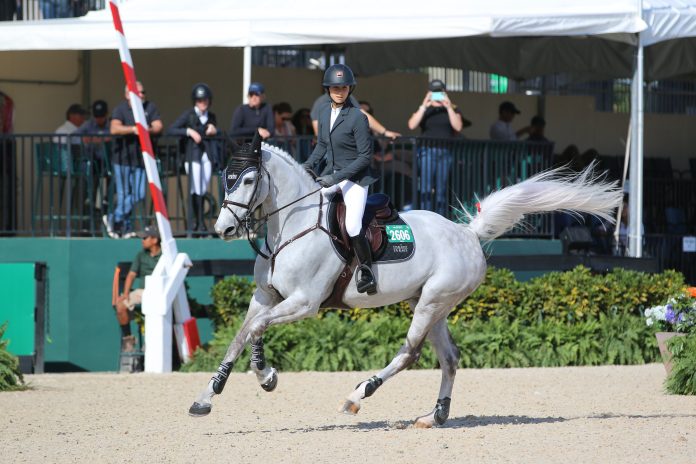
The canter is the most important gait because we jump from the canter. Every horse has its own canter, in terms of rhythm and miles per hour, to be the most adjustable (rideable) as well as producing the best jumping effort.
To achieve the best canter for jumping, the horse must be “in front of the leg” with impulsion and energy. They must also be light in the rider’s hand (not pulling) as well as balanced to achieve the best possible result.
Since the power comes from the hind end pushing as opposed to the front pulling and feeling downhill, the horse’s balance is of most importance. Some horses come by this naturally while others have to be almost manufactured, or of the least reminded. A thoroughbred comes by this more naturally and is in front of the leg the moment you get on. The warmbloods tend to be lazy and require the rider to put them in front of the leg.
In terms of miles per hour, each horse has its own set of requirements for the perfect jump. If the horse is below his natural good canter, or behind the leg, he will most likely chip (adding a last-minute stride) or reach for the long distance and make it look too long and weak. Conversely, if the horse is above the pace, he will look fast and cover too much ground, and the jump will be compromised. It will either be too close or too long, resulting in a poor jumping effort as well as losing the smooth canter and ridability.
This is where the rider comes into play. In order to be effective in getting the right canter, the rider must have a very good “feel” and equally good coordination as well as knowledge in order to be able to determine the correct canter as well as be able to make whatever adjustment is necessary to achieve it.
There are many ingredients that will have to come into play simultaneously, which sometimes are counterintuitive for the intermediate rider who is inclined to use hand or leg but not the combination, as well as the degree of both at the same time! There must be enough leg used to encourage the horse to maintain the right speed of canter, as well as impulsion, but not a strong driving leg, which is going to make the horse increasingly faster. The coordination of the hand and leg goes together as the hand regulates the speed at the same time and the leg encourages impulsion, similar to numerous instruments being played together in an orchestra. These aids must not clash. This can be difficult for the less advanced rider. The aids must work in concert with one another.
The horse’s temperament and sensitivity play a huge role in determining the degree of hand and leg used. For example, a lazy horse will require more leg and whatever is necessary, such as a stick or spurs, to create energy. Whereas a sensitive type will require less. This is what the rider must evaluate and use the appropriate degree of aids. Similar to following a recipe for baking a cake, a little of this and a little of that; too much of one results in an unbalanced product.
When this good canter is achieved, adjustments are easily made, resulting in a beautiful jump and an even, smooth round. A balanced horse with a good canter will respond more easily to shortening as well as lengthening than a horse lacking in these qualities with a poor canter.
You must be able to either see from the ground or feel from the horse’s back whether you have your horse’s best canter, as well as what adjustment you need to make to create it. The rider is totally dependent on having or creating, as well as maintaining, a good canter!
This is the goal for a successful round!
Holly Hugo-Vidal is a nationally respected equestrian professional, trainer, clinician, judge, and author based in Milton, Georgia. Originally from Bedford, New York, she operates Pacific Blue Training Stable and teaches at Michael Britt-Leon’s Windsor Stables. With decades of experience in the hunter, equitation, and jumper disciplines, Holly is known for developing confident, well-rounded riders through strong fundamentals, a thoughtful horse-first philosophy, and a focus on building both skill and confidence. A sought-after clinician, she has taught throughout the United States as well as internationally in New Zealand and Panama, and is the author of the bestselling book Build Confidence Over Fences, praised for its practical guidance on riding, mental strength, and partnership.