
BY TANIA GRANTHAM
Polework doesn’t need to be complicated to be effective. For riders who school regularly, it’s easy to fall into the trap of overbuilding exercises, measuring distances, adding lines, and creating technical challenges that can quickly become cluttered. In reality, some of the most valuable work comes from the simplest setups. The square is a perfect example: straightforward to build, yet surprisingly versatile for improving accuracy, balance and communication.
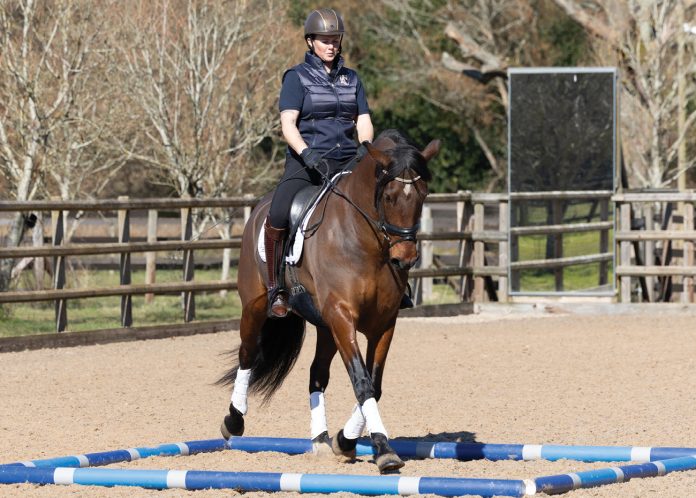
To set it up, place four poles of equal length in the centre of your arena to form a square. I always use standard 3 m (10 ft) jumper poles. Longer or shorter poles can be used however they will influence the distances and the pace you can ride.
The most obvious starting point is riding straight lines through the square, either on the centre line or across the arena from dressage letters E to B. These lines can be ridden in walk, trot or canter, depending on your horse’s level and the quality of the gait. The key here is not just the poles themselves, but the approach. A balanced, organized turn sets you up for success; drifting or falling in will quickly show in your line. Use the stripes on the poles as visual markers to check your straightness. For an added challenge, introduce a halt transition within the square. This tests your ability to stay straight, reactive and balanced without relying on momentum. The action of stepping over the poles often results in a square halt.
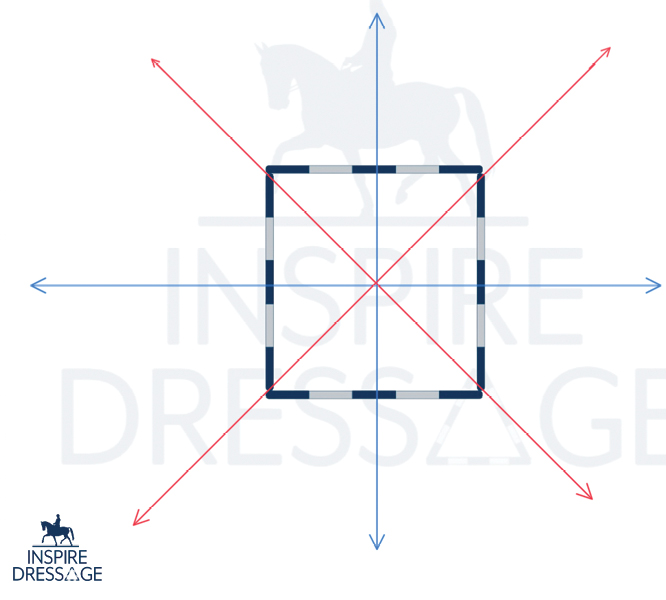
Once that feels established, turn your attention to the diagonals. Riding from corner to corner of the square, you’ll now ask your horse to pass directly over the point where two poles meet. This creates a much smaller target and a different visual question, requiring greater precision and control. It’s an excellent test of straightness and rider influence. Keep your upper leg steady to support the line, and allow your hands to soften, widen and lower slightly to guide rather than restrict. To progress the exercise, add transitions on either side of the poles. For example, approach in canter, transition to trot before the square, and then pick up the opposite canter lead after. This sharpens responsiveness while maintaining focus on accuracy.
The square also lends itself well to circular work. Although the poles are set in straight lines, riding a circle over them encourages both horse and rider to think carefully about line and balance. This is particularly useful for developing correct bend: the horse must stretch through the outside of the body while staying supple on the inside. Ride the exercise at any pace, but prioritise rhythm and consistency over speed.
To build on this, try riding two ½ 20m circles or even a full figure of eight, changing bend and direction through the centre of the square. This introduces coordination and timing, asking the horse to stay attentive and the rider to remain clear in their aids.
Simple it may be, but the square rewards attention to detail. Used thoughtfully, it can transform everyday schooling into focused, effective training—no elaborate setup required.
The Expert Tania Grantham
Tania Grantham of Inspire Dressage is a Grand Prix rider & trainer and Pole Work specialist. Based in the South East of England, she works with a wide range of horses & riders striving to bring out their best using innovative and fun polework layouts and exercises. She is author of the unique training book “Polework Journal” and co-host of popular equestrian podcast “Poles, Piaffe and Prosecco”.
www.inspiredressage.com