
LISTEN NOW
To listen to the Plaidcast, you can use the player above, Stitcher, Spotify, iTunes, Google Play Music, or your other favorite podcasting app!

Piper speaks with Katie Monahan Prudent about how she is working to grow the next generation of US Show Jumpers. Brought to you by Taylor, Harris Insurance Services. Listen in!
GUESTS AND LINKS:
- Host: Piper Klemm of The Plaid Horse Magazine
- Guest: One of the most successful riders in U.S. Show Jumping history, Katie Monahan-Prudent was a member of the 1986 gold medal winning World Championship show jumping team, took part in six World Cup finals, won almost every major grand prix in the United States and was named AGA U.S. Rider of the Year three times. In addition, Katie was inducted into the Show Jumping Hall of Fame and named Coach of the Year for developing riders by the U.S. Olympic Committee. Currently, Katie and her husband, Henri Prudent, run an international training program along with their son, Adam, at their three locations: Plain Bay Farm in Middleburg, Virginia; Wellington, Florida, and Rosières-aux-Salines, France.
- Title Sponsor: Taylor, Harris Insurance Services, Taylor, Harris Insurance Services (THIS) was founded in 1987 to provide specialized insurance for all types of equine risk. THIS places their policies with the highest rated and most secure carriers, meticulously selected for reliability and prompt claims settlement. THIS is proud of their worldwide reputation for responsive and courteous service, and welcomes the opportunity to discuss your equine insurance needs and provide you with a quote.
- Subscribe To: The Plaid Horse Magazine
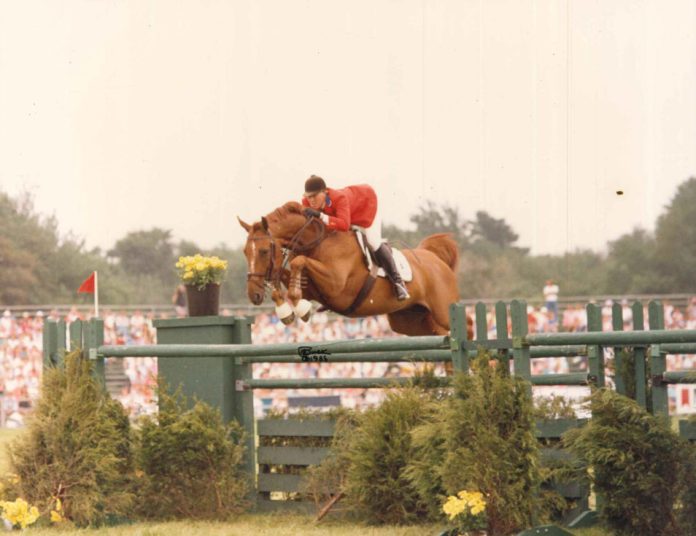
- Photo: Katie on Special Envoy (owned by Pamela Harriman) winning the American Jumping Derby in 1988
- Sponsors: American Stalls, Purina Animal Nutrition, America Cryo, LAURACEA, Wordley Martin Premium Equestrian Surfaces, BoneKare, Show Strides Book Series, With Purpose: The Balmoral Standard, Good Boy, Eddie and World Equestrian Center
This transcript was generated automatically. Its accuracy may vary.
Piper Klemm: This is The Plaidcast. I’m Piper Klemm, publisher of The Plaid Horse Magazine. And coming up today on episode 372, I talk with Katie Prudent about how she is working to grow the next generation of US show jumpers. This episode is brought to you by Taylor Harris Insurance Services. Before we get started with Katie, I would like to say that this episode we recorded in December, 2023, and we’re slated to release the second week in January. Given the controversy with the USCF Horse Mastership Clinic session, we decided that it was not the most productive to release the episode during that time of online fury. In the meantime, we had the decision to wait or to not put out the episode at all. It is my decision that Katie has so many things to teach so many of us. She has so much knowledge, she has so much horsemanship, being at the top level of the sport for so many years. She has so many pathways on how to guide and build and be part of the next generation. With that said, we obviously do not talk about that as we recorded it a month prior. And if you’re looking here for drama and clicks, you’re simply not going to find it. This is a real conversation about a real future. And whatever you think about that particular teaching session, whatever you think about individual moments, however you feel about pedagogy, which is extremely important, and your place and her place in this sport’s past, present and future. This conversation was interesting to me and I’m choosing to share it with you. Katie Monahan-Prudent is one of the most successful riders in US show jumping history. She was a member of the 1986 gold medal winning world championship show jumping team, took part in six world cup finals, won almost every major Grand Prix in the United States and was named AGA US rider of the year three times. In addition, she was inducted into the show jumping hall of fame and named Poach of the Year for developing riders by the US Olympic Committee. Currently, Katie and her husband, Henri Prudent, run an international training program along with their son Adam at their three locations, Plain Bay Farm, Middleburg, Virginia, Wellington, Florida and in France. Welcome to The Plaidcast, Katie.
Katie Monahan-Prudent: Thank you.
Piper Klemm: Can you talk to us a little bit about some of the issues you’re seeing in top level show jumping right now and then we’ll talk about how you’re gonna work on addressing them.
Katie Monahan-Prudent: You know, I’ve been watching our sport very carefully forever since I was on the teams. And now since I’m not riding on teams, but teaching people who have the dream of maybe one day going to the team, I have to say we struggled so much this year trying to get to the Olympic Games and it came right down to the wire. And it’s become clear to me that we have to do something more between the US Equestrian Team and our Federation have something that they call the pipeline. And they’ve done a great job trying to help grassroots people to get further. And they have something called the Emerging Athletes Program, which is a great program and it takes people who qualify and at the end of the season, they get a clinic with one of the top riders. I think that’s fantastic. But then between that and actually making an elite team to go to another country or to go to a games, there’s a huge gap in there. And the girl who rides for me right now is a girl named Cathleen Driscoll. And she went into the Emerging Athletes Program when actually she wasn’t a kid. She was already in her late 20s. And she had been riding on a small circuit in Maryland for her whole life trying to do the right thing, trying to get better, trying to get opportunity. And through the Emerging Athletes Program, she met a girl named Colleen Reed, who actually is a friend of mine who was overseeing the barn management part of the Emerging Athletes Program. And Colleen called me and she said, there is a girl who rides great, but in addition to that, she is so on top of every detail. She’s a hard worker. She takes great care of the horse. She’s the first one there in the morning, the last one to leave at night. She would make a fantastic working student. Will you hire her? And I said, Colleen, my business isn’t set up really to have working students. All of my horses are owned by clients. They want either me to ride them or they ride them. I said, I don’t really have work for a working student. And she said, please, please just interview this girl named Cathleen Driscoll. I said, OK, I will give her an interview. And within a few minutes, Cathleen called me. And I said, Cathleen, I don’t really need a rider. I need a groom. And immediately she responded with, I can groom. I like to groom and I would love to groom for you. So I hired her as a groom. And she groomed for me for a year. And she was a fabulous groom. And then I gave her a chance to ride some of the sales horses. And it was apparent to me immediately that she had that quality to make every horse better, to make every horse jump better. She started being quite successful with our sales horses. And then we put her on some horses that had a little more ability, and she was very successful. And in any event, she has now become our rider, and she’s breaking into the five star. And so this experience for me with this girl, who I would never have met unless she had come through the Emerging Athletes Program, and now I think she’s a super talent, super motivated, very patriotic, wants to be on teams, wants to support America. I might have missed this girl if I hadn’t done the interview. So I’m thinking to myself, wow, there are more young professionals out there trying their best to get an opportunity to get where they need to be in order to have a chance to be on a team. And because of Cathleen, I thought that if I could start a foundation that would allow me to put out feelers around the country, other people like Colleen Reed who had spotted Cathleen, other people around the country who might see young talent that needs opportunity, needs guidance. Anyway, the foundation I’ve started is called Road to the Top. And I want to identify and help riders who look like they have a lot of motivation, a lot of talent and want to try to get to a higher level. This is my mission in life right now. Now that I don’t show any more, I love the teaching, and I think and I hope that I could make a difference that would help our US Equestrian team.
Piper Klemm: It’s evident from your story that without that strong basis and in so many parts of the story of grooming and understanding that side of the training, none of this would have ever happened. Yet, so many of our riders that people doing their best or investing in are not coming up in programs where almost any barn work is normal.
Katie Monahan-Prudent: Well, and to make it to the higher levels, you have to have a great understanding of every phase of horsemanship. You have to be able to pick a good horse. You have to be able to understand the soundness of the horse and be able, you know, the horse can’t speak to you and say, Oh, my shoulder hurts. You have to be able to feel it and see it and live it and breathe it. There’s just so much to going that goes into being a great rider that is not just sitting on the horse.
Piper Klemm: How do we encourage young people? Do they have to want to do it? You know, I feel like even young people I know who want to be more involved at the barn, we don’t have essentially the trainers and the adults always encouraging that.
Katie Monahan-Prudent: I agree with you there. And as I said, there’s so much that goes into it. But my vision is to take people who are young professionals struggling, who know and have worked at the grungiest jobs of horsemanship and their desire is to be better, to make it to a higher level, to maybe one day ride on a team. I’m looking for the people who are highly, highly motivated and want this goal more than anything.
Piper Klemm: Can you talk a little bit with the audience about that gap that’s in between the EAP? They’ve done such a great job at bringing more people in at various levels and having the regional training programs and national training programs. I don’t think a lot of people understand kind of all the various levels of Grand Prix. I think our fan base doesn’t always understand because so many things are called a Grand Prix, like how different Grand Prix’s are from each other and what all these levels are. Can you talk a little bit about that gap of, I think, generally EAP as her riders who have not yet competed at the meter 30 or competed right around the meter 30 level? Can you talk about that gap between meter 30 and meter 60 to a broad audience?
Katie Monahan-Prudent: There’s, of course, this huge gap in the various areas of the United States. There are some states that you can go to where their biggest Grand Prix is a meter 40. And then you come to Wellington and you see those meters 60, 65 Grand Prix, and it’s like another world. We want people who have already seen and experienced some of the lower levels, and people that are ready to move on, to explain the difference is like you’re a skier and you’re very good at doing the bunny slope. But now you want to do the five-star, and I’m not a skier clearly because I don’t have the terminology, but you want to do the very hardest, highest peak. You already have your skills as a skier, but they’ve been honed at a low level. The people we want, and I say we and I’ll get into that in a minute, the people that we want are people who have already had a certain level of experience and know that it’s difficult, but are ready and willing and hungry to go on. Last year, I was sitting at a horse show in Europe with my good friend, Laura Kraut, and we were again talking about how we could help the US. Equestrian team. What are our skills now that for me I don’t show it all anymore. Laura is still at the top of her game, but wants to help develop young riders. And we thought if we could identify some good talent, hard-working, highly motivated people and take them with us, my plan would be to take a few riders with me. And of course, I’m so spoiled and so lucky to do just the major top horse shows in the world and take young riders and have them ride in lower levels, in meter 30 classes, meter 35, teach them how to come up the ranks, teach them how to handle problems, courses that might be a little difficult, riding the very fast speed courses against the best riders in America. These are the things that Laura and I want to teach young students. And that’s our goal with this foundation.
Piper Klemm: So what are your, you’re going to have people out there looking for you? Or, you know, where are you looking to identify these riders? Or where are you, you know, hoping to find them in micro markets, I guess?
Katie Monahan-Prudent: We’re going to have spotters around the country looking. And I’m pretty sure that as soon as word gets out that we’ve started this foundation, we will have people calling us. And we’re going to have to really sort through all of the applications and try to identify ones that we feel have the motivation and the talent. And you’ll notice I always say motivation before talent because the people who are very hungry and willing to work at it are sometimes better than the people with talent who aren’t willing to work at it. So the highly motivated, talented people out there, we feel like we’re going to get applications for this and sort through them and find deserving riders to come into this program.
Piper Klemm: When I look at how we bring riders up in this country, I think at a lot of the grassroots level, it’s because we’re horse showing so much and horse showing at such an early level, we’re driving this perfectionism narrative from almost day one, it seems. And with a lot of the young people I know, it almost seems to kind of pull from their natural bravery because people who didn’t necessarily have self doubt or over analyze stuff by horse showing so much early on in one’s career. I watched some of these kids almost develop these, I would call them bad habits that they might not have developed had they not shown so much early on. You know, I haven’t heard you say bravery per se, but as I meet so many people in the industry, I definitely would say that the people at the highest levels have a level of bravery that the average rider just doesn’t possess.
Katie Monahan-Prudent: Yeah, well, that’s an interesting word. Bravery, I think, comes from confidence and knowing what you’re doing on a horse. And I have to say, Piper, I agree with you totally that we horse show too much. There’s so much emphasis now on the lower levels, equitation and hunters. And no more emphasis on the things that luckily I had growing up. Fox hunting, riding out on the trails all the time, riding bareback, competing bareback, riding young horses, unbroke horses, learning how to break horses, learning how to start horses from the beginning. The kids today, as you said, are showing so much that that’s the only thing in their repertoire. There’s no branching out to learn everything about horsemanship, and we’re greatly lacking in those skills. I totally agree with you there.
Piper Klemm: I couldn’t help but notice from Cathleen’s background that she had some eventing, and some of kind of that background that I imagine resonated with you a little bit when she started riding, that outside forward Fox hunting type ethos, which you’re still capable of having in Maryland as opposed to many areas of the country.
Katie Monahan-Prudent: That’s true, and the three-day eventing gives riders such a nice array of skills, not only in jumping and galloping, but the dressage part of it, which is one thing I noticed about Cathleen right in the beginning, her skills riding a horse on the flat are superb. And to make great riders, as a teacher myself, I feel like I have to give these young riders many different ideas and avenues and knowledge about different types of things in the sport that they don’t get from just going to a horse show every week.
Piper Klemm: I think we’ve lost a little bit of ability to cheer for the people at the top level of the sport because there’s very much a perception right now that it’s bought and, oh, if only I had more money, I could be at that level, or I could be riding at that level, or I could be showing at that level. I mean, not me, I’m not very good at all. But I think when I talk to people, like that ethos I think takes away from the fandom and the excitement and other layers of owners and supporting people, and you’re actually training these people at the top of the sport. Can you talk a little bit about that? Because I don’t know how to combat that exactly, that kind of…
Katie Monahan-Prudent: Well, what you just said leads to the main point today is that the sport is so expensive. It’s expensive, the entries are expensive, the traveling is expensive. I’m thinking about young professionals who are scrapping to make a living. Buying horses today, it’s just outrageous. And that’s why we have a great group of people in the sport who have fantastic horses and they’re doing very well and competing for the team. Those people are great and they’ll always be great because they have great horses. But I have to develop a group of riders like McLain was when he was young, working for his father, Barney Ward, he was a dealer. He rode every horse that came down the pike. Laura Kraut, who didn’t have a ton of money when she was younger and rode every horse that she could throw a leg over. Beezie was my student for about 10 years. And I was competing at that time and I would give to Beezie every horse that I felt was a second horse, not one that I wanted to show. So Beezie got the second grade horses and every sales horse that came in. And then when she went to work for her, to become her husband, John Madden, who was in the business selling horses, she rode every sales horse that he had. And at that time, she was so highly motivated to make each horse look good because she loved John Madden and it was great for his business. That was such a big motivator that she became the best rider in the world. And kids just don’t have the luck. And I say the luck to have no money because then they have to ride everything that they can possibly ride and that is what makes a great rider. Not just buying the best horses that money can buy. That makes a bit of winning but not the type of rider who I envision to lead the team in the future. What are we going to do when Laura and McLain and Kent are gone? That is my question. What are we going to do when they are gone? I want people, I want to try to give my riders vast experience. When I was younger and rode with George Morris, he tried in his way in his day to give us vast experience and that is what I am going to try and Laura is going to try in our day here to bring along young professionals who really want it.
Piper Klemm: Do you think that almost we are going back to the basics? I think about how protective people are of how much money they are spending at every stage and you would never let your expensive horse go and take an eventing lesson.
Katie Monahan-Prudent: You are so right.
Piper Klemm: We have closed ourselves off on these opportunities. This is totally random, but I was talking to the vet at the horse show last weekend. I was like, how do they teach young people how to give shots and give injections and that kind of stuff? It is kind of the same thing. I was thinking that when you are working with horses that are, to just be frank, worth less money and have less investment into, you are going to go learn how to do that on your own horse. But when you have very expensive horses from day one, you just never learn any of these things because you can’t risk wrapping them wrong. You can’t risk giving them a shot incorrectly. You can’t risk any of this stuff. And at some point, we’re spending an amount of money so early on that it’s literally crippling the development of our riders because you can’t send them off to ride with someone else and you can’t send your, you know, equitation horse out to gallop across country jump because there’s so much tied up in this.
Katie Monahan-Prudent: You know, it all revolves around money and I just can’t let myself think of that Piper. I gave my kids, I had three 17 year olds here the last weekend and I gave them a bareback jumping lesson. And I’m sorry, I just can’t think of the horses costing that much. We take great care of our horses, but these kids have to learn to ride. If we keep going in the direction we’re going Piper, where everything is coddled and protected, we’re going to have a group of riders in the next decade that can’t do anything. So there comes a point where you have to say, I’m going to teach these riders what it takes to get to the top.
Piper Klemm: You know, I think that fear stems from more from the trainers than the customers necessarily because the trainers are afraid.
Katie Monahan-Prudent: Well, I can’t help that. I’m not afraid. And this is why Laura and I are going to try to take a group of a group of these young people in a different direction.
Piper Klemm: I love that. What did they do? What are some exercises they did bareback during their lesson? Well, first, we were going to have a bareback puissant. Since one of the girls was riding a seven year old, we thought that might not be fair. So instead, I just said a few lines. They had to do the course. Stay on. It was like 40 degrees. Horses were a little bucky and fresh. And yes, you push people. You push people to do things they would never do. That’s how they become great.
Piper Klemm: And did they stay on?
Katie Monahan-Prudent: They did. One girl almost didn’t stay on and was doing these little peeping screams over each jump. We were all laughing so hard we couldn’t stand it. But she stayed on and it was a great experience. And next time, she won’t be as scared.
Piper Klemm: I love this. I mean, this is what we’re missing with school and what we’re missing with so many aspects of this, is expecting people to level up. I think it’s surprising how often they can and do.
Katie Monahan-Prudent: Absolutely. You know, when you think about America, you can’t ride a bike anymore unless you have your knee guard and your elbow guard and your hat on. We are teaching kids in this country for sure and maybe other countries to be scared, to be scared from the beginning when they start doing a sport. You got to be scared. And I don’t want my kids to be scared of riding horses. You know, everybody has a fall. Everybody in their career is going to, you know, break a collarbone or whatever. But you can’t be afraid of that and you can’t go in your life going out the door every day saying, what’s going to happen to me today? I’ve got to be scared. I try to teach my riders how to fall, how to get out of the way as quickly as they can. I just, you know, there’s just so much about this sport that I feel isn’t going in the right direction, that I want to try to make a difference. And, you know, let’s say 10 years from now, if I haven’t had any success or done very well by any of my students, then shame on me. But this is my vision and my friend Laura Kraut is with me 100%. We’re going to try to take young talent and bring them up to the highest level we can. And this is all in our minds to help our US team in the future.
Piper Klemm: Do you have any like stories of old horses or big classes or things that you want people to know or hear or think about?
Katie Monahan-Prudent: The one story that comes to mind when you say that is years ago, I had an accident where I fell on my head and had what was called a rotational injury. It broke a little blood vessel under the skull and it became a subdural hematoma and I had to have surgery and blah, blah, blah. I came out of it and I was fine, but my depth perception wasn’t great. So I ended up getting a horse called Belladonna and she was a fabulous horse, except for one thing. If you were a couple inches off on the distance to the jump, she would stop and throw me off. So this was after I had this head injury and it kicked me in the butt to to get my accuracy back because it was do or die. And I went on to have quite a nice career with Belladonna. She won a million dollars and seven cars. And anyway, if I hadn’t had that horse at that time in my life, I may not ever have pushed myself to come back to be extremely accurate and ride well at a high level. Every horse you ride teaches you something. And she was a fantastic teacher for me at that time in my life.
Piper Klemm: So I’m thinking more about how kids start riding. And I was at the horse show this weekend watching absolutely terrifying lower level jumpers. And then, you know, the horse show I was at had very hard courses set for hunters and equitation, even at very low levels, which I’ve really thought about how much our sport, you know, before my time, just like looking back of what I can watch and what I consumed from the past, like was very much a sport of challenge and has become very much a sport of perfectionism in the hunters and equitation, even at a very low level. And, you know, and the lower level jumper is being scary. Like that to me is essentially lack of challenge in a lot of ways of not being hard enough to have the need to learn how to do it correctly. How can we bring back using horse shows and course design and these other things to help inspire these ethos to grow people starting earlier on? And I’m going to disagree with you on the trainer thing. I think if you set the expectation of better riding, I think other people will follow. I think a lot of trainers are afraid to be too far outside the norm. But I think you’re so focused on growing this exponentially for a number of talented kids. And I’m looking at how this trickles down of how we can elevate the entire grassroots of the sport.
Katie Monahan-Prudent: Piper, I hear you and I don’t disagree. But I’m only focusing my energy on bringing people to a high level. What you’re saying is true, the whole grass levels and up, it needs a major overhaul. And I’m not dedicated enough to go that whole route. There just isn’t enough time for that. So my energies are going to be spent on bringing people to a higher level. I don’t disagree with everything you’re saying. I agree with you, but there’s only so much I can think of in my lifetime. You know what I’m saying?
Piper Klemm: Absolutely. What other things are you going to do? Like, I love the bare back lesson. What other exercises, what other specific things help riders at the top level or help riders on their way to the top level start thinking in that one?
Katie Monahan-Prudent: First of all, any rider who comes with me is going to come and live on the farm, live with our farm, live with our people. And we all travel together. We all work together. We all ride here at the farm together. And I think that I have in my daily life, I don’t think I’ve gotten soft. We ride out on the trails a lot. We ride up and down hills. We gallop a lot. I have natural jumps on the property. I have all the kids jump the banks, jump the ditches, go up and down hills. And just for example, there are many trainers who won’t let their kids ride out on a hill without putting studs in the horses’ shoes because they’re afraid the horses will slip. I purposely don’t put studs in the shoes. And I tell the kids, don’t let your horses slip. The grass is slippery, don’t turn tight, don’t stop too fast. Feel the balance of your horse. Feel when he might slip and don’t let it happen. In other words, I’m not going to sugarcoat any of the things that it takes to feel the horse, to understand the horse, the balance, the riding, little things like that. Just living with us and traveling with us, it’s already going to be a huge different experience. I have three-day people come to my farm and give lessons. I encourage my kids, if they want to go out and listen to someone else’s lesson, go ahead and do it and then come back and we’ll talk about it. I am not at all like some of the trainers today who don’t want the kids to go out and experience anything else.
Piper Klemm: The saddle time is really interesting because I don’t think a lot of people realize the quantity, just the sheer quantity of saddle time of the top level riders.
Katie Monahan-Prudent: You know, 10,000 hours.
Piper Klemm: Yeah.
Katie Monahan-Prudent: 10,000 hours is what it takes.
Piper Klemm: I posted the other day that I thought by my calculation that that Nick Hanes had jumped about 34,000 jump show ring jumps this year so far.
Katie Monahan-Prudent: And, you know, when I was younger, and we’re talking a long time ago now, people, people who had kids who rode, the kids didn’t necessarily want to do jumpers. They didn’t really have that sort of desire. So I did a lot of catch riding where somebody had a horse that they thought could make a jumper, and I would get to ride it and teach it to jump bigger. And through catch riding, I got millions of hours of experience. And there were days when I, at a horse show, when I hardly touched the ground except to change from one horse to the other, I would ride three or four horses in every hunter class, every jumper class. And that type of experience was immeasurable for my career. And I see the kids today, okay, so they do the pre-children’s, the children’s, the modified children’s, then the low, then the medium. I mean, there’s just so much slower crawling progress for every rider that the trainers convince every rider that they want to be able to do everything. And so, but a lot of riders don’t really want to do everything, a lot of kids coming along. They would much rather go and watch the Grand Prix with somebody else doing it than come up the ladder and do it themselves. Going back to what you said about courage, I think many of these riders are pushed to do a little bit more and a little bit more. Because it’s money. It’s money. And I don’t know the answer to all those things. I just know what I can do to help or what I think I can do to help.
Piper Klemm: Yeah, it’s kind of that like celebrating the people who have something different than we do, which make them at the top of the sport versus having this pity party that like, oh, that could be me if I had the money.
Katie Monahan-Prudent: That’s not it. And it’s not what I’m going to teach them to do. It isn’t about what kind of money they have. It’s about how hard they’re willing to work.
Piper Klemm: So when Cathleen started riding, right in the beginning when she started showing sale horses for you, what kind of classes was she showing in?
Katie Monahan-Prudent: Meter 30, meter 35, meter 20.
Piper Klemm: There’s such a gap. You know, it’s just interesting for my brain because, you know, there’s so much that I do that’s for the bulk of the sport. And there’s such a gap between where so many people are and meter 20 seems humongous. And then there’s also, again, this huge gap between meter 30 and the five-star level, you know? And I think most people aren’t thinking of that gap as the same distance.
Katie Monahan-Prudent: But if people have that as a dream, wanting to get to the top, I can teach them the skills they need to have to ride horses at meter 30 to solve the problems that could arise with a multitude of horses at that level. And then teach them how to just push on to ride a little bigger and the multitude of problems they might incur at the higher level and how to solve them. You know, good riding is problem-solving. You find what each horse you ride, you find out what his strengths and weaknesses are, find out what you have to do to help him, what you have to do to pull the best out of him. And this is what Kent and McLain and Laura do. They’re at the top of their sport year after year after year on many different horses because they are able to bring the best out in every horse. And this is something you have to learn. And something you need to be trained to learn all the different problems you might face and how to solve them.
Piper Klemm: Because it’s not that the problems don’t happen to certain people. It’s that their toolbox is ready to solve them immediately.
Katie Monahan-Prudent: They’re with every rider and every horse. They’re with every rider and every horse problems. You have to learn how to solve them.
Piper Klemm: What problems do you see people struggling with? What are some of the common problems that come up frequently?
Katie Monahan-Prudent: Well, let’s say in our country today with people starting in the hundreds and the equitation, it has turned into divisions where the horses need to be very quiet and plod along and not flick an air left or right. Unfortunately, that’s not reality of horses. When you get on a normal horse who hasn’t been worked down or have his ears plugged or whatever, he’s got energy. He’s got spice. He’s going to see things in world. He’s going to spook at the jumps. I think many of the kids coming along today have to learn what it is to ride a horse that’s real. That’s real. That has all the energy and spiciness and spookiness and alertness that a lot of horses have. So first you have to learn how to handle a horse that actually isn’t listening, that doesn’t want to do what you want him to do. These kids have to learn how to get a horse’s brain to give in and do what you want him to do.
Piper Klemm: It was explained to me by one of the top riders that basically every hole the jumps go up, it’s an exponentially faster reaction time you need to have and exponentially better listening. You need your horse to have to react quickly enough to make the decisions you need to make. I’ve never jumped big, but I love that explanation because it made a lot of sense to me that it’s the same exercises and the same discipline we’re all trying to accomplish, but it just happens at a much different rate.
Katie Monahan-Prudent: Well, exactly. As the jumps get bigger, the rider has to be able to be more accurate. The training of the horse and the reaction time of horse and rider is very important as the jumps get bigger.
Piper Klemm: We will publish links when more information is available. Do you have any tips for people who might be submitting applications or things specifically? You and Laura might be looking for?
Katie Monahan-Prudent: When we get there, we’re going to sit down and make a date that all of this is going to come out.
Piper Klemm: I think it’s clear. I want to relate things to a broad audience. That’s my life’s mission. And I totally respect yours.
Katie Monahan-Prudent: I totally agree with you that from the Emerging Athletes Program to what we’re trying to do, there’s this huge gap in there. I know that some other people are trying to get things organized to put together more programs for the use. All of it is good. It’s all good. Then when we spot somebody who is highly motivated that looks like they have talent, we’re going to try to take them in our program and take them up to the higher level. As I said, I understand what you’re saying and I agree with you. But in my lifetime, there’s only a certain amount I feel like I can do. I want to keep it to what I feel like I do best and then leave the rest of it to somebody else to make a program from emerging athletes to get them up to our level. Then Laura and I will take them and we’ll take them to a higher level. It’s got to be like a pipeline.
Piper Klemm: Awesome. Well, thank you for doing this and thank you for everything.
Katie Monahan-Prudent: And Piper, thank you for asking great questions because everything you said is so true about our sport.
Piper Klemm: And yeah, I hope everyone listening pushes themselves on the next level of bravery, whatever the next level is for them.
Katie Monahan-Prudent: But like I said, bravery comes from knowing what you’re doing, from having the skills and the understanding of what you have to do. Then that makes you braver. You say, I’ve got this.
Piper Klemm: To learn more about anything we’ve discussed on today’s show, visit theplaidhorse.com. You can find show notes at theplaidhorse.com/listen, follow The Plaid Horse on all the social medias. You can subscribe to the print edition of The Plaid Horse Magazine at theplaidhorse.com/subscribe. Please write and review The Plaidcast anywhere you listen to it. And if you enjoy this episode, please share it with your friends. I will see you at the ring.