LISTEN NOW
To listen to the Plaidcast, you can use the player above, Stitcher, Spotify, iTunes, Google Play Music, or your other favorite podcasting app!

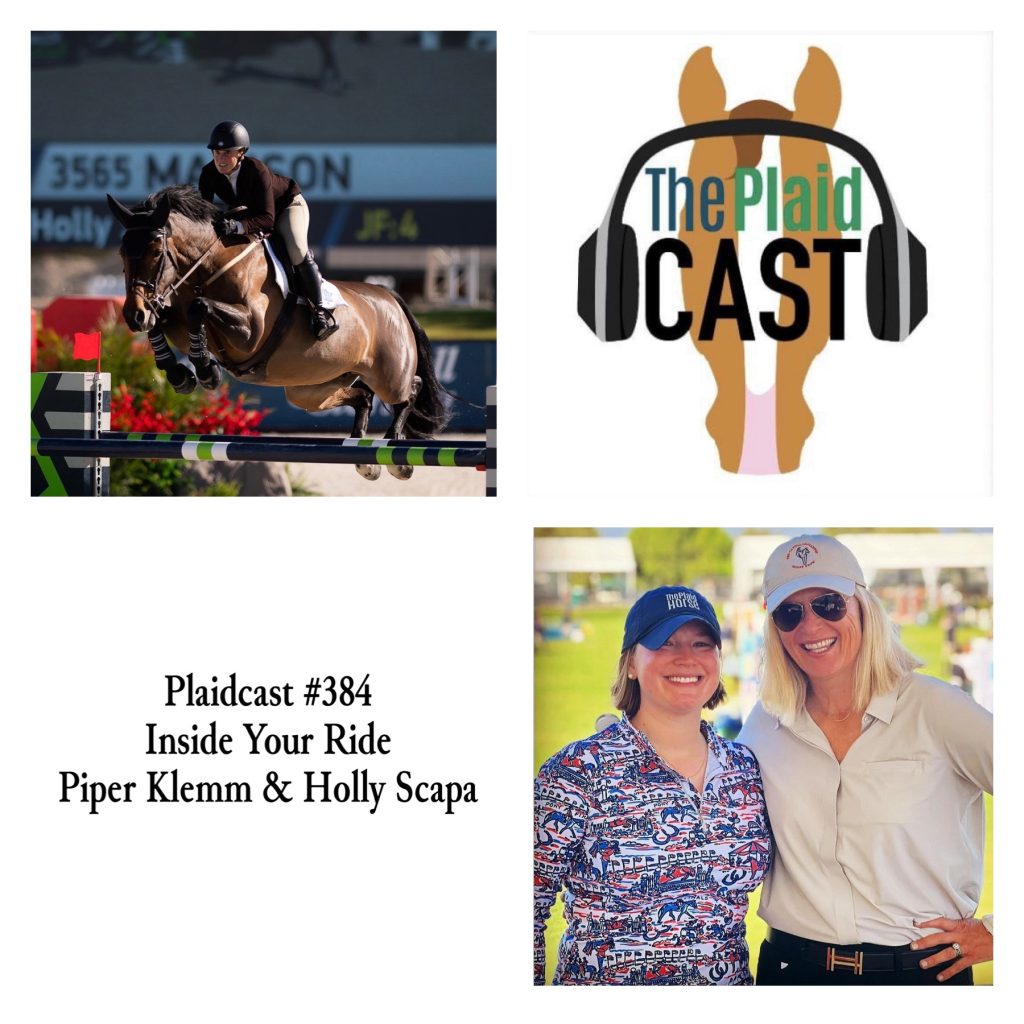
Tonya Johnston, Mental Skills Coach speaks with Piper Klemm, publisher of The Plaid Horse Magazine and host of The Plaidcast podcast. Tonya also speaks with amateur jumper rider Holly Scapa. Brought to you by Taylor, Harris Insurance Services. Listen in!
GUESTS AND LINKS:
- Host: Tonya Johnston, Visit her Website, Facebook and buy her book Inside Your Ride
- Guest: Holly Scapa started riding when she was 10 years old, but really began showing as an amateur. She has had success competing in the equitation through the grand prix level. In 1999, she represented the US in the Nations Cup in Bratislava, Slovakia. Holly currently competes in the 1.30-1.40m jumpers. Her husband is also an equestrian and plays polo.
- Title Sponsor: Taylor, Harris Insurance Services, Taylor, Harris Insurance Services (THIS) was founded in 1987 to provide specialized insurance for all types of equine risk. THIS places their policies with the highest rated and most secure carriers, meticulously selected for reliability and prompt claims settlement. THIS is proud of their worldwide reputation for responsive and courteous service, and welcomes the opportunity to discuss your equine insurance needs and provide you with a quote.
- Subscribe To: The Plaid Horse Magazine
- Sponsors: American Stalls, Purina Animal Nutrition, World Equestrian Center, America Cryo, BoneKare, Show Strides Book Series, With Purpose: The Balmoral Standard, Good Boy, Eddie, HITS Horse Shows, Sentinel Horse Nutrition, Laurel Springs School and Great American Insurance Group
This transcript was generated automatically. Its accuracy may vary.
Tonya Johnston: This is episode 384 of The Plaidcast. I’m Tonya Johnston, mental skills coach, and this is Inside Your Ride. Today’s podcast is brought to you by the Taylor, Harris Insurance Services and The Plaid Horse Magazine. On today’s show, I speak with Piper Klemm, publisher of The Plaid Horse Magazine and host of The Plaidcast. I also speak with amateur jumper rider Holly Scapa. Hi Piper, thanks so much for being here with me today.
Piper Klemm: Hi, thank you for having me.
Tonya Johnston: Yeah, this is so fun. We do this sort of sporadically throughout the years and I just thought it would be fun to have you on and talk about kind of what’s going on for us and what we’re noticing in hosting the podcast as well.
Piper Klemm: Absolutely. I mean, I think the biggest thing I’m noticing is how many people are listening.
Tonya Johnston: Well, that’s great. Oh, I’m so glad. That’s great to hear. I always find it like I love feedback and I always find it a little bit exciting when people will say something. I’ll be like, oh, wow, you listen, you know, because I’m used to being in a room with people or, you know, like talking to someone where I’m getting immediate feedback. So it’s so nice to hear when people are listening and people give comments and stuff.
Piper Klemm: I was talking to someone the other day and she was on the phone and she was like, I was wondering if you’re going to sound like the podcast. And she’s like, I don’t know. But then I laughed and she was like, oh, there it is.
Tonya Johnston: That is actually true. I had some new clients. I had like a little group of like three new clients and they were all like, oh, my gosh, this is so fun. It’s like it’s like actually being part of the show. And yeah, I agree that it’s just, it’s funny. I think also it’s been a minute, like, isn’t it this our sixth year?
Piper Klemm: We started in 2016. So I think it’s actually coming.
Tonya Johnston: No way. Yeah. Oh, wow.
Piper Klemm: Coming eight.
Tonya Johnston: Wow. Yeah. I remember my first guest was John French. And I remember podcasts were not as widely listened to or talked about at all then. And he was sort of unsure, like, did he want to do it? And so I ended up talking to him for a long time and talking about it and helping him get comfortable. Because, you know, like it was a new thing. And I was like, we’re learning together because I’ve never hosted either. So yes, you’re going to be very brave if you come on as the first guest. But you taught me and we’ve sort of learned as we went.
Piper Klemm: Absolutely. And, you know, and we were the only ones for a long time and kind of in our space, another ton of other podcasts, which is awesome. And it’s great that so many people are embracing it and using their voices and sharing their experiences.
Tonya Johnston: Right. Absolutely. How is your horse showing going? Speaking on a personal level, how have you been doing with your riding?
Piper Klemm: Yeah. So like a year and a half ago, I moved up to the 3-3 amateur owners, and then I wasn’t practicing as much and work got really busy. And last summer, Emily and I had that conversation that a lot of people have, like if you’re not going to practice, you can’t do the 3-3. And Ruben is happy to bail me out at the 3-foot and doesn’t care if I make mistakes at the 3-foot, at the 3-3, he’s just not. And so we moved back down to the adults about a year ago. And it’s been really fun. Like at first, without that kind of goal to like always go higher and always do bigger stuff, you know, I had been on the upward trajectory for a number of years with him at that point. And after the first couple of shows, I felt a little like almost lost without like a goal because, you know, we do a lot of the same shows every year. Now we’re in the same division. You know, what is the goal? But then it’s just been really fun because we’re old friends. I’m so busy right now, which is great. But, you know, I’ve been going all over the place and I really don’t have time to like invest in my riding growth at this exact moment. And he’s always there for me and we trust each other and we have that long standing relationship. So we’ve really just been having fun. And I showed in Kentucky the last couple of weeks and he was incredible. And by and large, I was pretty good. The last day I was like really mad at myself for I didn’t feel like I tried hard enough. I didn’t feel like I like was right there putting it all in. But other than that, it’s just been kind of this really enjoyable place. And I have a young horse and I haven’t started to ride him because it’s like if I’m not going to put in the time and being really that growth place. I just I’m overwhelmed and I can’t learn more things right now.
Tonya Johnston: Right. Well, it’s so good to recognize and not get stuck on. Honestly, I think height gets so…And I understand wanting a challenge and doing something new. I mean, I get that part, but there’s always something new to learn. It doesn’t have to be height or division. I just think, and I’m not saying you were like that, but I’m just saying, I think that height gets pointed at and used as this, such a pillar of, I don’t know, advancement that it just doesn’t, it can be other things. And I just think it’s a commitment level of finding like where the joy is coming from and what the growth edge is in, in, in whatever you’re doing, you know?
Piper Klemm: And like I’m just, I’m not at a place where I can put a lot of stress in. can put a lot of stress in.
Tonya Johnston: Exactly. Exactly. Like, and, and I think there are a lot of people in similar positions that still put that pressure because they’re putting sort of the goal before their own process, you know, and making it more important. And, and it’s, and I don’t, I don’t think that’s the recipe for success, certainly. And certainly not for joy, you know, of like true enjoyment. So it sounds super smart. I know in my personal process too, like I’m learning to do the international derbies and really working on that. And, and so that’s great. And so that is, you know, that is the kind of like it’s a new frontier type of thing, right? Which we all are kind of looking for. But within that, even when you’re doing that, you got to be looking at the really small little pieces of it. You know, I’m just thinking about like keeping my shoulders square. And like, not like tipping, you know, because my horse is so like, it’s easy for him and he’s just like wants to follow me. So he just drops down and we’ve had a couple rails of he’s just following. And it’s just me needing more discipline with my body. So that becomes my growth edge. Like, can I go do this, you know, new thing, but not be thinking about, oh, this is a new thing, be doing like, okay, this is a very small, specific thing that is my, you know, this is my challenge, which is fun. It’s fun to have small things and know where you’re at and what’s the right time, what’s right for you to focus on, you know, and that’s sort of like zeroing in. And it’s always a process, right? If you take the bigger picture and then you’re just zeroing in. So it sounds like for you, you’re zeroing in on wanting to be able to go to a show and be there and having fun and appreciating the partnership and not so much anything like giving yourself goals that are sort of beyond what you’re able to put in as far as your preparation goes and not stressing in the system that way.
Piper Klemm: Yeah. And I would say our growth edge has been a little bit like, how little can we do with this horse and still get the same result? He’s getting older and we want to preserve him. And can we jump less during the week? Can we optimize our warmups? How can we keep the same results that we’ve been getting? Because he’s very consistent out there and it’s always wonderful for me. And can we do less and keep that up? And I was really happy this spring for the May Kentucky shows, we did very little with him. The one week we jumped two jumps on Wednesday and then that was it besides warming up and horse showing. And so to me, that makes me the most happy because it says that we can keep this horse sound and happy longer because we’re just doing less.
Tonya Johnston: Yeah, yeah, yeah, that’s great.
Piper Klemm: So you have an exciting new family member, new man in your life.
Tonya Johnston: Yeah, well, I have a new horse. His name is Wolfie and he is an Irish sport horse and he’s just turned seven. So he’s young and he’s learning how to be an equitation horse, which is really fun. I haven’t done the equitation for years since I had Cosmo. So that’s a good eight years. It’s just, it’s been really fun process and I’ve really, I really enjoy it. The thing is with Cosmo now, like we’re both, well, first of all, we know each other inside and out. We can, I mean, I can tell what he’s thinking before he thinks it. And so it’s just nice now to have a horse that I’m getting to know. It puts me even present in a really new and special way, understanding and teaching him the ropes. And it’s just a great way to sort of breathe some new energy and fresh perspective into my riding. So I’ve really, I’m really enjoying it. Yeah, it’s been fun.
Piper Klemm: It’s, is it intimidating? Like I kind of, I kind of feel a little intimidated. I feel a little intimidated to get started with mine. I just, I find myself clinging back to Ruben and the comfort.
Tonya Johnston: Hmm. Well, it’s nice. I mean, certainly what a luxury to be able to have, you know, both, because certainly if I ride Wolfie first, then I can ride Cosmo and it’s sort of like, you know, putting on your comfortable, whatever, getting into the car that you like know everything and, and know where all the buttons are and all that. So that is a nice luxury. I think really it’s more about being again, like we go back to curiosity. I think it’s about being curious about, oh, do you understand this? Like, how can I ask this differently? Like finding those moments where we are on the same page. And I think it’s just really helpful in celebrating the small wins. And I think sometimes that’s easy when you know your horse so well, you almost, it’s easy to take wins for granted. And I don’t mean wins like, you know, blue ribbons. I mean, just like the things that you do well together can get a little taken for granted and trampled over. And so I think it’s always good to keep an eye on that. And certainly with a new horse, you’re able to have those small micro moments where like, oh my gosh, like, I loved those five strides of canter, or that particular lead change felt amazing. You know, it’s just, those are a little bit more lit up with spotlights. And so that’s fun to sort of gather those at the end of the ride and really look at like what’s working and why.
Piper Klemm: I was going to ask what Cosmo thinks about all this.
Tonya Johnston: Oh yeah, Cosmo, he’s not, he’s accepted it at the beginning. He was sort of like, um, what is happening? And I know there’s some people I’ve talked to are like, yeah, when I’ve gotten a new horse, I don’t keep them in stalls next to each other. So the one of them doesn’t see when, when I’m talking to or taking the other one out. But you know, Cosmo, Cosmo is confident in his place in the family and is confident enough to embrace. So yeah, they haven’t gone to this. We have only taken Wolfie to one show so far, so they haven’t gone to the same horse show yet. So that will be interesting. And I want to train them to be able to graze them at the same time, but I don’t know how that’s going to go. That’s sort of a pony club rule violation, I think.
Piper Klemm: Oh, I’ve already done that, but then my turn out together. So it’s somewhat cheating.
Tonya Johnston: Right, right. They already get that.
Piper Klemm: Yeah, yeah.
Tonya Johnston: It’s just really fun and looking forward to the process. And it’s actually helpful because like I was saying about like the derbies, like we’ve spent, I’ve spent so many years thinking about Cosmo and his jump and all of that. I think there’s been some things that have gotten, I’ve gotten a little bit complacent about in my own position that I think are coming up in our international derbies that it’s good for me to actually equitate. I did my first flat equitation class in nine years. And so that’ll make you honest real quick of like, what are you doing? Like, how’s that going? So I think that’ll be actually super helpful for the work I’m doing with Cosmo. So I’m looking forward to that crossover for sure. How about you? Are you getting out to Emily’s to ride?
Piper Klemm: No, I have not been practicing at all. Yeah, yeah, yeah, no, it’s not good, but..
Tonya Johnston: I thought maybe you would with the move. I thought I would.
Piper Klemm: I thought I would too, but it’s just made me busy. Oh, I thought it would be like easier and it’s easier, but I’m also busy. I don’t know. Everything’s great. I mean, we all we all know with this industry, you always got to make hay while the sun shines and the sun’s shining and I’m making hay.
Tonya Johnston: So, yeah, there you go.
Piper Klemm: It’s all good. And I’m really grateful that I have all those years behind me with Ruben, that I can just kind of giddy up and go and have fun. And he’s totally cool with that. I mean, he would be down. He’s down to just pull out of his stall a few times a year and go for it.
Tonya Johnston: So, yeah, that’s great. What kinds of mindset tips have you learned from your trainers over the years? Is there anything that stands out that has sort of stayed with you?
Piper Klemm: I think it’s just how much is within my control. Like how much is within my focus level, how much I’m responsible for in the show ring. And it’s that combination of being prepared and being in the moment. And I think you only learn that by going too far one way and going too far the other way. And keep always keep finding that balance. Like if you’re completely prepared and not in the moment, you’re not going to have a good trip. And if you’re completely in the moment and not prepared, you’re not going to have a good trip. And it’s like constantly feeling out overdoing it and underdoing it on both ways. And so I think that’s the biggest thing that that’s really made a difference for me. The other thing that was interesting because, you know, I don’t ride much and someone asked my trainer at the last show, they were like, well, she how does she do this? Like how she so consistently when she doesn’t ride. And I thought it was really interesting. My trainer said, well, she like truly understands how to ride a course. And I thought that was such an interesting point. I wouldn’t have put it that way exactly. But like when you watch thousands of rounds and you truly understand the goal you’re trying to reach and you truly understand the track and you truly understand the pace and you truly understand every piece. And that kind of goes back to the preserving. My horse thing also is like, how much can you get done with yourself by truly understanding what the metrics are, what the goals are, what you’re trying to do and how that pacing and striding and track and structure play into things.
Tonya Johnston: Interesting. Yeah, absolutely. And that you bring that to the equation. I think sometimes people understand that on an intellectual level, but they have trouble bringing it to the ring, but you sound good at bringing it with you into the ring, which is awesome and such a like tool.
Piper Klemm: And I judge a lot of local horse shows. And I think that’s helped me so much. And I think judging or pretending like you’re judging is so valuable if you sit in the same spot and can watch any horse show all day long, no matter how big or small the horse show is. If you can sit in one spot and have a note card and judge to the best of your ability all day long, like the stuff you’re going to notice, you notice every person who cuts this turn misses to the steps. That stuff really becomes obvious in repetition in a way that it’s not going to be obvious in your riding because you’re not going to repeat it that many times.
Tonya Johnston: The only thing I would say to that is for folks not to be doing that on days that they’re actually showing because you can fry yourself. But yes, as research and recon to go and be able to give yourself that experience is huge. Absolutely. I think also the focus on the things in your control, like you were saying, is very, very big. I think, like I remember from when I rode with Hope Glenn, I would occasionally have these catch rides or horses that I borrowed or what have you. And one day there was a horse that didn’t get braided accidentally. And it was, and this happened probably a couple of times and her attitude was always, okay, we’ll just ride better and make the judge ignore it. So any challenge that you’re going to have, take the circumstance and use it as a reason to rise above and to be better. And I think looking at a challenge as an opportunity was a mindset that I really learned from her, I would say. And I think that’s also obviously in line with my personal philosophy, but it was really a helpful note to hear. And I think I had a trainer when I was growing up back East, Sue Payne, who I would ride with in the summers, and I would show back in on the East Coast in the summer. And she was good. And we didn’t really, we weren’t talking about sports psychology, but she would say to put it for us to put our, we did more equitation, put more, you make sure you’re putting your mind in a place of ease to make the effort appear effortless. So she would have us use sort of just this mental construct of, you know, you know, even old school, like imagine you are sitting with a tea set, there’s a tray with like a tea service on your head or, and you’re just effort, you know, it’s just so easy. And you’re so effortlessly creating this sense of calm and smoothness. And, you know, just to use your mind to sort of help you with that, to be able to embody that ease. That was something that was interesting and that I used as a kid. And I think definitely shaped, you know, that whole, this whole concept, what you were talking about, about like visualizing and just being aware of like, okay, these are the important parts. And that ease is an important thing to put into your riding, especially in the divisions we do like the hunters and the equitation where, you know, it is a subjectively judged thing. Nobody, I think it’s just good to be aware of the tools that we have, that we can get to that kind of mindset and how that can impact our physical performance and our partnership with our horse for sure.
Piper Klemm: And I’m finding after so many years with Ruben that ease is just becoming natural.
Tonya Johnston: Yeah, yeah.
Piper Klemm: It was so hard in the beginning. I mean, both of us really struggled with each other. We were both a very new experience. And now, it’s just he understands the expectations and he’s really there for me.
Tonya Johnston: Yeah, that’s great. That’s awesome. What a nice feeling. What are some recent reads or listens that have motivated or impacted you and your mental game?
Piper Klemm: I actually, I listened to Jerry Seinfeld on The New Yorker recently. And he was talking about how skill, like, I’m going to paraphrase, but he basically said, I know a lot of rich people and money doesn’t make them happy. The only thing that makes people happy is skill. And the only thing valuable in life is building and developing skill. And I’ve just been thinking on that for the last month or so since I heard it because it’s such a fascinating concept. And I think when we talk to young people who are a little lost in this world and as things change so much, we all need so much skill. We need different skills, skills we need change and really emphasizing that that skill building I think could have a ton of value to our sport because it’s less about ribbons and more about like holistic building, building yourself.
Tonya Johnston: Yeah. Oh, that’s super growth mindset too, obviously, right? That’s awesome. He actually is pretty thoughtful. I know he meditates and he has a real preparation routine before he goes on stage. I’ve heard him in different interviews talking about a lot of different pieces of that. That’s an interesting perspective for sure. Yeah, the skill, the idea of well, and that’s also about mastery being a path to joy and to happiness, right? The more that you feel competent and you have tools to arrive at your challenges and feel like, okay, I can do this. That truly is such a joyful experience. When we feel that preparation, that’s when we talk about getting into a state of flow, is when preparation meets that opportunity or challenge, you’re able to be in a state of flow and you’re able to be so present because you’re leaning on, oh, I’ve got what it takes to do this right now, right? And that allows you to be in the moment and not overthinking or questioning or doubting yourself. Yeah, that’s really cool. I read a book. Did you read this book yet? The First Rule of Mastery, Stop Worrying What People Think of You?
Piper Klemm: I haven’t.
Tonya Johnston: Yeah, it’s Michael Gervais, he’s a high performance psychologist who works with, you know, elite athletes and musicians and artists and what have you. So it came out this year. It’s a great book on being like committed to like growth mindset in order to keep learning. And his basic thesis is talking about what he calls FOPO, which is fear of other people’s opinions, right? And if you think about it in the context of our sport, I think, I think it is a really important thing to consider because really when you consider like when we go in the show ring, we’re basically always still learning. So you’re this concept of learning with an audience is very challenging. And it really puts a question to your ego of can you let go of your desire for people to like you and think you’re good and really focus on the important things in that moment? It has some really great points about the fear of other people’s opinions and the exhausting attempt to interpret what other people are thinking all the time in order to avoid negative evaluation. It’s something to consider. It’s really an energy drain. And for example, rather than looking outside of ourselves to see if others approve, we can rewire the mechanism to turn inward and check against our own purpose. Am I being true to my purpose becomes a new reference point instead of am I being liked? So am I doing the work? Am I present in the moment? Am I going in the ring and riding every stride with my horse? That becomes the much more important piece than do people think I’m qualified for this division or that I should have bought this horse or whatever it might be, which are really distractions and things that can take us away from being in the moment and having fun and going after our goals that we have set. Let’s talk about the podcast, things that you have noticed. I was thinking it might be cool to talk about what are some themes we’ve noticed in the most successful trainers and riders we’ve had on the show. Any factors that you see come up again and again?
Piper Klemm: I think it’s that they’re constantly adapting and melding their base of knowledge. And most of them have a base of old school knowledge and they’re constantly integrating new concepts and new things with that. And I was sitting with a trainer in Ocala and we were talking about like old school riding styles versus newer riding styles. And we were watching the Grand Prix and he would point out people’s elbows and different things and he’d say, that’s old school and that doesn’t work anymore. That’s old school and that does work. This is a new way of riding. And it was very fascinating that a lot of old school people want to be like, oh, the old ways were the best. And there’s so much good stuff in the old ways and needing to meld that with the new data that we have. And I think that people who are really successful today understand and have mastered the old systems and are completely open to new ideas and alterations to their base of knowledge.
Tonya Johnston: Yeah, because then you’re getting the best of both. And it’s coming from a place of information and knowledge instead of just, oh, this is new, it must be better. That’s like a distraction sometimes of the new fad or the new way of doing something.
Piper Klemm: Yeah. And I think about how many things in our sport that we’ve inadvertently changed and then later found out that the old way we were doing for a specific reason. One of my horses recently, we started in about the last year bedding him on straw and his entire body has changed and that’s been the only change in his life. And that’s not universal for all horses, but whatever it is for this horse, whatever nutrient, whatever standing on it, it’s one of those, the old way really works for him. And so that it’s fascinating.
Tonya Johnston: Yeah. Yeah. I think another thing I may be very related would just be curiosity. You know, that’s a theme that I think comes through in some of the interviews that I have done of just always being curious and interested in learning and continuing to improve. Because that shows also being so confident that you can be curious. You know, I think sometimes that the fix, like this is the way it is, comes from a place of a little bit of insecurity. Because if I change what happens, what’s going to, you know what I mean? Like just being constantly curious and learning is such a hallmark and such a theme across sports as well of athletes who really rise to the top and just curious about themselves, curious about what works for them and new ways of preparing and gaining strength and skill, really.
Piper Klemm: And I think also there’s a level of like self evaluating and I think it’s easy to think, oh, I have a trainer, other people will tell me stuff. But you know, the people that are good are self evaluating everything they’re doing and they are second guessing themselves. They are going through and saying, how could I have played this day differently? They are putting everything in a data bucket of like, oh, you know, yesterday I had an egg sandwich for breakfast and I rode like this and today I had a fruit smoothie for breakfast and I rode like this and you know, and what’s like keeping that, like always like following that data through and saying, you know, okay, and then the next time you have another data piece to add to this and really being critical of yourself, I think the most improvement is going to come from day in and day out evaluating every one of your decisions.
Tonya Johnston: Yeah, absolutely. Yeah, I think that’s really true. And I think being really good at using, and this is maybe even more basic as far as just we’re talking about horse showing of like, they’re so good at having these consistent metrics of like measuring progress and instead of just relying on outcomes and scores and that kind of thing. And I think amateurs and juniors, the pitfall of horse showing is that you can get really distracted and stuck on those outcomes as being the only important metric. And like, making sure you have so many different ways of asking yourself, okay, what’s going on? How’s it going? What’s working? Like, like what you just were saying, just taking it even further is like really making sure you have a process that you’re tracking that is looking at, okay, what is my best? What is our focus? How are we making progress on it?
Piper Klemm: I think it’s hard to like have that again, have that balance of being negative or shaming yourself and evaluating constantly. And then that’s kind of a constant conversation with yourself is how, how can you be content with your performance today and also be geared up for your performance tomorrow?
Tonya Johnston: Yeah. Well, I think curiosity is a good sort of non-judgmental way to, to, to lens to use when you look at that of like, huh, well, that’s interesting, you know, more of interesting. So this sort of led to this and maybe tomorrow I can have, I can start, you know, with a different idea. Maybe I get to the ring a little earlier or whatever it might be curiosity and treating it as sort of a grand experiment and sort of evolution of the way you think and the way you prepare, I think is probably optimal rather than judgment in general. And I think, yeah, and I think we hear that a lot in the in our in the interviews that we’re doing, which I think is fantastic and super inspiring for everyone. I also I think another theme that I see, because obviously I’m talking more mindset and mental skills is this whole idea, this whole concept of using nerves as a cue to rise to the occasion and bring the best and like that, that the excitement of that is a total theme. I think top riders really have mastered nerves as a good thing. And that’s something for people to aspire to for sure. So that when you feel that adrenaline, you may not even call it nerves, but that adrenaline that comes with challenge, especially in a competitive environment or in a lesson doing a new thing, that it becomes like, oh, wow, I’m like, you know, there’s nowhere I’d rather be, you know, being able to have that kind of sense of excitement and positivity around it instead of the negative like, oh, I’m going to ride badly because I feel nervous that I think people default to often as nerves being bad. I think the top riders have really, really, really, really come to an understanding about how it, how they’re helpful. Would you agree? Do you hear that?
Piper Klemm: I think so. And I also think that a lot of these things I’ve been thinking about a lot of this lately as I get older, a lot of the skills I developed when I was younger, even ones that I don’t use all the time, the amount, how easily they come back to me when I need them has been really interesting to me. So stuff that I had done a lot when I was younger, but haven’t really done as much lately, maybe making that investment earlier on and even I’m noticing, putting that investment into really learning to control my nerves, I’m not practicing it as much anymore. I’m not really showing much. I’m not rehearsing it. I’m not doing as much of my mindset exercises in between, but I go back and I have that like muscle memory, that mind memory of how to do things. And so even though I’m not utilizing all these skills constantly, the fact that I built them and built them with a really strong foundation, I can access them anytime I need them and that’s been really empowering. I feel like I’ve just really started feeling that this year about so many things in my life of just like accessing back skills that I haven’t really needed in a while and it’s been really empowering and given me a lot of confidence.
Tonya Johnston: Yeah, that’s awesome. I think that it also speaks to the idea of using life skills and making sure you’re applying skills you have, whether they’re in your past and you want to bring them forward or like from other parts of your life too and using them in a riding environment. I think that’s something that is really impactful for people to think about. I mean, that’s awesome. We sort of can sometimes undersell ourselves when we’re faced with new challenges in our riding thinking we don’t have what we need. And yet if you look through other areas of your life, there’s actually plenty of skills you can bring to bear. And just like you said, whether it’s from things you’ve learned that maybe you’re not practicing on the daily right now, but you can bring them out, or things in other parts of your life. I think that absolutely, we’re stronger than we give ourselves credit for. That’s what I will say. And so anything we can do to be like, wait a second, I can do this. I have these skills. I have these talents. I have this experience. Decision making is a way to confidence and excellence as well, just simply deciding to. I am going to use these other parts of me in this equation that feels really scary as I start whatever it might be, you know, with your riding. I think that in our culture, we tend to minimize and look at others, especially with the whole social media thing. We’re looking at others so much instead of looking at our own resume and our own history and experiences and drawing on those to help us rise to the occasion for sure. Any of the reflections from the podcast?
Piper Klemm: I think it’s just crazy we’ve been doing it for so long because I feel like I’m just getting good at it. So I don’t know what that’s about.
Tonya Johnston: Well, I think I think learning is good, right? Like we’re learning as we go like and everyone’s I’m so grateful that people are along for the ride of that. Well, good. Well, hopefully I’ll see you down the road.
Piper Klemm: Absolutely, maybe Junior Hunter Finals.
Tonya Johnston: Holly Scapa started riding when she was 10 years old, but really began showing as an amateur. She has had success competing in the equitation through the Grand Prix level. In 1999, she represented the United States in the Nations Cup in Bratislava, Slovakia. She currently competes in the meter 30 to meter 40. Her husband is also an equestrian, as he plays polo. They are a very horse-oriented family. Welcome, Holly. Thank you so much for joining me today.
Holly Scapa: This is exciting.
Tonya Johnston: Yeah, this is so fun. And I’ve sort of known you, we’ve been acquaintances for many years, but I’ve seen your success and just how long you’ve been doing this here in California. We have a great circuit and I know you’ve done a lot of different things and you do the jumpers at a high level and you’ve done the equitation and you’ve won a lot of our amateur medals here in California and been very successful. And I just I wanted to have you on because I feel like you would have a lot of insight in how you have progressed and insights you’ve gathered along the way.
Holly Scapa: Thank you. Thank you very much.
Tonya Johnston: So maybe we could start about, you know, talking about like how you’re riding, like progressed. I know, I think I read somewhere that you didn’t really show a ton as a junior, but began really kind of going into it more as an amateur. Can you talk about that a little bit?
Holly Scapa: Yes, I started my career with Foxfield and I basically started doing a weekly lesson when I was a teenager. I first rode a horse when I was 10, but that was my Brownie troop took me there. And that was my introduction to horses because my family is not a horsey family. But then it’s like, you know, I don’t know, 12, 13 years old. I started with Foxfield and rode there once a week and it was the best. And I learned a lot. And then I basically, you know, stopped, was working, you know, going to college. And then I began again. And that’s when my career started to take off when I had enough money to actually start showing and doing. I leased a horse from them and his name was Nanook Yesterday Again. And Nancy coached me and we won everything as adult amateur jumpers. I was unbeatable. A star at that level. We did a lot of equitation. I bought myself my first horse and that was my first equitation horse. Leased my horse from Foxfield as my jumper. It all kind of evolved from there. And then I went and had several trainers throughout the years that have taught me lots. Dale Harvey, I’ve had Bernie Traurig, I’ve had some fabulous teachers. Kyle King, he’s now one of the best, he’s the greatest. I love him. Susie Hutchinson, so super, super people behind me and supporting me and helping me. And with Dale, we went all the way. We made a team. It was called the West Coast Active Riders. Richard Spooner organized this years ago. Then you had to qualify. And I was on a team with Richard. It was Nikki Shehanian, Richard, Harry Potter and myself. And we got to do a tour in Europe, which was phenomenal.
Tonya Johnston: Amazing.
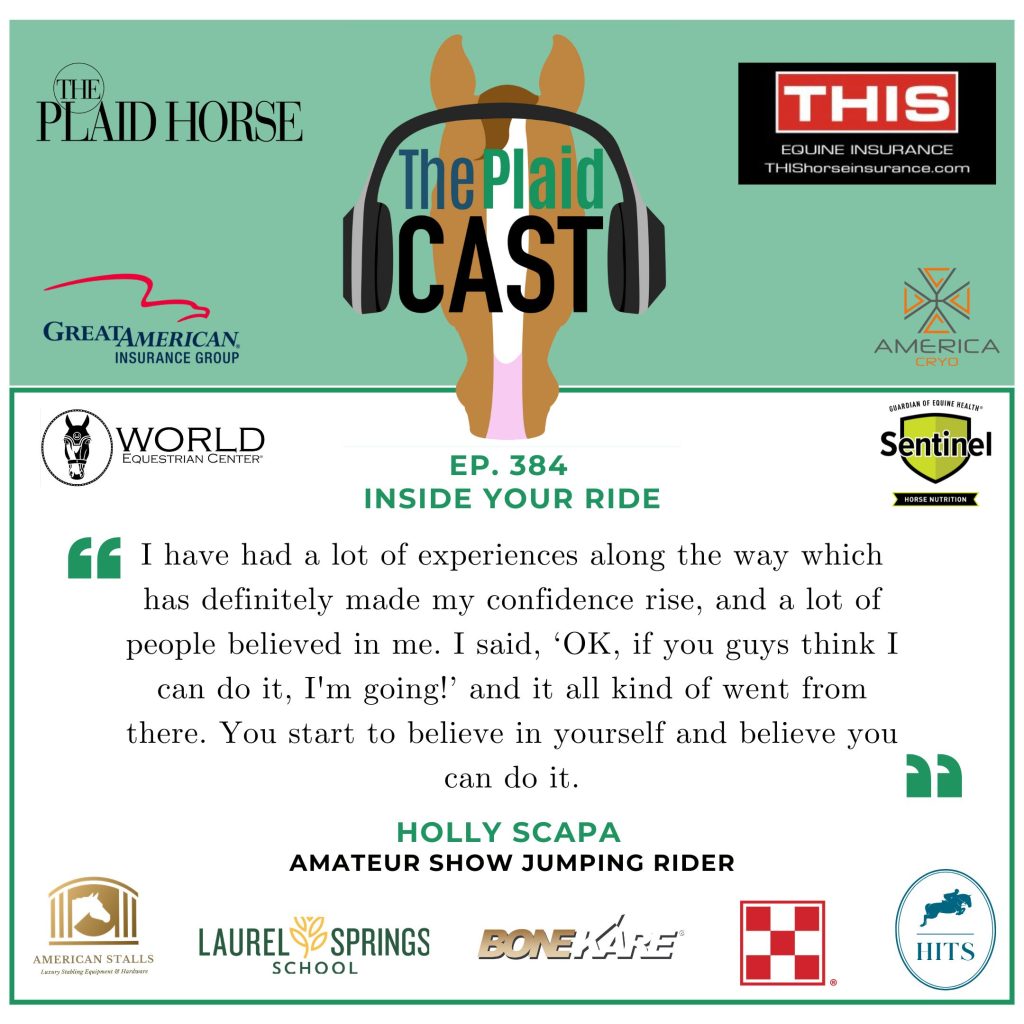
Holly Scapa: So I had a lot, a lot of experiences along the way, which has definitely made my confidence rise. And a lot of people believed in me. And I said, OK, if you guys think I can do it, I’m going. And it all kind of went from there. And you start to believe in yourself and believe you can do it. And you can actually compete against these other people. And I’m always an amateur. I’ve never been a professional. It’s been great. I can’t complain. I have gone farther than I ever thought I’d ever go in my life. I who knew how did that?
Tonya Johnston: So sometimes that can hold us back. Right. So sometimes we can think, well, that couldn’t possibly be me. You know what I mean? So what would you say helps? So it sounds like your trainers belief in you was one factor. What were some other factors that sort of helped you gather that belief and impossibility?
Holly Scapa: Well, I mean, by just actually doing it yourself, like you walk in there and you think first time, oh, my God, these are the biggest jumps I’ve ever seen in my life. Can I do this? And you’re like, oh, God, why don’t I stay in the small division? I’m fine just right there. You know, you push yourself and then you come out of the ring, and it’s the most exciting thing you’ve ever done, and then you really start to believe, oh, my God, I just had one down. I can do it. And it doesn’t matter what my horse looks like or what’s that. You know, the jumpers was my way because in the hunters, I would have had problems because I didn’t have the fanciest horses or this or that. But in the jumpers, it all didn’t matter. I just believed if I went faster than them, I was going to beat them. So that kind of helped. And I mean, Nancy from Foxfield, I still remember she tells me as I’m going in the rain, go as fast as you can, honey. And that’s sort of been my motto. So as I’ve gotten older, I don’t go as fast. I go as fast as I’m comfortable with now. Not as fast as I can. But when I was young, it didn’t matter. I’m going.
Tonya Johnston: Well, let’s talk also because I know you did a lot in the equitation as well. How did that, the discipline of that, do you think impacted sort of maybe your preparation or handling of pressure? I think it’s we’re so fortunate here in California to have finals that are really steeped in tradition and well respected and well attended. You know, really, really wonderful events that I think teach a lot about, you know, as as everyone traditionally says, how the equitation kind of sets you up for the jumpers. Can you talk about that?
Holly Scapa: No doubt about it. It sets you up in my opinion. I mean, it teaches you how to ride a track, a line, you know, if it’s steady to forward, you get all. And to be honest, it’s more nerve wracking for me to do the equitation than it is to do the jumpers, because you have to be perfect, you know, you’re thinking about your body position, you know, and the jumpers, if you ride off that field, and it doesn’t matter if you’re a little bit deep here, you know, you can get away with two things. But it definitely helps, helps my career a million percent to learn by doing the equitation first. I don’t think I would be anywhere I would have been able to do what I did without that experience of riding in the equitation division. And like you say, you know, mentally, you go in there and those finals are hard. It’s a lot of pressure. So I definitely help with when you go and ride in these classes or on a team, so to speak, which you want to perform and you don’t want to be the drop score of your team. So that it’s kind of a similar pressure in that way for sure.
Tonya Johnston: So do you think was there anything you particularly pulled into your routine or your preparation? Like at a fine like keeping on a theme of the equitation like that that would help you like things that you did before you got on or ways that you talk to yourself. Is there anything you remember learning throughout that?
Holly Scapa: A lot of it is really flat work preparation of how to become a partner. You can do it on the flat or over little cavalettis. You’ll be able to do it over the course. So we didn’t constantly drill, drill, drill, but we did it over little cavalettis. And you can make a cavaletti course so difficult. So it and practicing and preparing. So I felt like when we went to the medal finals, we prepared properly. So when I got there, I didn’t look at the course and go, oh my God, I’ve never jumped Liverpool or oh my God, you know, look at these jumps. So that preparation now for the jumper, same thing. If I’m going like I’m going to go to Spruce Meadows, so out come all the Liverpools, we’re going to jump combinations with Liverpool. I’m going to jump whatever walls I have. Any kind of a spooky thing or just for my head, because my horse jumps them all, that I go in positive thinking, oh, I just practiced this at home. I’m golden. I’ve got it. I don’t even think twice. So the preparation of preparing yourself, the same like for the medal finals as for the jumper classes, is the most like I want to feel like if I need to go to the store and buy flowers to put around my jumps, if I had a green horse, I would do that to prepare, you know, so he doesn’t get to the show first and think, Oh, what’s this? I’ve never seen this before. So I think same for a horse, same for a rider. You want to be prepared, feel like you are totally prepared when you get to that show and you’re ready to roll.
Tonya Johnston: Now, is that something you talk to Kyle about? Do you guys both plan of like, okay, this is something I remember last year at Spruce that was intimidating. Can we make sure we jump this? Or is that like a conversation or is that more he’s already doing that? Or what’s that relationship like?
Holly Scapa: We do it. And then Kyle, if there was anything he needed me to practice or do, he would for sure tell me to do it since I don’t stable with Kyle because my horses live at home.
Tonya Johnston: Okay.
Holly Scapa: So we do everything, you know, if I need him, I call him or I can make a video of me practicing and, you know, shoot it over to him and say, should I do anything else?
Tonya Johnston: Right.
Holly Scapa: Although my horse right now is, she’s wonderful. And really the practice is for me, not for her. So just keeping my eye tuned and getting me going.
Tonya Johnston:Right. Got it. Got it. What about, you know, that whenever I see you, you’re always smiling and you have such a positive attitude. Is that a personality trait? Is that something that you feel is, is helpful that you, you know, consciously sort of nurture in yourself because it helps, you know, handle the ups and downs of the sport? Or can you talk about that? I don’t know if you can reflect on that.
Holly Scapa: I think I do. I have a positive. I mean, I get down on myself when I make a mistake for sure. So some, but most of the time, I mean, I’m out there to have a great time at this point in my career. I want to have fun. I want to ride well. And it’s exciting for me. And it’s fun to go out there and do it well consistently. And I am having a blast out there, to be honest with you. I don’t care if I, I don’t have to win. I could, you know, if I can get double clear and make the top ten, I’m thrilled. I, you know, I do. I am very competitive, though. And I would, I like to beat Kyle if it’s possible, but it’s not so possible that often. I’m getting closer. I’m getting closer. He’s a great inspiration. He’s a very positive guy. Emily’s terrific, too. She’s always there for me. They keep me going on a positive way. And his, you know, personality just, he’s always up. He’s always happy. He’s never, he’s great. He’s just great for me to work with. Because everything that he tells you is positive. He doesn’t come out of the ring. I don’t come out and he goes, what did you do out there? You know, what was that? You know, never. Always positive. Even if I do make a mistake, he gives me positive input. Which for me, works.
Tonya Johnston: Yeah. Right. Right. Isn’t that so key is finding a style? I mean, it’s hard with geography sometimes limits people in their choices, but finding a trainer that fits your style and personality and sort of what you need to balance your own tendencies is so key.
Holly Scapa: Yes. It makes a huge difference. Huge difference. For sure. And he knows me and I can’t, you know, a lot of people count, you know, 10 strides or both. I can’t do that. I ride off a feel more than anything. I mean, I obviously I walk and I have an idea of what it’s going to be, but I don’t set myself up that it has to be eight strides here. It doesn’t have to be. It could be nine. It depends where I am and how it all works out. So I have an idea, but he doesn’t make me stick to you got to do it, you know, which is great for me because that messes me up more than anything. If I have to be stuck on a number. I mean, obviously, there’s the places. But when you have, you know, eight or nine, ten strides, there’s options. My horse could land right, my horse could land left. You know, I might be in, I might be out. So I like it that way. And Kyle is very good about allowing me to ride with a feel more than we make a plan. But there’s definitely plan A and plan B.
Tonya Johnston: Right, right. Absolutely. What would you say has helped you most in situations where you have felt nervous? Maybe your first time at Spruce or like a time coming back on top in a medal final. Do you like, is there anything that you have specifically focused on that has helped you channel those nerves or put your focus elsewhere?
Holly Scapa: I just try to walk in the ring and believe that I can do it and I can win. And or, you know, whatever I, you know, like Kyle said, don’t walk out there if you don’t believe. It’s true. You’ve got to walk in knowing you can do it. So I think I try those nerves by that point. You know, you just want to know. Nail it. I’m there. That’s my head.
Tonya Johnston: You want them so they help you. Is that what you mean?
Holly SCapa: At that point, I don’t think they’re making me nervous. I’m just thinking, I got this. Come on, go. You know, so it’s good. And we were doing a jump off at the Oak, I don’t know, a few weeks back. And it was like the serpentine at the beginning. And Kyle went before me and I thought, oh God, he was fast. I’m thinking, I’ll be fifth or sixth or whatever. But the serpentine thing, and I’m like, he did this at Boxfield all the time, serpentines. And then I said to myself, you’ve got this, Paul, just the serpentine. So boom, boom, boom, boom, boom. I never touched the reins. It was beautiful. And I landed and they were like second place. And I’m like, no way. So it wasn’t like I went in thinking I was going to beat him, but I knew I could do it smooth and great. And I did, and I beat him. And I was like, wow. There you go.
Tonya Johnston: But that’s a great strategy, though, of calling up. And that’s something I will talk to people about is when you see things in the ring, in the show ring, if you can like snap back and remember pieces of that, that you’ve done in a lesson or polls on the ground, it doesn’t even have to be like they were jumps, like just those kinds of questions. If you can call up memories of how you’ve practiced that, there can become that like what exactly what you did, like you reminding yourself like, wait a second, I have experience with this and this is something that’s in my wheelhouse and it lends you a little boost of confidence in that moment.
Holly Scapa: 100%.
Tonya Johnston: That’s great. Yeah. Awesome. Yeah, that’s a great.
Holly Scapa: Also, I like to visual. I definitely am the type, I like to get there early. I like to look at my course. I like to walk my course twice always and realize where I, and I walk the whole like I’m walking the corner to the next jump. I just don’t like scoot over to where it is because a lot of people do. I walk like I’m actually riding my horse, you know, around the corner, what it’s going to visually look like. Right. So I walk everything twice and then I take my time. I’m watching. I go by myself sort of and close my eyes and go over the course like I’m riding it. And then that’s definitely part of my preparation.
Tonya Johnston: That’s awesome.
Holly Scapa: And then after the fact, I like to watch the videos so I can see if my, if I, if I rode well, if I’m getting, you know, things are getting smoother and better and, you know, pick things apart.
Tonya Johnston: Yeah. Do you ever watch with Kyle?
Holly Scapa: I do sometimes watch with Kyle for sure. I love to watch with Kyle, but he, you know, he’s a little busy.
Tonya Johnston: Yeah. I wish, I so wish that was, I know, I wish there was 30 hours in the day, but I wish that people had more opportunity to watch with their trainers because it’s just such a ripe learning opportunity of like, you know, then you can really marry the feel of what was happening to what your trainer’s feedback was. Because when we come out of the ring, sometimes the adrenaline is so high. We’re taking in as much as we can, but it can kind of fall away. And so it is, it is a challenge, I think, to use those three minutes when we come out of the ring and we’re still breathing hard and we’re still sort of absorbing what happened to like have that be your peak learning moment, I think is a challenge. So it’s nice if people can create opportunities even once in a while with their trainer, just to like look at something together. I think it’s just so, so helpful for folks.
Holly Scapa: I agree. We’re lucky we have this, you know, years ago. No, nobody had it.
Tonya Johnston: I know. It was such a thing. Yeah. It’s a huge tool. Yeah. 100%. So how, so how many times, so you’re headed to Spruce. Is that, is this sort of like one of the biggest trips of the year for you? I know I’ve been helping other clients get ready for Spruce and it’s such a big thing on people’s calendar. Is that something you look forward to?
Holly Scapa: I haven’t been in, in, I don’t know, maybe five years or so. So yeah, it is. I mean, it’s a great show. It’s a great place. It’s terrific. And it’s a lot of fun and you have to be completely prepared because it isn’t easy. And you have to have a very brave horse and you have to, you know, the terrain is, although now they’ve changed the rings. So I don’t know, but it used to be there was a lot of up and down.
Tonya Johnston: I heard they flattened or some.
Holly Scapa: Yeah, I heard it. So that’s kind of a bummer because that’s what makes it more challenging, I guess. You know, sort of like Foxfield used to have the Derby and you had to jump in the ring, out of the ring, out in the field, back in. It was great. I love that.
Tonya Johnston: Right. That Derby was classic. The things you had to do, right ?The banks and the drops and all kinds of stuff. Yeah.
Holly Scapa: I think it makes you, well, makes me anyway, feel, you know, spruce meadows. I kind of get it because I did that Derby thing from Foxfield. And it was difficult. So you realize, this is a whole other ball game out here.
Tonya Johnston: Right. Which sometimes it’s nice to do things that challenge you, you know, that isn’t the competitive challenge. It’s more just that it helps you drop into the moment and into the experience and not think about the winning as much when it’s challenging in those sort of unique ways.
Holly Scapa: 100%. You just challenge. You were just thrilled that you made it.
Tonya Johnston: Right. Like, wow.
Holly Scapa: I just did that. Which is again, you become braver and you, your confidence just builds if it all goes right. You know?
Tonya Johnston: Yeah. Yep. Totally. Is there anything that like, as you look forward, I mean, riding is so wonderful in that we can do it till we’re at a much more mature age than a lot of sports and be competitive. Is there anything else on the horizon that is really a big goal of yours in the next five, 10 years or in particular?
Holly Scapa: Well, hopefully I’ll still be riding, you know, to jump in the big Grand Prix again, would be a goal if I could find a horse and afford one that could do that. But if not, I’ve reached that goal, so that’s okay, too. At this point, I just want to ride well. And if I ride well and my horse is produced clear rounds, then it’s a great feeling. No matter what level I’m at, it’s really fun, you know, you become a partner with your horse and she’s, you know, she’s my best friend. I believe in her, I think she believes in me and we go in and we do our best. And that’s more fun than anything, you know. That’s awesome.
Tonya Johnston: Yeah, absolutely. So it’s so wonderful to have that kind of relationship.
Holly Scapa: I’m lucky. Very lucky. Yeah. And my husband is wonderful and he, you know, totally helps me and he supports me in every way and he’s great. And I think you got to have that in your life too because the horses take up a lot of time.
Tonya Johnston: Yeah.
Holly Scapa:Your partner has to understand that. Yeah. And he does. Yeah. And he supports, so supportive. That’s also part of it. At this point, I’m just having fun. Maybe one day you’ll see me out there in the big class.
Tonya Johnston: That would be awesome. Well, good luck at Spruce and have so much fun. I hope the weather gods are on your side. There’s no, there’s no haol or some of the crazy things that can happen up there.
Holly Scapa: It can snow!
Tonya Johnston: All of that. Crazy. But thank you so much for taking the time. This was so great and so inspiring.
Holly Scapa: Thank you. Thank you. I really appreciate it.
Tonya Johnston: Yeah. Well, congrats on your awesome career and much luck and hope to see you soon.
Holly Scapa: Alrighty.
Tonya Johnston: Thank you. Okay. Thanks, Holly. Bye-bye.
Holly Scapa: Bye.
Tonya Johnston: You can find the links to today’s guests and the show notes at www.theplaidhorse.com forward slash listen. Follow The Plaidcast on all of the social medias. Just search for The Plaid Horse. You can follow me on Facebook at Tonya Johnston Mental Skills Coach and on Instagram at Inside Your Ride. Please rate and review our shows on iTunes. Five-star reviews help people discover our show. And if you enjoy our conversation, please share it with your friends. If you have a question about your mental skills for riding, please message me on Facebook. Inside Your Ride is available on Amazon in paperback and ebook. You can find out more about my mental skills coaching on my website at www.tonyajohnston.com. Remember, focus is a skill. Use it to make every ride great.