By MARLEY LIEN-GONZALEZ
In 35 years of breeding, Tracy Bryant had never seen a dummy foal until newly born Cricket, a Quarter Horse filly, lay wet and shapeless on her stall floor.
Dummy Foal Syndrome, or Neonatal Maladjustment Syndrome, is a neurological condition. It’s accompanied by symptoms of detachment, disorientation, unresponsiveness, confusion, or trouble nursing. It’s often, but not always, caused by insufficient oxygen. Though Cricket’s dam suffered from severe abscesses in her feet during the pregnancy, there was no indication of how critical Cricket’s condition was until she was born.
It was Bryant’s mother, Terry, who first found her. During foaling season at the family-operated Twin Oaks Farm in Ocala, FL, Bryant and her mother keep strict surveillance on all the broodmares. When not in the barn, through cameras in the house. It was a quiet moment between watch shifts when Bryant caught up on lost sleep for 40 minutes in the predawn hours. Seeing motion in a stall through a camera, Terry headed down to the barn to investigate, leaving Bryant to recharge.
The sound of the farm truck returning to her house brought Bryant to alertness, and her chest squeezed as she heard the engine idle in the driveway almost with a sense of urgency.
“Josie had her baby!” Terry said, running through the front door. “It’s not good. Let’s go.”
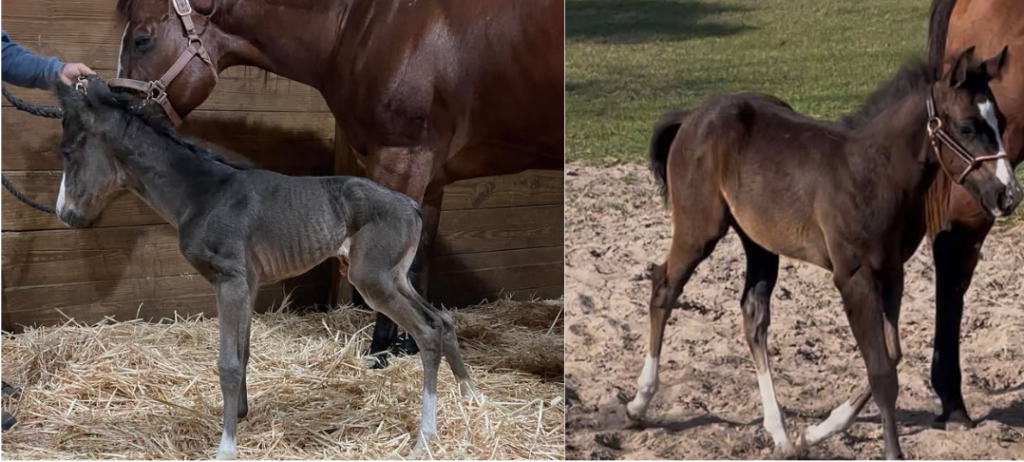
In a bathrobe, Bryant scrambled after her mother into the still-running truck, and they shot to the barn. “Cricket was ice cold and not moving,” says Bryant. As soon as the filly’s light, frail body was untangled from the afterbirth, she was rubbed down and warmed up. When she finally stood, she was barely the size of a German Shepherd and only weighed around 57 pounds.
Though Cricket’s nose was poking around under her dam like she wanted to nurse, she was in no shape to do so. Bryant extracted milk from Josie and transferred it to a bottle to manually feed Cricket. When Cricket made attempts to nurse on her own, she wasn’t able to latch on to the udder.
“I started calling other breeding managers and people that I knew to find out what we could do. And we were told to try the ‘Madigan Squeeze’ on her,” says Bryant.
The Madigan Squeeze Technique (MST) was developed by UC Davis veterinarian Dr. John Madigan to practice on foals with Neonatal Maladjustment, or Dummy Foal Syndrome. Using a rope secured firmly around the body like a harness, MST stimulates the feeling of passing through the birthing canal for the foal in an attempt to trick its brain to reset and “wake up.”
Cricket responded to the Madigan Squeeze and, once released, dashed under her mother to nurse. Sighs of relief filled the air, but her fight was only beginning.
Cricket’s dam had been weakened by months of fending off abscesses. “Her mom did not have much milk because she had her own problems going on,” Bryant explains, “When their bodies are in rescue mode or trying to save themselves, milk production is one of the first things that gets cut off.”
Already at a dangerously low weight, Cricket needed nutrients to survive. Following the advice of her program’s trainer, Chris Arentsen, Bryant tried feeding Cricket Lactaid and milk replacer. The filly wanted nothing to do with it. Hopelessness flooded Bryant, “I thought, we’re gonna lose this baby. She’s going to die because mom doesn’t have enough milk, and we can’t get her to drink the milk replacer.”
Then, three days after Cricket entered the world, something strange and unexpected happened.
“She had started picking at her mom’s grain, which was Sentinel Safe Start,” said Bryant. At first, this raised alarm bells because Bryant reasoned that since Cricket had no teeth, she had no business eating grain. But, she says, “Lo and behold, she had little back teeth, and she was gumming it.”
Sentinel Safe Start is meant to be easily digested. Crafted for lactating mares and growing foals, it’s an extruded feed that’s light, airy, and easily breaks down with saliva–making it a safe option for Cricket, even with her limited ability to grind and chew.
Faced with picky Cricket and the only thing the filly was interested in eating, Bryant decided, “She’s going to either make it or she’s not, and if she’s got the will to fight, I’ll keep doing everything I can to fight with her.”
Every time her mother was fed, Cricket would stand and eat grain out of her bucket. By day 10, Cricket decided she wanted milk replacer with her grain.
“We hung a little bucket of milk replacer next to her Sentinel Safe Start, and it was so cute because she had a few pieces of grain, then she dunked it in the milk. And we called it her milk and cookies,” says Bryant.
Cricket put on weight, filled out, and transformed. As is the course for all healthy foals, it was soon time to wean Cricket from her mother–a transition Bryant says was more difficult than usual. “She was stressing pretty hard, because she had a different bond with her mama than most babies. They went through a lot together, so where most babies rely on their mom for protection, she wasn’t that way. It was kind of a reverse role.”
On a hunch, Bryant gave Cricket a grain bag as an out-of-the-box idea to soothe her. “When Cricket’s mom was going through the abscesses, we used to take one of the Sentinel bags, and that’s what we would use to set her mom’s feet on after soaking so they didn’t get dirty from the shavings,” says Bryant. Sure enough, the pink feed bag was immediately adopted by Cricket.
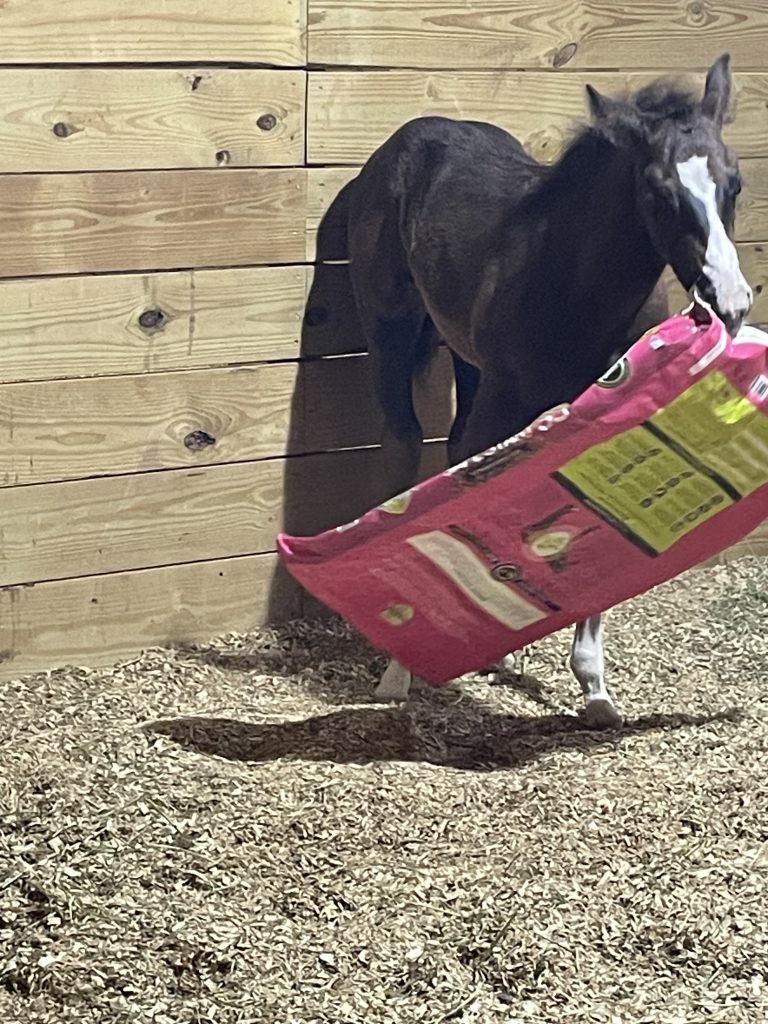
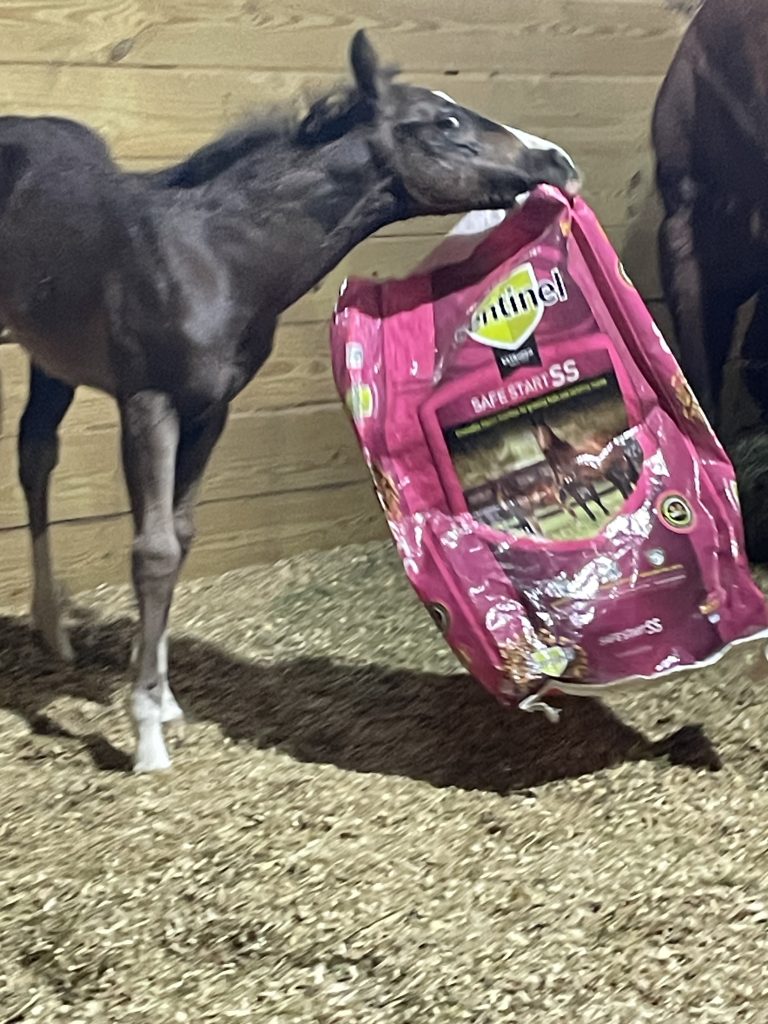
“She would start playing with the bag since she was so used to it. It didn’t scare her. When we would go down at 10 o’clock at night to feed and clean stalls, we would let her play with the bag while we were down there, and we would joke and say that was her feed bag friend.”
Bryant safety-proofed a designated feed bag by cutting off all loose ends and offered it to Cricket. Within minutes, she curled up beside the feed bag and went to sleep. Bryant says she’s grateful to Sentinel not only for their grain formulated so a young horse could manage eating it, but also for the emotional support it’s given that same baby in the form of companionship.
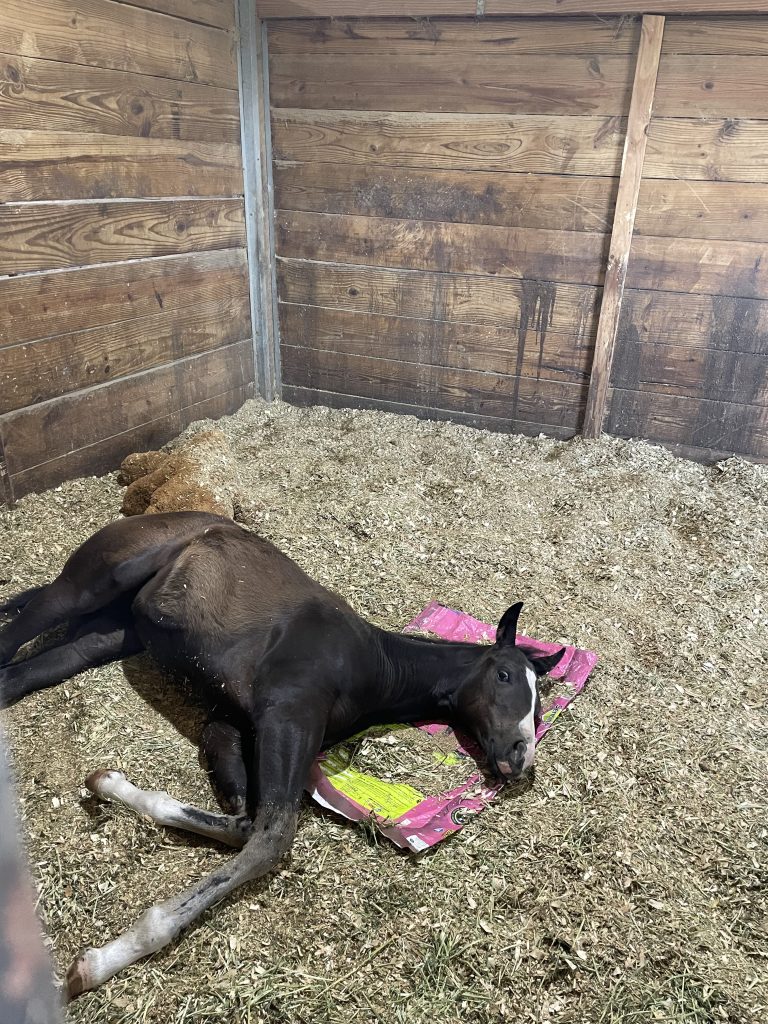
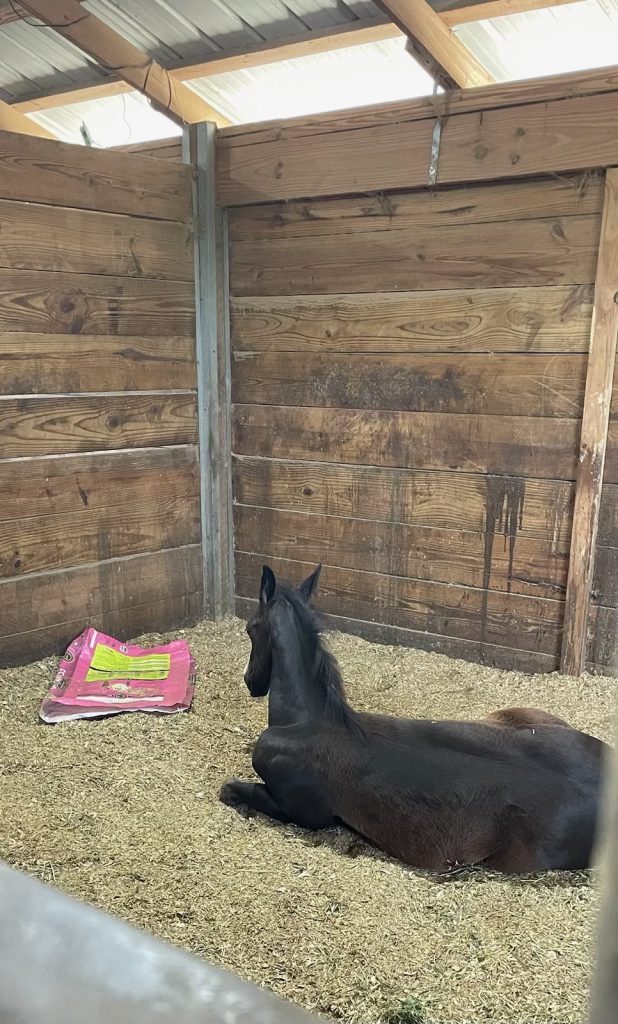
“It is the weirdest thing ever, but that is her comfort,” Bryant says.
Bryant was resigned to the idea that Cricket’s complicated birth and development meant that she would be a pasture pet. But Cricket had another surprise in store. It seems she’s beginning to take the shape of a promising show horse.
“She has just blossomed. She’s shiny, starting to gain muscle, and her head is changing to the point that I’m waiting on my trainer to call me so that we can discuss bringing her up to get her ready for the Breeders Halter Futurity this autumn.”
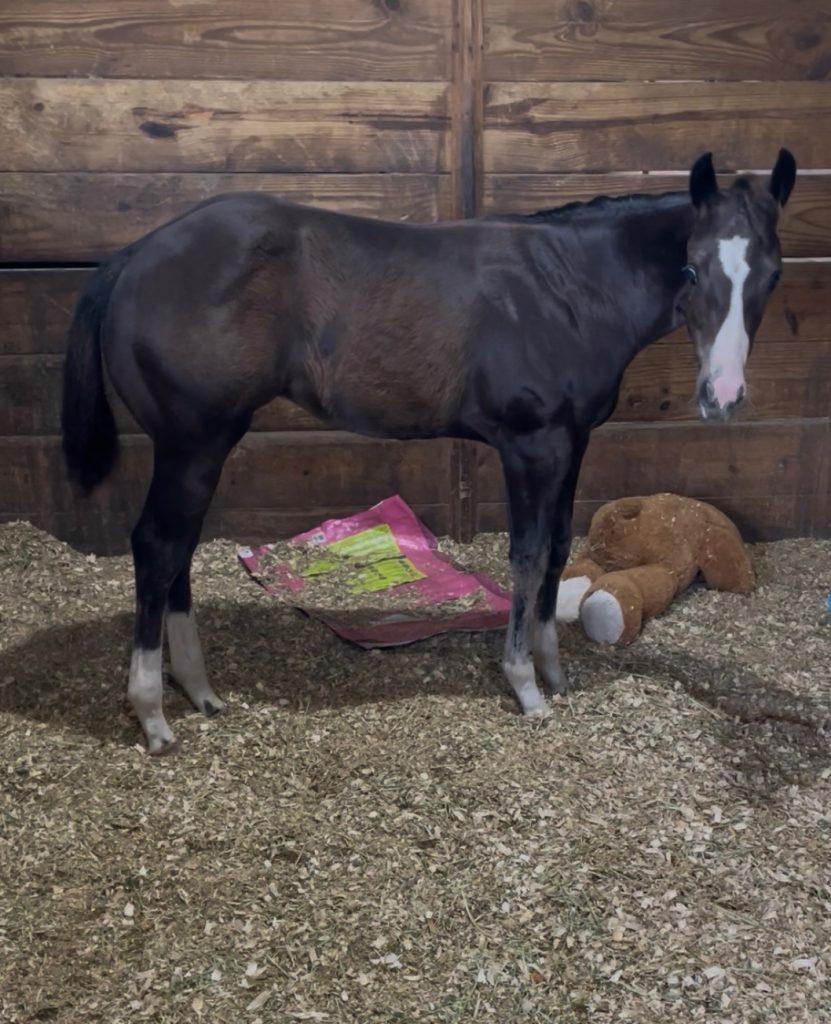
At Twin Oaks Farm, Bryant and her mother breed, raise, train, and sell Futurity horses. They’ve welcomed many champion Quarter Horses into the world in the past five years, and prior to that, they specialized in breeding and producing Appaloosas. What makes Cricket even more special is that her dam, Josie, was never meant to be at Twin Oaks Farm. She was rescued by Bryant and saved from being euthanized for failing to flush any more embryos.
Since with Bryant, Josie has produced Cricket and another high-earning filly. Shez Very Stylish, also known as Linda (to honor the late Linda Gordon, breeding industry icon and a friend of Bryant’s), is Cricket’s half sister and had standout showing results with Bryant, winning a career total of close to $30,000 in earnings.
There are no expectations on Cricket now, but Bryant hopes she’ll have the opportunity to one day step into the stadium light and prove that the right care and proper nutrition can change everything.
“I never expected her to make it,” says Bryant. “I get emotional talking about her. She’ll never go anywhere; she has a permanent home here with us.”