By HALEY LOFLIN
The 2025 USHJA Annual Meeting took place in Orlando, Florida, Dec. 8-11 with approximately 177 attendees representing multiple Zones, disciplines, and backgrounds including stewards, judges, show managers, amateurs, and two juniors attending with help from the Alvin Topping Governance Grant. Throughout the meeting, USHJA President Britt McCormick noted that our sport is at a turning point. On Monday morning, he said the very first USHJA meeting asked a similar question: “Who are we, and what do we want to be? Do you have to sit on a horse to be part of USHJA? Do you have to ride? Do you have to jump?”
We, as an organization, he said, needed to decide what we want the next 20 years to look like and make sure that we’re still here in 20 years. There was not a split of the status quo versus the new guard, but a divide in how to effect the change that is clearly needed to move forward as an organization. Throughout the meeting, affordability, horse welfare, and the need for more education hung in the air, but they were often cast through a far different lens than seen in prior town halls or in social media comments.
Affordability became a discussion on balancing FEI-rated shows versus regular national shows in the jumpers, adding prize money to equitation classes, and creating a “championship week” instead of multiple championships from June to November. There was also frequent discussion of how to save both the “boutique” and one-day shows, as they are increasingly victims of the “big box” shows.
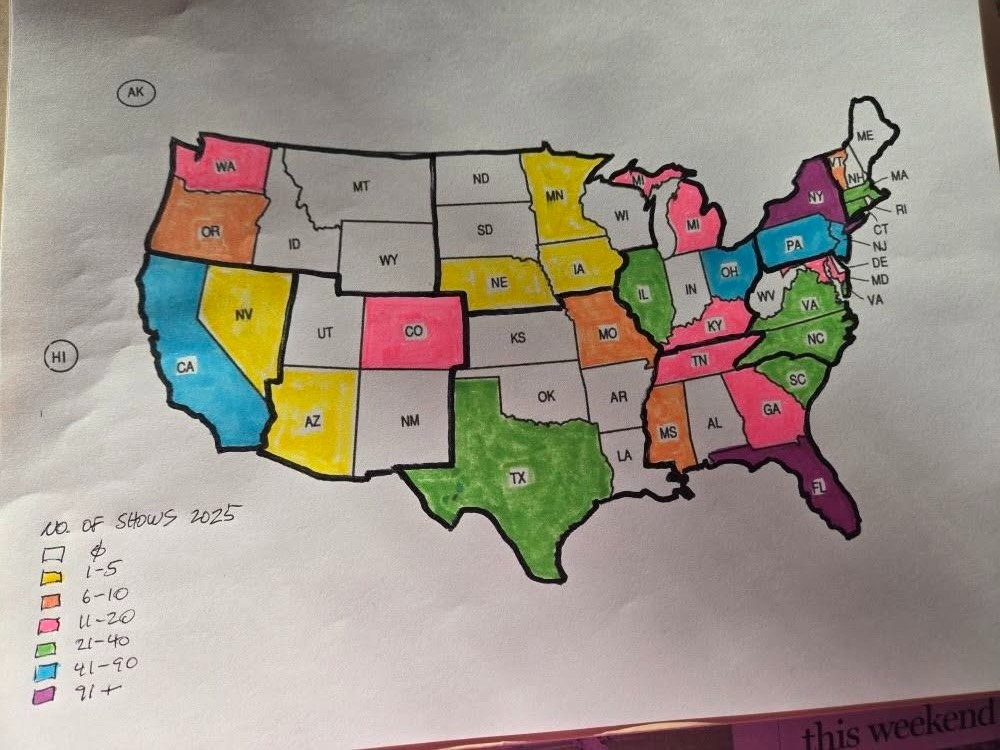
Betsy Checchia of Zone 8 compiled a map of all USEF shows, which showed New York and Florida had 91+ shows in 2025, with California, Ohio, Pennsylvania, and New Jersey right behind with 41-90 shows, demonstrating a large disparity across different zones. She noted that the closest rated show is 400+ miles away, leading to discussions about what could be done to bolster existing shows or support new circuits.
Suggestions slowed after McCormick said, “Part of the thing we struggle with is, are we responsible [as an organization) for making sure horse shows stay in business? I don’t think so; that’s not our job.” He endorse that circuits and large shows that offer all levels will both continue to grow in popularity and widen the show desert across Zones.
Scott Hakim, owner of Old Salem Farm, proposed adding prize money to equitation classes which could be placed in an investment-style fund similar to a 529 plan rather than direct prize money, since the current rule against no prize money has been circumvented by gifting items (as the (WEC Premier Equitation Cup Championship does) or money to trainers (Traverse City Equitation Championship).
McCormick suggested a “Championship Week,” which would start on the West Coast, but offered no further specifications. Combining championships could either be a buoy for historic boutique shows, or they could go towards the established circuits—only time will tell. Notably, the changes to the Adequan/USEF Junior Hunter Championships, from a qualifying event, with qualifiers winning one Champion or Reserve at a Premier, National, or Regional show or being top 10 in either HOTY rankings, to a completion event, where you can now qualify after completing all Junior Hunter sections in five competitions, was never brought up or discussed, and was not discussed in the Junior Hunter Working Group before being published by USEF.
Horse welfare and overuse have been frequent topics at USEF and USHJA town halls for the past year, leading USEF to publish educational guidelines on how to recognize and report concerns. The topic of minimum eligibility requirements (MER) came up in two separate discussions. There was broad support amongst those in attendance and from the joint working group tasked with examining MER and overall safety when progressing up jumping levels. Joint working group members stressed that any decision to create a rubric or warning system must be data-driven. However, it’s hampered by the fact that faults are only tracked at the 1.30 m level and above, for junior jumpers only. There would have to be a different way to track for 1.30 m and below, or USEF would have to start tracking faults across all classes.
Exploratory questions included: whether MERs apply to rider-and-horse combinations, riders alone, or horses alone? How do we account for experienced horses carrying underprepared riders? How do we distinguish between clean rounds that are technically competent versus clean rounds that are still unsafe to watch? Are clear rounds the right metric? How do we distinguish between paper results and what is actually happening in the ring?
The entire group agreed that results don’t tell the full story—leading to consensus that all levels should be tracked with different criteria, giving trainers clear progression guidelines to communicate to their clients. Optimum time has been implemented in many 0.85 m and below classes, but that still doesn’t mean the round is well ridden. Possible solutions included expanding use of recorded warnings, watch lists for riders of concerns, and structured follow-up requirements (education, supervision, or temporary step-downs).
The need for more education was stressed throughout the conference. A hot topic was how to support Recorded (small r) Judges in their journey to become Registered (large R) judges. A committee was established to revamp both hunter and equitation judging by December 2026 that will streamline training from application all the way to large R judges. The Zone meeting revealed that most in attendance did not see a need for different rules for each Zone, which could lead to a streamlining of conflicting rules across Zones in future years.
The session where the board voted on rule change proposals was sparsely attended. Those proposals will go to USEF for final approval at their June 2026 meeting. This part of the conference seemed to be downplayed after the rule change discussion on Tuesday morning.
Overall, the Annual Meeting fostered conversation about the many issues facing USHJA, USEF, and our sport as a whole. There were many new and young faces in attendance, thoughtful suggestions, and interesting discussion. After the increase in town Halls in 2025, it’s clear that both members and USHJA officials are ready to work for the most important part of our sport—the horses.