LISTEN NOW
To listen to the Plaidcast, you can use the player above, Stitcher, Spotify, iTunes, Google Play Music, or your other favorite podcasting app!

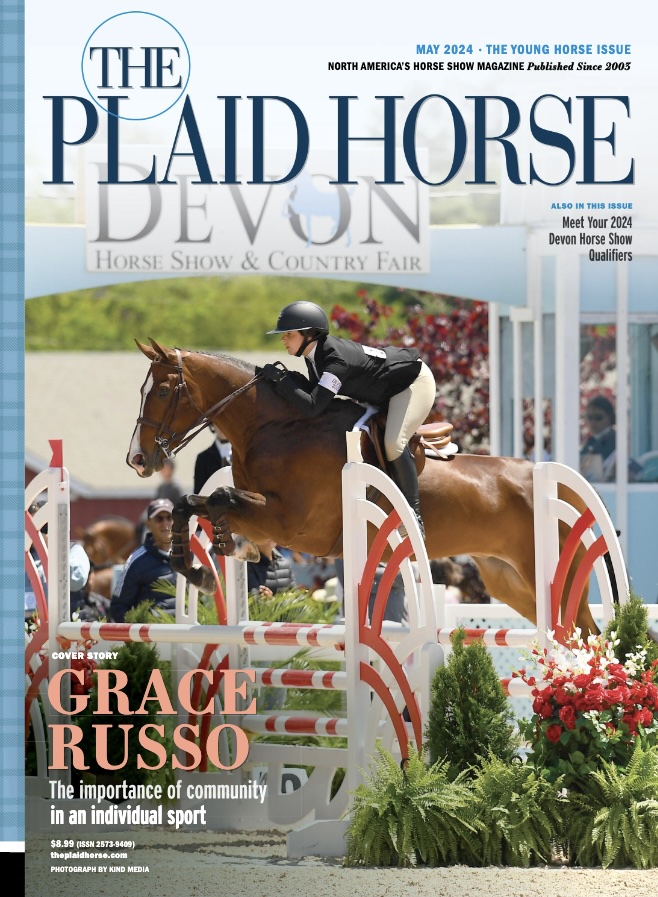
Piper speaks with Dr. Jim Chiapetta about the equine respiratory system and May cover of The Plaid Horse magazine and top junior rider, Grace Russo. Dr. Timothy Winegard also joins to talk about his upcoming book, THE HORSE: A Galloping History of Humanity. Brought to you by Taylor, Harris Insurance Services. Listen in!
GUESTS AND LINKS:
- Host: Piper Klemm of The Plaid Horse Magazine
- Guest: Dr. Jim Chiapetta DVM, JD is a graduate of the University of Minnesota College of Veterinary Medicine and Mitchell Hamline College of Law. He was a racetrack and performance horse veterinarian prior to entering corporate intellectual property law. He is the co-inventor of FLAIR® Equine Nasal Strips and a CEO at Achieve Equine, LLC. His equine research interests have focused extensively on exercise induced pulmonary hemorrhage and the care of the equine respiratory system as well as other conditions impacting performance horses.
- Guest: Grace Russo is in her last junior year, balancing a rigorous in-person school schedule while showing at some of the top horse shows in the country. From Los Angeles, California, Russo attends Flintridge Sacred Heart Academy and rides with Susie Schroer at Meadow Grove.
- Guest: Dr. Timothy C. Winegard is the author of five books including the New York Times and international bestseller, The Mosquito: A Human History of Our Deadliest Predator. Dr. Winegard’s works have been published globally in more than 15 languages, and have been covered by hundreds of other media outlets. He has appeared on CBS This Morning, Netflix, C-Span, NPR, and numerous other national and international documentaries, television and radio programs, and podcasts to discuss his research and books. Dr. Winegard holds a PhD from the University of Oxford and is an associate professor of history at Colorado Mesa University. His newest book, THE HORSE: A Galloping History of Humanity, is set to be published at the end of July.
- Title Sponsor: Taylor, Harris Insurance Services, Taylor, Harris Insurance Services (THIS) was founded in 1987 to provide specialized insurance for all types of equine risk. THIS places their policies with the highest rated and most secure carriers, meticulously selected for reliability and prompt claims settlement. THIS is proud of their worldwide reputation for responsive and courteous service, and welcomes the opportunity to discuss your equine insurance needs and provide you with a quote.
- Subscribe To: The Plaid Horse Magazine
- Sponsors: American Stalls, Purina Animal Nutrition, World Equestrian Center, LAURACEA, America Cryo, BoneKare, Show Strides Book Series, With Purpose: The Balmoral Standard. Good Boy, Eddie, HITS Horse Shows and Great American Insurance Group
This transcript was generated automatically. Its accuracy may vary.
Piper Klemm: This is The Plaidcast. I’m Piper Klemm, publisher of The Plaid Horse Magazine. Coming up today on episode 389, we have right out of the May issue, Grace Russo, right after the July issue, Dr. Jim Chiapetta talking about the equine respiratory system and right out of the September issue, Dr. Timothy Winegard talking about his upcoming book, THE HORSE, A GALLOPING HISTORY OF HUMANITY. This episode is brought to you by Taylor Harris Insurance Services.
Dr. Jim Chiapetta, DVM, is a graduate of the University of Minnesota College of Veterinary Medicine and Mitchell Hamlin College of Law. He was a racetrack and performance horse veterinarian prior to entering corporate intellectual property law. He is a co-inventor of Flair Equine Nasal Strips and CEO at Achieve Equine LLC. His equine research interests have focused extensively on exercise-induced pulmonary hemorrhage and the care of the equine respiratory system, as well as other conditions impacting performance horses. Welcome to the podcast, Dr. Chiapetta.
Dr. Jim Chiapetta: Thank you. Great to be here.
Piper Klemm: A lot of us don’t necessarily think about our horses’ respiratory health on a daily basis. Sometimes things come up, like environmental, that we really start to think about it as a community. Where should people kind of start when they start thinking about their horses’ respiration?
Dr. Jim Chiapetta: Well, I may be a little bit biased. You know, we hear people say, no foot, no horse. Our feeling is no lungs. It really doesn’t matter how many feet you got, if they can’t breathe, they can’t do anything. So I, when it comes to why horses are retired, we know that lameness is very high, it’s number one. The second most significant reason that horses are retired is because of respiratory issues. So it should be considered quite a bit up there at the top when we think about how we keep our horses healthy and nothing is more frustrating than when you get ready for a competition or you’re going to put your horse on a trailer and you start hearing that hack or they come home from that type of event and they’ve got some type of respiratory infection. And I think sometimes we focus around respiratory infections, but just the overall physiology, this part of the horse’s body is so important in the things we ask them to do and the thing that makes them such incredible athletes that they are and give them the capabilities above most other mammals is because of the respiratory systems and the efficiency they have in that system.
Piper Klemm: When we think a lot about like kind of hunters especially or getting our horses fit, I think we tend to think a lot about muscular fitness and not maybe as much about heart rate and lung capacity. How do you kind of measure that as you’re riding or how would you kind of assess your horse if they had good lung function?
Dr. Jim Chiapetta: Yeah, you posed a question in a great way. What’s really interesting is what we got to think about is how do we keep their lungs healthy because they have what they have and they don’t get any more. And what I mean by that is if you start a young horse in training, the limiting organs are going to be the bone and the muscle that need to get stronger. We know that concussion helps the canon bones and the other bones of the body get stronger. We know that increased work helps the cardiovascular system become more effective. And we know as we continue to train the muscular system develops as well, not only in the size of the fibers and the capability of the fibers, but in addition to the physiology going on in the muscles that makes the muscles more tolerable for greater levels and intensity of work. However, when it comes to the lungs, the lungs don’t train. The lungs in a unfit horse are just the same as the lungs in that same horse when it’s fit, because it doesn’t have the systems in it to make it stronger or bigger or increase capacity. So what we have to think about is given we’re, you know, we get one set of lungs, how do we keep them as healthy as possible? But when we see these horses train, or I even think of us when we were kids, and you’d be running, you’d stop running, and you’d be tired and, ah, my lungs, my lungs, well, you know, you may feel it, or may feel like it’s in your lungs, but it’s not. Your lungs can only do what your lungs can do. It’s all the systems that the lungs are providing oxygen for that are optimizing and improving to give you greater performance capabilities.
Piper Klemm: We had a fire alarm at my apartment this morning, and so I ended up walking back up the 18 flights of stairs when it was done. And I was very much more aware of my lungs than I have been in a while.
Dr. Jim Chiapetta: And you do. And humans have some different capabilities. We’ve got more musculature in our lungs, and that muscle helps move our rib cages in and out. Horses, it’s less so. And when we look in the lung tissue itself, the amount of muscular tissue that’s in the lung doesn’t exist like it does in humans. And so when we think about lung capacity, you’ve seen people in the gym, and as they’re working on their biceps or their triceps, those muscles actually grow. And we can visibly see it. But inside the lung cavity, the chest cavity where the lungs are housed, we’re limited, right? You got a big heart in there. So where the heart is, you can’t have lungs. And outside of it, you’ve got a rib cage. And so the lungs are housed in there. And if you take the lungs out, we’ve got some videos and some pictures on our website. And you take the lungs out of the body, they’re much bigger. They’re much bigger. They’re about three times the size they are in the body. But within the body, because of these restrictions of the rib cage and because of the size of the heart, the lungs are just stuffed in there. And that’s all you get. Because you’re going to get as much oxygenation in there that you can when that rib cage expands. And that’s it. So unless we find some way of expanding their rib cage size, the overall capacity for oxygen within the lungs is limited by the horse’s physiology and anatomy.
Piper Klemm: You are the co-inventor of the Flair equine nasal strips. Can you talk a little bit about why you felt that a product like this needed to come to the market and then how it works?
Dr. Jim Chiapetta: Sure. It goes back many, many years now. When I was a practicing veterinarian and working on sport horses and on the racetrack, what caught my attention was two things. One, EIPH, and we can talk more about that later, exercise induced pulmonary hemorrhage. And it was an issue that we were very aware of on the racetrack. But it was also something you would see in magazines. And you would see this spectacular picture of a horse crossing the finish line and they’re extending their stride. And oftentimes the way the picture is taken in the phase of the stride the horse was in, the area of the nasal passages, not the nostril, the horse’s nostrils open as wide as they open. Behind them is the nasal passage that takes air from the nostril down to the lungs. You would see that tissue collapsing. And that was always kind of intriguing of what was going on there. And after we developed the product, I can say we’ve learned a lot more about that piece of the anatomy. And so, it was my co-inventor, Dr. Ed Block, who I started out in equine practice with, called me up one night because it woke him up at night, is why nobody had thought about a nasal strip for horses, because at the time the human nasal strips were out there. And we saw some on football players, and we laughed about it. It was funny. And I then had the opportunity, I had gone to the University of Minnesota, and the pathology department head was a good friend of mine. And when I told him I wanted to explore this, he would leave the back door of the pathology lab open, and I would work on post-mortem specimens to understand that part of the horse’s upper airway. And we started realizing that that part of the upper airway that I would see collapsing was unlike other parts of the upper airway that are supported by cartilage and bone. And because it wasn’t supported by cartilage and bone, but rather by soft tissue and skin, that it was more vulnerable to collapsing when horses were subjected to the high negative pressures that the airway is subjected to when a horse is breathing air in. What started out kind of as a joke, as we started exploring it more, we figured we probably could provide benefit to horses that would optimize their breathing because we could physically see that that tissue was being drawn in and narrowing the inner diameter of the airway the more the horse worked, the harder it worked.
Piper Klemm: So I, you know, always saw these on like race horses and stuff, but like it almost never felt like relatable to me, I guess, because, you know, I have a hunter and like our horses are just not exerting quite the same way. I mean, some of the jumpers are and the jump off, but, you know, even the jumpers, it’s so much about technique and track. It’s so interesting when like what stuff comes down to and as you said in the beginning, like no hoof, no horse, like we all know how much comes down to their feet, but the average horse, how much of their performance is coming down to their lungs and how much of a difference can this make in kind of the regular horse?
Dr. Jim Chiapetta: Well, it depends on the regular horse, let’s break it down a little bit further because I think what I’m gleaning from your initial impression is correct, that I think the strips are very important, the harder a horse is working and in fact, as I said, we learned more of this as we went along. We learned about some literature back in the late 80s that was done that showed the amount of resistance of bringing air into the lungs at different gates. And you can watch the, in the studies that were done, the really nice pie charts to show you that the faster the horse goes, the more resistance they’re going to feel on bringing air in, so top speed is most important, where you’re going to get the biggest benefit. However, if we think about how a horse moves at a canter, the horse has one stride for every breath. And so when the horse is breathing air in, they’re extending their stride. And when they are getting air pushed out, they’ve come past the point where the lead leg has hit the ground, and the back legs are coming forward, pushing air out. And again, on our website, we’ve mapped that out, we show some drawings that were done to show people how every stride takes one breath in and one breath out as at a canter, and particularly as your canter speeds up. When you see a horse break from this pattern of breathing and stride being linked, there’s some type of pathology going along. So, think about the fact that a horse, unlike you and I, only breathes through their nose. And I assume when you’re coming up the stairs today after the fire alarm, you’re probably doing a little mouth breathing as well. It wasn’t just you know.
Piper Klemm: Yeah. Starting about floor 15.
Dr. Jim Chiapetta: Well, at a canter, a horse can’t do that. A horse’s soft palate separates the upper airway, so it only takes air in through its nose. And we believe, or at least if you look at the literature, it is proposed that that’s an evolutionary thing. You’ve got an animal who was designed to graze and eat, and all of a sudden they get startled by a predator, and they take off and run, and to prevent that bolus of food they just stuck in their mouth from going down their throat, and all of a sudden they have to kick it to high speed, their soft palate moves up and closes off so everything is coming in through the nose, and anything that was in the mouth isn’t going to get into the airway and block them up. So we’ve got an obligate nasal breather. They only get one path to bring air in, and they get one breath for every stride. So now think about the size of the opening, and the easiest way for me to illustrate it is a bellows. And if you think about a bellows for, you know, the old bellows they use in fireplaces, where you pull the bellows open to bring air in, and you push the arms of the bellows together to shove air back out again. That’s exactly what a horse is doing on their cantering. They’re opening up their stride, they’re bringing air in, the lead leg hits the ground, and now they’re pushing air back out again. But it’s all going out through the same little hole, the nasal passages. And then think of that bellows, if the diameter of the opening is a half inch versus an inch or two inches, that you feel more resistance when you have to move through a smaller opening. And you’re going to feel that at every speed, but again, you’re going to feel it most at the higher speed where it’s going to have its greatest impact. But because breathing and stride are linked, anything that impacts breathing is going toimpact stride, and anything that impacts stride is going to impact breathing. So if you’ve got a horse that’s lame on the left front and they’re not extending their stride, that means they shorten the duration, they’re taking error. So overall, the two are linked, and what the goal is, is to optimize performance, is to help breathing as much as possible because it does tie into stride. So what we find from many people, but we found in particular, is I’ve got a horse that I put in a stall and I go to work, and on weekends I come out and ride my horse, and it’s a pleasure horse. Unlike that fit jumper that’s in an intensive training program and they’re worked every day, that little horse might be a little bit overweight, its physiology isn’t optimized as much, and so the work of breathing is actually more stressful on them than a performance horse even though they’re going slower. And so for their particular level of fitness, they’re being challenged more. So the fact that you’re at a lower level of performance doesn’t mean your body isn’t working just as hard to bring in air. And so I think part of it when we think about boy, my horse doesn’t go that fast. The other part is, but how hard is my horse working? And I think that should be the question, that when we look at a racehorse that’s going full intensity on a racetrack, he or she is running at their peak at a very high level. But if you take a hunter that may be working at a lower level, they may be working just as hard. And I think a lot of times heart rate can help us understand how hard our horse is working, as well as respiratory rate tells a bit of a secret of how hard that horse is working. And so we learned, we found that at all levels of competition, people can find benefit in the strip, obviously, highest level, especially in jumpers too. But at lower levels, there’s probably going to be less of a need for it. But also think about, like I’m a little bit stuffed up today, think about when you have a cold and what your breathing feels like when you’ve got a stuffy nose and how that impacts your performance, whether you’re just taking a walk or whether you’re running hard.
Piper Klemm: And with the hunters and equitation, I mean, it’s so focused on evenness and stride, you know, balance and evenness of the round and evenness of stride length that the more breathing options the horse has essentially and the more help, I mean, it would sounds like it would make a much more even and smooth round if the horse could be breathing about the same the entire way around the ring.
Dr. Jim Chiapetta: Yes, that’s a great point. I always want to, you know, maintain balance with what I say because I am a breathing advocate. But what’s interesting with human athletes, we used to see nasal strips, the breather right strip on human athletes, particularly football players, some runners. One of the areas that product is seen quite a bit is on cyclists. It’s on race car drivers. And there are people that have these very intensely focused, I mean, what is a race car driver doing, but holding on to the steering wheel and the brakes and the gas? Well, not really. There’s a lot of tension and stress and you’re keeping your mouth shut that you’re focusing on that they’re optimizing their breathing to perform. So one of the questions I want to know is we think about breathing, we think about someone going fast, but when I watch dressage horses, right, they’re not going fast, they’re not going fast at all, but they’re holding that body, their core is engaged, they are using energy just as much, but they don’t have the capacity to do a lot of the deep breathing. So I believe those horses, for a lot of reasons, have a lot of intense needs for air. Horses behind the vertical bothered me because we are really cutting off their airway in so many ways. But again, they’re not going fast, but we’ve tightened up everything. So one of the things that I am on a quest to figure out, and have engaged a few mechanical, biomechanical vets, as well as respiratory, is what’s going on with breathing when horses are under more intense circumstances? They have to tighten their stride up. Dressage brings all kinds of reasons for that horse’s body to be splinting, if you will. What’s going on with the breathing during that? Because I know they’re consuming energy, and I know they’re not given the opportunity to expand quite as much with their chest. And so, leading back to your point, you’re right. Keeping your stride balanced and even, what we’re trying to do is look for marginal gains, right? Where this panacea that you can bring in something that’s a silver bullet, and all of a sudden you’ve made this significant change, not so much. But we optimize our training, we optimize our feed, because we’re looking for all these pieces to come together so we get, we’re going to get optimal performance. And that includes breathing, stride, etc. And so it’s putting all, this becomes a tool that’s part of everything we’re looking for, how to get all the pieces together to make this horse perform at his or her best.
Piper Klemm: We’re thinking right now and rethinking about how we have done things for decades and sometimes generations in the horse industry and I think looking at everything critically is always good for all of us and good for the sport. There’s been a lot of talk about nosebands lately of various forms. You see a lot of jumpers very nosebanded up with, you know, drop nosebands and flashes and all of those things. You see a lot of hunters with very tight nosebands. It just blew up on social media in the last week or two that, you know, that having a chain noseband or a tack noseband is not actually against the rules and is allowed in the USEF Hunter Rulebook. How do all of those things relate to breathing? How should we be rethinking about some of the things that we’ve quote unquote always done from, you know, the double bridle and dressage to rethinking anatomically how what tack we should use and how we should use it?
Dr. Jim Chiapetta: I think we have to rethink all of that, right? I think this is one of the few industries that as a veterinarian, I was always appalled and frustrated when people would do something because great-great-great-grandfather did it. And so that’s the way we do it. And if you think about how we used to treat people medically with leeches, et cetera, I think, God, these same people weren’t helping us think through how we get better health care. This tradition is great, and there’s so much to be respected for it. But we’ve got to look at what we’re really doing. And we are smarter. And we do have better equine programs and equine research that allows us the opportunity to get better at how we think about this. But we need objective data. We need to have more research to answer these questions. A lot of the things we do with the respiratory system of the horse and what we measure is still a challenge to get the right equipment to help us look for what we’re looking for. I think even heart rate, we do have tools that are a bit frustrating. Some of the heart rate tools out there now are a bit cumbersome. But heart rate is a really good tool to help us see how our horses are doing. So what we need to do is have more objective studies done to look at that. My biggest concern with nose bands is when they are improperly placed. And I see this because the nasal strip gets in the middle of this when people put a figure 8 on. And that figure 8 is so far forward that when they tighten it, it squeezes down on the nasal passage. And just to go back a minute on that nasal passage, what we learned was it’s nothing magical. It’s a law of physics. There are several rules of physics that come into play when you look at what a nasal strip does. But one of them is called Quasi’s Law, and I think it’s on our website. It’s a complicated equation unless you love equations. But what it says is basically when you take any tube, a garden hose, blood moving through blood vessels, and you open it up by an increment of 1, your resistance to flow goes down 16 fold. It’s 1 over R to the fourth. So what that means is that if I squeeze on that tube a little bit, I make it a big impact on how much resistance there is going to be to flow. And given how efficient the horse is, he or she can work through it, even though they may be gasping and sweating and working, but we can narrow that passage. And I’d like everyone to go back and take their index finger and their thumb and start just below the horse’s eye so you’re forming a U with your, you know, between your index finger and your thumb, and you can squeeze the bone just in front of the nose and then run your hand all the way down to the nostrils. And you will be moving, moving, bone, bone, bone up and you fall into a sinkhole where it softens up. That is the part of the nasal passage which collapses because there’s no bone there. Incidentally, it’s also the part of the nasal passage where the nasal strip works to hold it open. But it’s also the point where nose bands are positioned as well and if improperly put on, they can squeeze on that area and shove that tissue in so we’re creating an obstruction for a horse. So we want to think about how we’re positioning that and that doesn’t need any research. That one’s pretty easy, common sense. We’ve looked at what putting, you know, resistance at that point does, but proper positioning. Now, I can talk to the figure eight in racing and you and the listeners are going to have to draw your own conclusions only because I like to do the nitty-gritty science and this science hasn’t been done that I’m aware of other than in race horses. But if a horse needs to open its mouth to breathe because we’ve limited its airway capacity because we’re squeezing on the nasal passages, they can do it, but when they open their mouth, think about what happens, and maybe it’s best, I’ll put more on the website to see what the soft palate does. But in a racehorse, if a horse is going 40 miles an hour and they start to fatigue and their jaw muscles relax, they open their mouth. And when they do, well, think about if you’re going in a car 40 miles an hour and you stick your head out and you open your mouth up, you get a big gulp of air. But in the case of a horse, that big gulp of air hits the soft palate and shoves it up and does exactly what it’s not supposed to do for swallowing. And it gets in the way of air coming into the airway. And so the horse struggles. They have to swallow to put that soft palate back into place. It stutters their stride. Their stride breaks for three-tenths of a second while they get everything back into place and get their mouths shut again. I haven’t looked at critically in a dressage horse or a hunter what happens when they’re subjected to a condition where they just got to open their mouth because it’s a natural reflex with fatigue to take in a little bit more air because we’ve reduced their airway. Now, having that band position in the right place, from a respiratory perspective, I don’t have a problem with it, and I’ll defer to others more knowledgeable on the humanness, etc. But my big concern is when we use these tools, they were started for a reason, and sometimes people do them because their trainer told them to or somebody told them to, but they don’t quite know exactly how to use it or take the time to fit it properly. That I get concerned with. And so I think it’s really understanding why we use these tools. What are the pros? What are the cons? What are the tradeoffs? And if we are going to use them, and there are some cons, because it’s like anything, we know the debate on shoes, right, their benefits and their downsides to it. But objectively looking at that, so we can make a better decision for each individual horse, the particular situation that he or her is contending with, that’s causing us to add a new piece of equipment to have an impact on them.
Piper Klemm: So it’s much more, just like everything else, it’s so complicated because it’s much more about placement and nuance than it is about any piece of equipment. I mean, nowhere in there did you say, you know, we always talk about it’s in all caps the answer. And it’s kind of what you were saying before, is that like we’re all trying to piece together things for incremental improvements and there’s no the answer to anything. And so it’s not all X are bad or all type of this type of tack is bad. It’s about placement, it’s about tightness, it’s about nuance. And it also made me think about how many people don’t love their horses but don’t know confirmation really well. And it’s almost if you don’t have someone with a very good knowledge of confirmation tacking up your horse, whether that’s you or someone else, I mean, no matter what your intentions or no matter what you normally do, it’s very easy to make a mistake with a nose band.
Dr. Jim Chiapetta: Absolutely. I mean, I think we, I saw it in my early days at a racetrack where people would buy a horse, particularly a filly who wasn’t a runner. And part of the reason he or she, in this case, a filly, wasn’t a runner is she would soar up a lot and she would soar because she just didn’t have the confirmation to take the speed. And so we’re going to take her off the racetrack and what are we going to do with her? Put her in the breeding shed and you just shake your head and say, no, because we start giving them confirmation capabilities that they pass on to the next generation that likely isn’t going to go away. And so I’m such a firm believer in pony club and any kind of training from early stages in life that horses are a lifelong passion, but they are a lifelong learning. There’s so many parts to them. I’m a Western rider and I’m introduced to Dressage and my little quarter horse who now has to collect himself and do his side passes and it just fascinates me all the different things you can do with the horse and how much they’re paying attention and how little tweaks impact them. And I think that’s why we do is we got a lifetime of challenge to getting better and getting smarter and having a solid foundation and really understanding our horses. And then asking the question, we definitely are going to know the answer and unfortunately you’re going to get 50 different answers when you ask, but it’s when you ask and start formulating your own opinions because you’ve collected that data set and looked at it that you can hopefully continue to make better decisions. But it’s always questioning, how do we do a better job for them? How do we make that a little bit better? And asking the question and learning, and so where I started this is with Pony Club and organizations like that, that start teaching us young to do things as right as we know we can do with the knowledge we have today and then continue on that question and those questions and continue learning. Because it is, it’s all so nuanced that we have to bear in mind what we’re trying to accomplish and who we’re trying to accomplish with.
Piper Klemm: How does weight impact lung capacity and weight over different stages? We’re just coming out of hunter breeding season where the young horses show on the line and I think this is slightly getting better but it was very in vogue for a long time to just have these massively obese yearlings, two year olds and three year olds, which always just made me shake my head. And then the hunters, and again, I think we’re going in the right direction, there’s more discussion on it, but pony hunters, the last 10, 15 years have been just wildly inappropriately fat. “Many hunters are fat and my personal horse wants to be very fat. He’s always on weight management stuff, he gets weighed every week, it goes into a spreadsheet, which is color coded based on how fat he is. But how does that stuff impact lung capacity and how is that different in horses and humans and how is that different with a young horse, a peaking horse, and horses are getting older?
Dr. Jim Chiapetta: I always like to caveat it as I’m not an expert on that topic, but there are some common sense things. One, fat deposits in all parts of the body, it’s like people carrying extra body weight, but they also pick up body weight in the belly, in the omentum, parts of the tissues in the body. And you can see the same thing in the thoracic cavity that they are going to carry some of that excess weight in the mediastinum area where you’ve got tissues that are vulnerable to collecting fat, which is going to reduce size of that space that can the lungs can expand into. And then you have the overall, they’re just carrying more weight and it’s the difference between you going to escape for the fire drill today and having a backpack on with 10 additional pounds. You’re going to work harder, you’re going to consume more energy, you’re going to put more stress on the system. And while stress is important to help get us fit, when we’re carrying it needlessly for cosmetic reasons, that doesn’t do anyone any good. When we look at our society with humans, what’s the impact of obesity? And we know that diabetes, heart disease and all the things that go with that. Well, we see it in horses as well, like we do in the little poodle and the dogs that are queuing over from heart attacks too, because people like their fat little trowel or they don’t want to say no to that next little treat for them. Obesity in any species isn’t designed for their benefit. And so I think we have to always look at what’s best for their health. I know we love these creatures. They’re gorgeous to look at. And there are some things that, as human beings, we appreciate that. But again, it’s looking at good quality research and how it’s impacting their fitness. And I don’t know a lot. We’re seeing a lot more research on obesity. We’re seeing feed count is really focusing on improving the feeds to minimize it, but seeing more studies on showing, yes, with this level of obesity, what does it do to performance? What does it do to increasing the opportunity for founder and other metabolic diseases that are going to impact them? And I think like humans, too, it’s like the frog in the water. When you slowly turn the heat up, a lot of times you don’t recognize the impact is happening because it happens gradually. And we kind of accept it because we feel it gradually. But over time, all of these things are reducing the performance. But I would like to see more objective data on what exactly the obesity does. And it’s not just in carrying the extra weight that is obviously going to make them work harder to get the same work done, but all the other metabolic factors that go with it that impact them. And when you think of these are incredibly big, powerful animals, but they’re also really fragile. As of that, when I would see a laminitis case, my heart just went out because it’s an ugly condition on these huge animals sitting on these relatively small feed. But they can tolerate so much up to a point and then they break. So I think we need to be wise on conditioning and really look at horses. I don’t think it does anyone or anything, including horses, to be carrying more weight than they need to for the job they’re doing. And we really got to be mindful of how far we carry our aesthetic interest relative to this animal’s ability to function.
Piper Klemm: Dr. Chiapetta, thank you so much for joining us on The Plaidcast.
Dr. Jim Chiapetta: Well, thank you. I enjoyed it.
Piper Klemm: Grace Russo is in her last junior year balancing a rigorous in-person school schedule while showing at some of the top horse shows in the country. From Los Angeles, California, Russo attends Flintridge Sacred Heart Academy and rides with Suzy Shore at Meadow Grove. Welcome to The Plaidcast, Grace.
Grace Russo: Thank you so much for having me.
Piper Klemm: Let’s start talking about kind of school. So many different junior riders are balancing it in many different ways. You’ve opted to continue the brick and mortar and traditional school pathway and try to go to the horse shows. Can you talk to us a little bit about your school life?
Grace Russo: Well, I’m really, really grateful for the school that I’m currently at, Flintridge Sacred Heart Academy. They have made so many allowances for me and really supported me throughout my riding decisions and career. They’ve allowed me so much flexibility that it has been really impactful to me as I’ve gotten to show so much more. Just this year, previously this year, I took a month away from school and I showed in Florida. And that was, I’m so grateful for my school for allowing me that opportunity. I work with a lot of my teachers to, I email with them to make sure I’m staying on top of it. I communicate with them before I leave a lot of the times. We discuss upcoming assignments. Sometimes I complete alternative assignments. Sometimes I complete the assignment early. Sometimes I submit it over just email. My school has a website where all of our assignments are posted. That website also, depending on what the teacher allows, can allow submissions on it. So a lot of my work, I am able just to do the standard way through that. Additionally, I work with Upper Echelon Academy when I’m at shows. They proctor me when I have tests. My school can send them tests. It’s amazing to be able to stay on top of the tests that could really pile up for when I get back to school. I have been an in-person school, which I’m greatly, greatly appreciative of. I really value being an in-person school. I love a collaborative environment. I find academic discussion to be one of my favorite ways to learn, and I think the way I personally learn best, I think debating an academic issue and really looking at it from and hearing so many perspectives on it really cements the ideas in my mind and really encourages me to think more about them. So it’s just, I value the in-person school experience so much, and I’m incredibly grateful that I found a school, my current school that is willing to work with me. So that I can maintain that.
Piper Klemm: We don’t always get a lot of perspectives at the horse show because we’re all into the same thing. Talk to us about kind of an average horse show show day. You’re working kind of between school and riding. You know, what does that look like on, say, an average Friday or Saturday during the year when you’re showing?
Grace Russo: Well, typically, most of my school work happens in the evenings, in the post-show day. So I like to start my show days early. I like to get to the barn. I ride in the rings with my horses in the morning, get prepared for the classes to come. And then I, throughout the day, I show normally across a horse show property. So it’s on the move. And I do do most of my homework post the show day. Normally, I’m busy enough during the day that I don’t really have time to get assignments done during the show day. And then once the show day wraps up, I do head back to wherever we’re staying. And that’s when I do a lot of my schoolwork. Additionally, Mondays are very helpful because I get to get a lot of my work done then.
Piper Klemm: This is your last junior year, and it’s always an exciting time. But it’s easy to feel a lot of pressure. And there’s such a big line in our sport between junior and amateur. And, you know, I think in a lot of ways it feels bigger than it is. But there are a lot of classes that aren’t open to you after this year. So how are you making the most out of this year? What are you most excited to compete in? And what are you looking forward to?
Grace Russo: I like to think my great love of this sport is the equitation. So I am sad to lose a lot of those classes. Though I am looking forward to in the past couple of years, we’ve gotten more and more adult options. So I think that’s very exciting as well. I am really looking forward to making the most of my equitation this year, because it is my last year with a lot of the really big equitation classes. I really adore the equitation. I love how it always offers me opportunities to continue working on myself and continue working towards making myself the best I possibly can. I’m looking forward to, well, I’m always looking forward to this, but always making myself the best horsewoman I can, continue learning as a student of this sport, continue working with my horses, learning from them, about them. All of it is extremely important to me to develop myself as a horsewoman and a student of the equestrian and the entire horse world. Also, I’ve been given the opportunity to catch ride quite a bit, and I love that as well. I know that I have given some wonderful, wonderful catch rides throughout my junior career, even recently at Devon, and I am looking forward to continuing that through the final steps of my junior years.
Piper Klemm: What skills do you rely on to catch ride?
Grace Russo: One of the biggest skills I believe in in catch riding is adaptability. It’s one of the reasons I also love the equitation, because I think in the equitation, there are so many variations of classes that focus on so many things, whether it be test included, work off, jumper style, hunter style, flat phase, so many different things where you really have to work on improving all aspects of yourself. And I think being able to ride in such a variation of ways and styles based on the class is really important. And I also think that’s very important based on the horse. So I think there’s adaptability with both. And in catch riding, it very much applies because you have to be both adaptable to the horse and adaptable to whatever classes you’re doing the horse in. And I think that constantly gathering just a wide, wide variety of tools and aids that you can use and figuring out more and more ways that you can make yourself fit to different horses. I think those are some of the biggest skills to use when catch-riding.
Piper Klemm: Diplomat had never done an equitation class when you started riding him. Can you talk about how developing your partnership and your time in the equitation ring helps you ride other horses?
Grace Russo: He is wonderful. It was a little bit sudden, though. My horse, Casolino, that year, who I had been riding at that point for maybe three years as my equitation horse, he had a bladder stone that year. So then my partnership with Diplomat kind of began from a get-go. I think about two weeks into it, we competed in the USHJA Huntseat Finals where we ended up fourth. It was either our first or second work-off, and that was a little bit different because I think initially when we went into the ring and we stood in line up, I was like, okay, better really make sure I have my leg around him and I really make sure like he knows what he’s doing because I’m pretty sure he’s never done this before. And so that is certainly just keeping in mind that he’s a horse. He’s an amazing horse, but knowing that I have to really support him in those moments was a really big thing. Coming off of Casolino, who I’d ridden for most of my equitation career, I am lucky to have had such a strong partnership with Casolino. I still have him and it’s been four and a half years now. And I’m so lucky and I’m so grateful for that partnership. But he is much smaller than Diplomat. And so it was, you know, a big moment where it was like, Diplomat was very new to me and it was just working with him to the best of my ability at the time and really throughout the whole ride, just trying to support him as the best I could.
Piper Klemm: You’re looking forward to riding in college. Unlike most sports, college riding is different from your junior years in that you’re on a team and it’s a much different dynamic and most of the teams are involved, very involved in horse care and kind of all sides of it. What has attracted you to the college experience and to that team environment and approaching our sport in a new way?
Grace Russo: Honestly, I’m really excited about the team aspect. I have really valued my time on the West Coast. I have always loved how supportive and encouraging we are of each other on the West Coast. I’m really excited to see that carry over into a team environment where I can be supportive and encouraging of my teammates, supporting them in whatever ways I can because I think this is something, this sport is something that brings us all together as horse lovers and we all want to provide the best we can for our horses. We always get on them and want to provide the best ride or we get off and we want to make sure we take care of them the best we can. Another aspect is that college is something foreign to me. It’s going to be definitely a new experience. For me, having the equestrian team, specifically having the horse aspect, I feel is going to really ground me. You mentioned horse care and being involved with that. I’m so excited for that and I’m really, really grateful that that is there. The barn is my happy place and even just doing barn work around the horses, just being there, I feel like for me throughout college, it’s going to be the greatest gift I could ask for. And additionally, the teammates I earn as people is going to be wonderful and I’m incredibly grateful for that. And I’m also looking forward to the horses as teammates because that’s what I feel they are. And just again, the reason I love the equitation is because of the adaptability and there’s a variety of horses you’ll ride throughout college riding. And I’m very excited for that to continue improving my adaptability and continue learning.
Piper Klemm: And you’ve been a big part of your interscholastic equestrian league team through high school?
Grace Russo: Yes, I love that because it is smaller. This year there were five of us. It was amazing. It’s wonderful because it’s collaborative amongst grades and we all get to share our love for horses. I love that as a team aspect right now. And I really love just supporting each other, being there for each other, getting to root and cheer each other on and getting to just really engage with our love of horses. We have an amazing team parent as well. She was the first female vet in Orange County. And she teaches us so much as well. She’s a really amazing woman who I’m so grateful to be learning from.
Piper Klemm: So she’s really teaching you to notice things and be more aware and curious on the ground, I’m sure too.
Grace Russo: Yeah, everything. And that’s my favorite part about this sport is I can learn and learn and learn. There’s so many things to learn about, whether it’s vet care, ferrying care, horse care in general, on the horse, riding. There’s so much to constantly be learning about. And I love that.
Piper Klemm: And I think something else that I always like to talk about too, I know you travel with your mom a lot. And I think we really have really special mother-daughter relationships, especially in this sport because we get to spend a lot of times with our moms and travel and your mom rides too. Can you talk a little bit what that’s like getting to do this with her?
Grace Russo: Yeah, it’s really, really incredible. Basically, where my love for horses started was basically when I’d be left with an assistant trainer as a very, very small child while she would ride and just looking up at her on the horses and loving the horses and also loving her and just wanting to be just like my mom. So it was the combined love of horses and admiration for my mom that really drove my excitement as a child to ride. I was four when I finally got through and got to go take my first lesson at a lesson barn. And it was just, I could not, like, the entire time we got in the, since we like started walking down the barn aisle, I was like jumping up and down. And I think they had to calm me down because they were like, this is too much energy for the barn. You know, my mom was there with me and she’s been there every step of the way since. And it’s been amazing, the support she’s had. After she had me, she also had my little brother. So she wasn’t riding super consistently after my brother’s birth. And it actually, when I was eight, I was still at the lesson barn. And when she got back into riding, she went to Storia Stables with Victoria Lacanina. And she actually, she took me with her. And that was when I first, I had a split lease on a pony with another girl. So that was when I started riding like one pony consistently. And that, you know, that was because of her too. And I went, that was when she took me with her. And I was so, so excited. A little bit after that, she took me with her again when she trained with Archie Cox at Brookway Stables before I was born actually. And when she did return to Archie Cox, she took me with her. My riding journey, it’s been moving steps forward because of her because she’s, you know, seen me continue to love the sport and, you know, took me along on her journey that she had been through, even some before I was, you know, born. That’s just the most incredible thing. It’s the love of horses that is so incredible that we share, you know. Even now, as she’s not riding so much, it’s just being around the horses and engaging with the horses, and that is truly what we both love doing together.
Piper Klemm: As you get older, in your teenage years, you’ve started to notice that you’re a role model for younger riders, like the older girls were when you were that age. Can you talk a little bit about thinking about yourself as a role model and being very aware of your actions and how they’re perceived by younger riders who look up to you as you have more success?
Grace Russo: It’s funny because I don’t always think of… I rarely actually think of myself as a role model. I don’t know if I’ve ever actually used that exact framework for thinking, but I think one of my biggest things is I love engaging with all riders about our love for horses, no matter age or anything or level. And that’s something I think that I just… I make friends even with a lot of the younger riders. I do help out a lot whenever I can. If my day ends relatively early for a horse show, if my classes are done kind of early, I’ll stick around, I’ll set jumps for the younger riders. I’ll watch, I’ll clap, I’ll do it all. Recently, I modeled a small pony, which was an experience I hadn’t been back physically in a pony ring in years. And I think it’s just having older girls pay attention and really respect the riding at all levels and at all ages. I think that’s something that just really forms a bond with them. And I mean, I truly think that’s the encouragement that is most valuable. I do ride at the top equitation level, but I really am like a little horse girl at heart. And I just love to talk about horses. And I didn’t actually myself, I spent very little time in the ponies. I grew to 5’4″ in fifth grade and quickly was moved out of the ponies. And then I grew one more inch in my sophomore year of high school. So I’m currently 5’5″. But being tall, young, I missed a lot of the ponies. So I also love to live the little pony life through them a little bit. Because I think, I mean, I know ponies can have their attitude, but I think they are adorable. I mean, I just think that solidifying our relationship as like horse girls, like little horse crazy girls is just really what a lot of us equestrians are at heart.
Piper Klemm: You’ve been able to work with some of the top people in the sport over your years. Who has really influenced you and whose words do you still hear when you ride?
Grace Russo: So, my first time at a barn where I had a lease on my own pony was at Storia Stables with Victoria La Caninia. So, that experience was definitely very impactful. Prior to that, I had only walked trotted in Canada on a lunge line at a lesson barn, which was of course also a wonderful experience and very foundational in my riding. But at Victoria’s barn, I jumped my first jump, I cantered off the lunge line. I did a lot of the little pony kid stuff. I jumped bareback and had the rainless lunge line lessons and a lot of that growth and development, which I think is very important. And then after that, when I was nine, I moved to Archie Cox’s barn, Brookway Stables. And I was at that barn for a very long time, which makes it very impactful for me. I got Casolino while riding with Archie. Casolino is a horse who’s been with me for four and a half years now, and he’s been a partner for so long in my riding career. I almost think that Casolino has had many trainers as well, but as a horse had the most influence on my riding style as for so long I rode him. So a lot of my riding habits, we all have them, but they’ve developed around him and around the type of horse he is. He’s a little guy, so encouraging him to lengthen through his body. A lot of the stuff that I do initially when I begin a warm up, a lot of them, and even throughout an entire ride, a lot of them were formed around him as a horse. Now I’ve had him for four and a half years, and well, we are actually the same age. His birthday is in February and mine’s in July, so that’s a little fun thing about us too. But really at Archie’s barn, he had such an influence with me, along with Carly Postel-Scroder, who was his assistant for many, many years while I was there. And both of them have taught me so much in terms of I moved off ponies with them and basically continued into like majority of what my career is, riding career is now with them. You know, I did the 3’6″, started the 3’6″ eq with them and started most of everything I still do now. You know, Archie, he’s a huge name and he, I always felt so honored to be at his barn, especially because, you know, my mom had trained with him previously and when she went back to riding with him, she took me with her. I’d always made sure to value every word Archie said because I wanted to make sure that I wasn’t taking his time for granted and was really committing everything he said to memory and making the use of the opportunities I had in large part because of my mom. And I was just so grateful to be there that I just truly wanted to make the most of it that I possibly could. And then since then, I’ve had a number of influences and ridden with a number of people through catch riding and training. I’ve had influence from the Endocots and Corinne Beavis. And now I ride with Meadow Grove and also Ken and Emily Smith. And I’ve also had influence from Don Stewart and John French and Karen Healy and so many, so many people. And it’s just with every single person, it’s just wanting to soak up as much information as I can and utilizing it as best I can, because it’s just such an amazing opportunity to learn and keep learning. It’s a challenge that I’m really sinking my teeth into in the sense that I’m really like doing everything I can to make myself the best rider, the best horsewoman I possibly can.
Piper Klemm: Dr. Timothy C. Winegard is the author of five books, including the New York Times and international bestseller, The Mosquito, A Human History of Our Deadliest Predator. Dr. Winegard’s books have been globally published in more than 15 languages and have been covered by hundreds of other media outlets. He has appeared on CBS This Morning, Netflix, C-SPAN, NPR, and numerous other national and international documentaries, television and radio programs and podcasts to discuss his research and books. Dr. Winegard holds a PhD from the University of Oxford and is an associate professor of history at Colorado Mesa University. His newest book, The Horse, A Galloping History of Humanity, is set to be published at the end of July. Welcome to The Plaidcast, Dr.
Timothy Winegard.
So you’ve written a number of other books, including your most recent book about the mosquito. What made you want to venture into the history of the horse and think about our community?
Dr. Timothy C. Winegard: Well, as a historian, I’m not a biologist or an archaeologist. I’m a historian. I think we often like to assign historical events or our progression or evolution of civilization to the wonderful things that our human species does, when in fact, outside sources usually have a huge influence on our evolving civilizations. And so with the mosquito and horse, it’s a different way or a different lens to look at history and look at the influence of external factors in our human history. And certainly from a disease point of view, the mosquito is enemy number one. And then from, you know, another species that has aided or helped in the trajectory of our civilization, there’s nothing that surpasses the horse across all elements of our evolution as a species. And it’s amazing how evolutionarily the horse kind of, all societies essentially figured this out. Eventually from the, you know, the point of domestication, which is still, there’s some contention and it’s a hot button issue as to when and where the horse was first domesticated. But roughly 3500 BCE on the Pontic Caspian Steppe, north of the Black and Caspian Seas in what is now Southern Russia, Ukraine, Kazakhstan. From that kind of focal point, the horse spreads out and becomes a global animal. And I mean, really is a multipurpose living machine, if you will, until roughly 100 years ago when the internal combustion engine unseats the horse. So we forget that for roughly 5500 years, our species relied on the horse literally for everything.
Piper Klemm: One of the things you mentioned in your book, which we were actually just talking about on the podcast a couple of weeks ago, was how big our horses are today, our recreational, our sport horses are, compared to what evolutionarily people were riding and what was used around the farm. Can you talk a little bit about kind of that sizing of the traditional horse through history?
Dr. Timothy Winegard: Yes, so the horse originally, the evolution of the horse starts in the epicenter is in North America, which people often don’t know. It is a North American animal. Over 60 million years from roughly a 10-pound creature that was roughly looked like kind of a fox, a Hierachytherium, specifically in Wyoming, Colorado, Montana, that area. And with some survival pressures and luck, we get this modern creature over 60 million years that has numerous kind of exploitable traits for humanity, which makes it our premier sidekick. But the horses, I guess, that people first domesticated are 13, 14 hands, which are still plenty big to ride and plenty big to pull wagons and then eventually early chariots. But they’re certainly not the 16, 17 hand horses that we have now for, you know, riding recreationally and certainly for racing and other, you know, sport functions. So over time, like any other animal, we selectively bred horses to be bigger, faster, stronger, bulkier if you’re using them as a plow horse. And that’s eventually how we get the different breeds of horses. Obviously, there’s just one species of horse, but many different breeds for specific purposes. And actually, that selective breeding happens immediately upon domestication for both temperament and the backs of horses to flatten them out a little bit to make it easier to ride.
Piper Klemm: Let’s talk about how the horse spurred some evolution of technology. One of the things I didn’t know, I guess, I mentioned this to my husband last night, and he was like, oh, I saw that, I read about that, but I didn’t know this, that the world’s oldest pants were created by horsemen.
Dr. Timothy Winegard: Right, they’re found, well, when we think about all cultures, pretty much all over the world, prior to riding horses, our transportation was our own feet. So people wore togas and sarongs and kilts and no undergarments, obviously. You get on the back of a horse with wearing those clothes, and you’re going to realize pretty quickly that we need something else. I don’t imagine it would have been very comfortable for any gender. So the first pair of pants we have date to 1300 BCE, and they’re taken from some mummies in the Tarim Basin, they’re Indo-European horsemen, in the Tarim Basin of Western China in Xinjiang Province. And they’re purposely fashioned for these two horsemen. Likely pants were invented earlier, but certainly there’s a correlation between early horseback riding and the purposeful fabrication of pants because of riding. So the horse gave birth to a universal gender-fluid fashion.
Piper Klemm: And let’s talk about kind of the stirrup and some of those evolutions, and how much they impacted, how much people were able to travel and experience new cultures and the horse is responsible for essentially the globalization that we see now. It’s that starting to interact with other cultures and other places due to an ability to travel.
Dr. Timothy Winegard: For sure. And we see the earliest migrations of Indo-European peoples out of the Pontic Caspian Steppe, which I mentioned earlier where the horse is domesticated. And they genetically and culturally literally take over Eurasia. From India across Europe, they spread their DNA and culture very quickly. And old Europe or Neolithic Europe is replaced very quickly. And this is why 47% of our planet now speaks an Indo-European language. So we see the horse mold and shape all sorts of elements of our culture. So right at the beginning of the book, obviously, the horse is an organic animal. But I asked the reader to think of the horse more as a machine or a living machine. And like anything else with our own machines, we make upgrades to them. So we invent things to upgrade the horsepower of this animal, so to speak, whether that be saddles, stirrups, whipple trees, harnesses, bits. We’re continuously adding artificial technology to this animal to upgrade its capabilities, which we use for obviously whether it’s farming, transportation, traction capacity, and certainly warfare. We see this throughout history, which is quite amazing. Just like we add upgrades to our cars now, we added artificial upgrades to this living machine, which enhanced its multipurpose capabilities.
Piper Klemm: And then let’s talk about the first moving picture. I think a lot of people know this story, but for those that don’t, can you talk about how our camera and our videography technology really have the horse to rely on?
Dr. Timothy Winegard: Fortunately or unfortunately, the horse gave birth to modern Hollywood, whether we like it or not. So Leland Stanford, who was the former governor of California, who made his fortune during the gold rush in California as a merchant, who donated and bequeathed a bunch of money to start Stanford University, which obviously is his namesake. He had a wealthy bet with some friends whether when a horse is galloping, if all four hooves are off the ground at the same time. But unfortunately, they couldn’t prove this. The Egyptians actually asked the same question. So he hired a very eccentric cameraman who set up a series, and Stanford was an avid racehorse breeder and horse lover. So he set up a series of cameras on the track at Palo Alto Farm, which is now Stanford University, to capture a series of successive shots of this horse named Sally Gardner running across the track. So then he put these pictures on a glass disk and spun it on his invention called a zoopraxiscope. So it was kind of like a repeating loop, if you will, of these pictures of this horse running, which is really the first moving picture. And sure enough, Stanford won the $25,000 bet and affluent bragging rights. All four feet are off the ground when the horse shifts from pulling with the front to pushing with the back under its barrel. So he won the $25,000 bet, but it’s estimated that he spent about $50,000 to actually prove he was right. So it’s an interesting story, but it gave birth to the motion picture. And Edison worked with this photographer very quickly, and the rest is history, so to speak.
Piper Klemm: Those are some horse economics, if I’ve ever heard them.
Dr. Timothy Winegard: That’s right. Oh, I won the bet. Yeah, it’s like gamblers now. They say, oh, I won $8,000. And I’m like, yeah, but how much of you gambled in order to win $8,000? Well, $20,000, but that’s not the point. I’m like, well, so you’re down $12,000 still.
Piper Klemm: Yeah, horse people have very unique math. I thought this was interesting, that there are currently an estimated 58 million horses in the US., making them the ninth most abundant mammal on the planet, down from, you know, about 100 years ago, an estimate of up to 150 million horses. That’s still kind of more horses than I thought, considering how much land use has changed in the last 100 years.
Dr. Timothy Winegard: It actually surprised me that we still have roughly 58 million horses globally. But I guess if you think, I mean, as you know, horse racing is a huge business. But I think what that’s a testament to is just our relationship with horses, that even though they’re redundant as far as, you know, something we use in society still to farm and war and travel and transport and trade and traction and deliver our milk and our Amazon packages, that we still have so many horses on the planet because there’s this enduring relationship between horses and humans and they’re just a part of what it means to be human in a way. So people still feel this affinity to horses, whether that be recreational riding, rodeos, and even now with the therapeutic healing, with the equine therapy that we’re seeing pop up around the world using horses to treat depression, PTSD, at-risk children, inmates, which we see recidivism rates go down, where inmates are training wild horses that are pulled off the range, these Mustangs, and then adopted out. So I think it just speaks to how that tight bond and close knit that we have as species.
Piper Klemm: One of the other things that interested me was I didn’t realize that the kind of the Appaloosa was essentially forgotten between the 1800s and the early 1930s. A group of breeders essentially brought them back. Can you tell us a little bit about the story of the Appaloosa horse in the United States?
Dr. Timothy Winegard: Yes, so the horse went extinct in the Americas roughly 9,000 years ago because of climate change predominantly and maybe some overhunting or a combination of both by the first peoples or indigenous peoples. But Columbus reintroduces the horse to the Americas on the second voyage and obviously it quickly spreads through trade, theft and then just the feral horses escaping and indigenous peoples latching onto these horses. So it spreads very quickly from Mexico up the southern United States and eventually into Canada. So the Nez Perce indigenous peoples start their own breed, which is the Appaloosa. But then obviously with the American Indian Wars and the subjugation and destruction of indigenous peoples in the late 1800s, the Nez Perce are put on reservations. What’s left of their horse herds are taken from them and the Appaloosa breed is really forgotten about these painted horses that Lewis and Clark mentioned in their diaries as they’re voyaging out, traveling out to the Pacific. And they’re brought back and essentially saved by a group of horse lovers and now they’re the state horse of Idaho. But so it’s a remarkable story kind of brought back from relative obscurity because they’re such unique breed of horse and people think of the Lone Ranger with the beautiful painted horses.
Piper Klemm: I was thinking about that too because I think we have a lot of breeds right now that are kind of at a similar place and maybe have a couple dedicated breeders looking to bring them back. But it’s a great story of triumph, of actually successfully bringing a breed back into kind of regular use, shall we say.
Dr. Timothy Winegard: Yeah, and same with the Lippins or horses with the Second World War, where they’re going to be extinct and there’s a crazy rescue mission between a joint American and Nazi prisoner of war that goes save these horses from the Russians eating them and the SS killing them. It’s a crazy story at the end of the Second World War that’s in the book to save that breed of horse as well.
Piper Klemm: And we’re seeing this, you know, right now, originally, when the war started, trying to get horses out of Ukraine and like these bloodlines are not unlimited anytime there’s conflict.
Dr. Timothy Winegard: No, there’s Shavolsky horses, which is again, there’s argument about this, whether their own species, because they have two extra chromosomes compared to the Cavaline horses, but or a subspecies of, you know, the Cavaline linear species of horse, because they can reproduce to produce fertile offspring. So it’s likely a subspecies, but these Shavolsky horses in the Ukraine, they’re actually in the Chernobyl exclusion zone. And there’s so again, there’s a roughly 2000 to 2500 of these horses on the planet. So trying to kind of keep track of them and perhaps save these horses again from people who are starving. They don’t really care what the species is they need to eat. So keeping an eye on these horses in the Ukraine and Belarus.
Piper Klemm: What we’re kind of some of your take homes. I think we’re so in the weeds, focused on the day to day. But really thinking about the global and timeline stories of humans and horses, I think can almost take some pressure or stress off of the day to day.
Dr. Timothy Winegard: To me, kind of just thinking bigger. I think social media and stuff train us all to teach so small and so in the moment. What were your big feelings on doing all this research? I guess we forget because most of us today, the horse, even if you’re a horse lover and a horse person, horses are recreational. We forget that a hundred years ago, the entire planet, everything we can think of, everything we use cars, trains, planes, bicycles, transport trucks, you name it, that was all done by the horse. And I think we forget just how indispensable this animal was to day-to-day living, whether it’s delivering your bread, delivering your milk, delivering, it doesn’t matter, everything, transportation, farming, producing the food, moving the food to the distribution points. It is amazing how indispensable this animal was to human society for 5,500 years, when we’ve only had the internal combustion engine really for 100. So its impact far outweighs the internal combustion engine. In fact, all the automobile did was ride the tails of the coattails of the horse. It had already kind of fashioned society and the roads were already there for horses and then we just drove cars on them. So we forget how indispensable this animal was and how much of an influence it had on shaping and laying the building blocks for the foundations of modern civilization, really going back 5,000 years to present, whether that be farming, migration, war, trade, traction, transport, travel. And I think while I was researching and writing, I was just constantly reminded of that. And we kind of blithely overlook the historical impact of this animal because it’s no longer fundamental to our societies. And that’s kind of what the book is about, is just highlighting just how important and game changing this animal was to our own human journey.
Piper Klemm: Dr. Timothy Winegard, thank you so much for joining us on the plaidcast.
Dr. Timothy Winegard: Oh, you’re very welcome. Thank you for having me.
Piper Klemm: Follow The Plaid Horse on all the social medias. You can subscribe to the print edition of The Plaid Horse magazine at theplaidhorse.com/subscribe. Please rate and review The Plaidcast anywhere you listen to it. And if you enjoy this episode, please share it with your friends. Until next time, this is Piper Klemm, and you’re listening to The Plaidcast.