
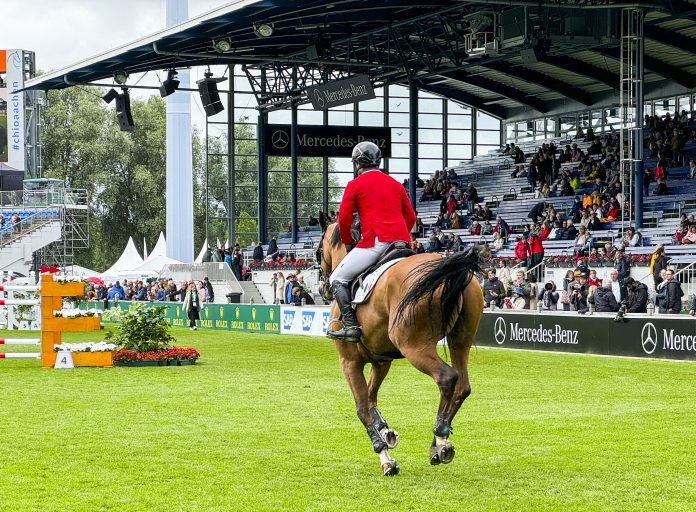
Welcome to Trainer Tuesday! Each week, we ask trainers a question and gather their answers for you. These trainers have a range of experience, backgrounds, and focus points of their programs, so the answers have as much variation as you would expect, and also probably much more similarity.
This week’s question posed is: How do you work with a horse who rushes fences?
Here are their answers:
“In my experience, a horse who rushes the fences typically does so because of a lack of strength to push effectively, or the horse is not comprehending how to properly use its body. Go back to basics, make sure the horse’s core muscles are strong with good flatwork…this will give the horse confidence that it can jump properly. Then, start by introducing poles, cavalettis, and trot jumps so the horse can slow its brain down and process the objective. If the horse has proper core strength and is given time to understand how to think and take its time, you should be able to achieve your goals. Do not increase height or width, or complicate the exercise until the horse feels fit and confident.” – Krystalle Glosser
“Horses that rush fences often need their minds slowed just as much as their bodies. One of my favorite exercises is bringing them back from the canter to a trot, or even a walk, to small fences. That transition encourages them to relax, rebalance, and stop thinking about the jump before they get there. Instead, they begin focusing on the question in front of them and waiting for their rider. Once they’re approaching the fence in a relaxed, consistent rhythm, I’ll allow them to canter to it again. If they stay quiet, confident, and don’t rush, I end the session. I don’t believe in drilling the exercise. A little progress each day builds into lasting confidence.
As they become more settled, I’ll add placing poles in front of the fence. The poles encourage the horse to pay attention to where they’re putting their feet and give them another job to think about, naturally shifting their focus away from speed and onto balance and accuracy.
For me, it’s not about simply slowing a horse down. It’s about teaching them to stay mentally connected, balanced, and confident so they can approach every fence in a quiet, thoughtful rhythm. When a horse understands the question and feels confident in the answer, the rushing usually disappears on its own.” – Stacy Reser
“I always revert to the basics. I find a horse rushes for one of two reasons – they’re either eager or unsure, both of which can be addressed with miles. I take the fences away and work on ground rails in an array of designs to train tempo and gain confidence so the job itself doesn’t seem so impressive. Once the horse can work through various tests over ground rails without rushing or worrying, we reintroduce the fences similarly to the ground rail work, with leaving and landing rails to keep the focus on the footwork and not necessarily the fences.” – Megan Yanko
“When we have a horse that wants to ‘rush’ a jump, we start by slowing things down. Usually involves trotting over poles and cavaletti. Then we will set a small cross rail and turn left, then right, and repeat the process until they slow down and think. We also leave room to circle out from the jump if the rushing continues.” – Sue & Katie Leverick, Millennium Farm
“We do lots of open-close transitions and halting in our flatwork, then we do the same in front of and on the backside of jumps, as well as placing rails front and back of fences, and grid work mixed into our courses at home.” – Rachael L. Lively
“For single jumps, I do very small circles to and after the jump until they begin to hold themselves and wait for instructions. For lines, I like to combine transitions and circles in the approach, landing, and in between. Once they realize they are not going to be able to run away, they usually slow down and become patient very quickly.” – Amanda Flint
“Set up a line and as soon as you feel the horse rushing to the next jump, turn him in a tight circle until he gives, and then jump the jump. If that doesn’t work, try halting and backing up before the next jump.” – Abby Lockwood
“In my experience, horses who rush are not stabilized. By definition, stabilization is the horse’s ability to maintain the speed and gait asked for in all situations: alone, in a group, in a ring, over uneven terrain, on the flat, and over fences on elementary level control. In my opinion, although perhaps oversimplified, two factors contribute to rushing.
One factor is the horse’s lack of basic education at the elementary level of control. It lacks calm, relaxed mental and physical carriage. Its inability to remain stabilized on the flat is exacerbated when presented with the challenge of an obstacle. Fear, anxiety, and confusion are often the result and manifest as rushing. An educated and progressive program of teaching stabilization takes time and patience. But it is essential to a happy horse and good riding.
The second factor for rushing is due to rider position flaws, failure to communicate aids in the correct sequence, and lack of experience. A green horse with an inexperienced rider is a recipe for disaster. An inexperienced rider lacks the timing and coordination to guide the green horse safely and quietly using elementary control. This rider generally does not have an independent hand, which results in unintentional abuse to the horse’s mouth and back.
These two factors, alone or combined, can create dangerous circumstances. They can cause the horse to move into a state of self-preservation, and the rider becomes unintentionally abusive, fearful, and confused.
1) Teaching stabilization
Be it a green horse or one being reclaimed, the best place to start is on the longe line. Teaching the horse voice commands at the walk, trot, canter, and halt is essential to stabilization under saddle. Once the horse masters the voice commands, it is ready to attempt a single pole on the ground on the longe circle. The horse stays mentally calm while making the effort over the rail. When the horse can remain stabilized at all three gaits over a single pole, a low cavaletti may replace the ground rail.
The same slow program continues as the horse masters stabilization over the slightly higher obstacle. The horse must practice a downward transition when approaching the pole or cavaletti. Sometimes they should come down to the walk and step over it. This teaches them to wait for the command on how to address the obstacle. Once the horse demonstrates stabilization on the longe line, it is time to introduce a mounted rider
The educated rider is mounted during this longe line exercise, and goes back to the beginning of the stabilization process. The rider uses voice commands at the walk, trot, and canter while softly applying the natural aids. It is essential in all cases that the rider uses the weight aid before the rein aid. The rider must practice periods of two-point or half seat position. The change in position should not result in increased speed on the part of the horse.
Next, the single rail should be placed again on the circle. When the pair approaches the ground rail, the rider should assume 2-point and grab the mane. This teaches the horse to maintain the same speed and rhythm before, during, and after the pole.
Once the rider successfully communicates the signals for the gaits on the longe line, it is time to “turn them loose” in the arena. The same commands are given to the horse when off the line. This sequential practice is a clear system of communication with the horse. Single rails may be placed at different locations on the arena. The horse should be as stabilized under saddle in the ring as they were when on the longe line.
If at any time the horse becomes confused… gets quick or worried, the rider should go back to the place where the horse last had success. This reinforces the simplicity of the commands and reassures the horse’s understanding of them.
2) Correcting rider errors
The second factor that contributes to rushing is an inexperienced rider with position flaws and a misuse of the aids. This rider should be mounted on an educated, stabilized horse to correct the design of position and clarify the use of the aids. The rider’s hands must become independent of the body. And, she must learn to make position adjustments subtly and with appropriate timing.
Once these two factors have been successfully addressed, a simple combination may be introduced to the program. Horse and rider must be able to trot a series of 3 poles 4.5’ apart set between two standards. The rider must assume an early two-point, holding the mane. The horse must maintain the stabilized trot. A gradual downward transition to the halt on a straight line after the poles should finish the exercise. After several repetitions, one end of one rail may be raised to the bottom hole of the standard closest to the inside of the arena. The approach to this remains the same. As the pair continues, the rails are raised to make a small cross rail. Alternate the commands to include halting before the cross rail, or coming down to the walk and stepping over it.
The goal is that the horse waits for the command and remains mentally and physically calm in the process.
Of Note: As herd animals, it can be beneficial for at least one other educated, calm horse be present while the ‘rushing’ horse is in training. Hunter Exercises are an excellent way for a horse that lacks stabilization to follow a “steady eddy”.
A horse that rushes may be in pain, which can be determined by a veterinarian.
However, in my opinion, a horse that rushes does so due to memories of fear or anxiety from previous experience. Rushing is a man-made problem and therefore requires a slow, methodical, progressive system of retraining the horse. We must take all the time the horse needs to relearn what we’re asking. They deserve our patience. It’s on us to take responsibility for their worry and anxiety at the jumps. Horses aren’t naturally in a hurry. When they are, it’s our job to ask why, and assume it’s our fault.
And remember… sit before you pull.” – Susan H. Sjolund